


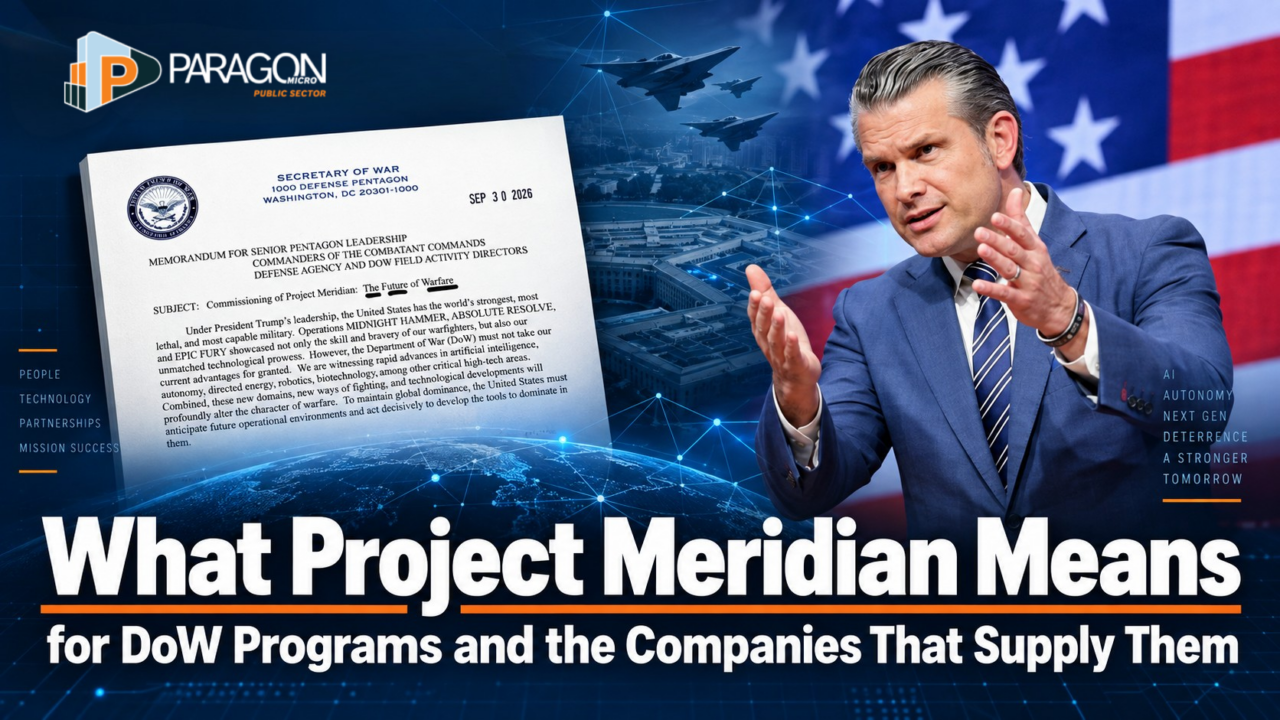
Department of War | Project Meridian
Project Meridian has 120 days to find the capability gaps. Programs and suppliers should plan for what follows.
On September 30, 2026, Secretary of War Pete Hegseth commissioned a 120 day study of future warfare, codirected by Elon Musk, Palmer Luckey, and Newt Gingrich. Here is who runs it, what it covers, and the develop, test, and field work its findings are meant to start.
01
The chief technology officer, 3 codirectors, and a partner organization
02
120 days, with findings due January 28, 2027
03
From subterranean depths to the cislunar frontier
04
Develop, test, and field, under the new acquisition system
Project Meridian is a 120 day study of future warfare that Secretary of War Pete Hegseth commissioned on September 30, 2026. Its job is to study the battlefields of the future, identify the weapons and technologies warfighters will need, and propose actionable solutions to start developing, testing, and fielding them (Hegseth, 2026).
Hegseth announced it at Marine Corps Base Quantico as 1 of 6 initiatives, alongside the Autonomous Warfare Command and FORTRESS America (Edwards, 2026; U.S. Department of War, 2026). Findings are due to Hegseth's office by January 28, 2027.
This explainer is for the program offices that will be asked to act on those findings and the companies that supply them. Paragon Micro is not part of the study. We follow it because any develop, test, and field work it recommends would depend on the hardware, facilities, and contract vehicles DoW programs already use.
Key takeaways
- Emil Michael, the department's chief technology officer, is facilitating the commissioning, which the memo routes through a partner organization. Elon Musk, Palmer Luckey, and Newt Gingrich codirect the study (Hegseth, 2026; U.S. Department of War, 2026).
- The study runs 120 days. Findings are due to the Secretary's office by January 28, 2027, and the study ends with a public unclassified report plus a classified annex (Hegseth, 2026; U.S. Department of War, 2026). Neither source gives a publication date for the report.
- Its scope covers every warfighting domain, "from subterranean depths to the cislunar frontier" (U.S. Department of War, 2026).
- The memo tells the Joint Staff and all services to be prepared to connect their future warfare efforts and research to Meridian (Hegseth, 2026).
- If the department turns the recommendations into programs, they would run under the Warfighting Acquisition System, which prefers commercial products, uses modular open systems, and requires at least 2 qualified sources for critical program content unless waived (Barna, 2025).
Chapter 1
What Project Meridian is
The memo's first paragraph names technologies it says are changing warfare, among others: artificial intelligence, autonomy, directed energy, robotics, and biotechnology. Combined with new domains and new ways of fighting, it says, these developments "will profoundly alter the character of warfare" (Hegseth, 2026).
Primary source
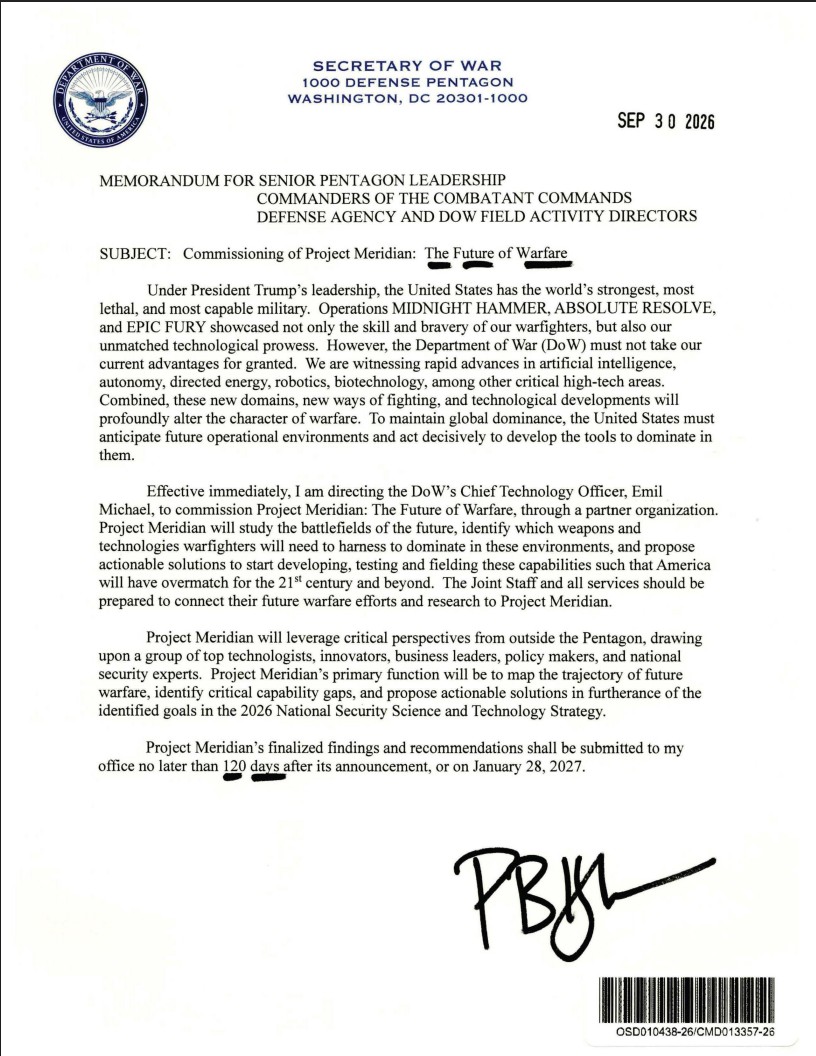
The memo that commissioned Project Meridian
Dated September 30, 2026, and signed by Hegseth, the memo directs the department's chief technology officer, Emil Michael, to commission Project Meridian: The Future of Warfare through a partner organization (Hegseth, 2026).
- Charge
- Study the battlefields of the future, identify the weapons and technologies warfighters will need, and propose actionable solutions to start developing, testing, and fielding them.
- Input
- Perspectives from outside the Pentagon: top technologists, innovators, business leaders, policy makers, and national security experts.
- Services
- The Joint Staff and all services should be prepared to connect their future warfare efforts and research to the study.
- Deadline
- Findings and recommendations go to the Secretary's office within 120 days, on January 28, 2027.
“Project Meridian will study the battlefields of the future.”
Secretary of War Pete Hegseth (2026, para. 2)
The memo gives the study a primary function: trace the trajectory of future warfare, identify critical capability gaps, and propose actionable solutions that further the goals in the 2026 National Security Science and Technology Strategy (Hegseth, 2026). The White House Office of Science and Technology Policy released that strategy in August 2026 (Office of Science and Technology Policy [OSTP], 2026).
Announced with 5 other initiatives
Meridian was 1 of 6 initiatives in Hegseth's State of the Force address (Oliverio, 2026; U.S. Department of War, 2026). Paragon Micro has guides on 2 of the others: the Autonomous Warfare Command, which has a target date of October 1, 2027 to stand up (Edwards, 2026), and FORTRESS America, the installation resilience program. The rest are a new Corps of Cadets, the Next Great American Base, and the Office of Religious Affairs (U.S. Department of War, 2026).
Chapter 2
Who is running Project Meridian
Hegseth commissioned the study. Emil Michael, the department's chief technology officer, is facilitating the commissioning through a partner organization (Hegseth, 2026; U.S. Department of War, 2026). Michael is also the Under Secretary of War for Research and Engineering (Lopez, 2025). Neither the memo nor the release names the partner organization.
- Commissions
Secretary of War Pete Hegseth signed the memo and receives the findings.
- Facilitates
Emil Michael, the chief technology officer, handles the commissioning.
- Partner organization
The memo routes the commission through a partner organization it does not name.
- Codirects
Elon Musk, Palmer Luckey, and Newt Gingrich lead the study.
- Supports
A team of academic, policy, and industry experts works with them.
Sources: Hegseth (2026); U.S. Department of War (2026).
The 3 codirectors
Codirector
Elon Musk
Founder and CEO of SpaceX (Edwards, 2026).
Codirector
Palmer Luckey
Cofounder of Anduril Industries (Edwards, 2026).
Codirector
Newt Gingrich
Former Speaker of the U.S. House of Representatives (Edwards, 2026).
The memo describes the wider group as top technologists, innovators, business leaders, policy makers, and national security experts from outside the Pentagon (Hegseth, 2026).
What the services are asked to do
The memo tells the Joint Staff and all services to be prepared to connect their future warfare efforts and research to Project Meridian (Hegseth, 2026). Program offices with work in the memo's technology areas can prepare now by documenting how their current efforts relate to those areas.
Chapter 3
The 120 day timeline
The memo sets the deadline: findings and recommendations go to the Secretary's office no later than 120 days after the announcement, on January 28, 2027 (Hegseth, 2026). The release says the project ends with an unclassified final report released to the public, accompanied by a classified annex (U.S. Department of War, 2026). Neither source gives a date for publishing the report.
The study window
120 days
From the memo on September 30, 2026, to findings due January 28, 2027 (Hegseth, 2026).
Day 0 | Sep 30, 2026
Memo signed
Hegseth announces Meridian at Quantico (Hegseth, 2026; U.S. Department of War, 2026).
Day 41 | Nov 10, 2026
CMMC Phase 2 begins
Applicable contracts begin to require Level 2 certification from a third party assessor (Fitzgerald, 2026).
Day 120 | Jan 28, 2027
Findings due
Findings and recommendations go to the Secretary's office (Hegseth, 2026).
Day 123 | Jan 31, 2027
SEWP V extension ends
NASA's extension of SEWP V runs out 3 days after the deadline (National Aeronautics and Space Administration [NASA], n.d.).
The 2 deliverables
Public
Unclassified final report
Findings and recommendations, released to the public (U.S. Department of War, 2026).
Restricted
Classified annex
Accompanies the public report (U.S. Department of War, 2026). Expect it to reach only people with the right clearances and a need to know.
For most suppliers, the public report is likely to be the first look at the recommendations.
Chapter 4
The scope: from subterranean depths to the cislunar frontier
The release says Project Meridian will examine "the full spectrum of future warfighting domains, from subterranean depths to the cislunar frontier" (U.S. Department of War, 2026). Subterranean means underground: tunnels, bunkers, and buried facilities. Cislunar space is the region between Earth and the Moon, including lunar orbit.
The national strategy the memo points to already sets priorities in several of those domains (OSTP, 2026).
Cislunar space
The region between Earth and the Moon
The strategy calls for the ability to detect, characterize, and counter threats to U.S. space interests from very low Earth orbit through cislunar space (OSTP, 2026).
Earth orbit
Satellites for communications, navigation, and sensing
Space is 1 of 3 priority areas for battlefield dominance that the strategy takes from the 2025 National Security Strategy (OSTP, 2026).
Air
Aircraft, missiles, and drones
Air superiority and long range strike are on the strategy's list of other critical areas (OSTP, 2026). Scaled hypersonics is 1 of R&E's 6 critical technology areas (Lopez, 2025).
Land and sea surface
Forces, vehicles, ships, and the logistics behind them
Contested logistics technology is 1 of R&E's 6 critical technology areas (Lopez, 2025).
Undersea
Submarines and undersea systems
Undersea is another of those 3 priority areas (OSTP, 2026).
Subterranean
Tunnels, bunkers, and buried facilities
The strategy calls for positioning, navigation, and timing technologies for settings that include subterranean and underwater (OSTP, 2026).
Where the 3 priority lists overlap
The memo names 5 technology areas. The national strategy lists 3 priority areas for battlefield dominance, taken from the 2025 National Security Strategy, and R&E named 6 critical technology areas in November 2025 (Hegseth, 2026; Lopez, 2025; OSTP, 2026).
Meridian memo
5 technology areas
(Hegseth, 2026)
- Artificial intelligence
- Autonomy
- Directed energy
- Robotics
- Biotechnology
White House strategy
3 battlefield dominance priorities
(OSTP, 2026)
- Undersea
- Space
- AI and autonomy
R&E, November 2025
6 critical technology areas
(Lopez, 2025)
- Applied AI
- Biomanufacturing
- Contested logistics technology
- Quantum battlefield information dominance
- Scaled directed energy
- Scaled hypersonics
Shaded items appear in some form on at least 2 lists.
AI is the only area on all 3 lists. Autonomy, directed energy, and biotechnology each appear on 2. Robotics appears only in the memo. Until the report is out, these overlaps show where White House and department priorities already agree.
Chapter 5
What follows: develop, test, field
The memo asks Meridian to propose actionable solutions "to start developing, testing and fielding these capabilities" (Hegseth, 2026). The release says the study will find advanced systems and speed their fielding (U.S. Department of War, 2026). If the department turns the recommendations into programs, they would run under the acquisition system Hegseth set up in November 2025.
The acquisition system the work would use
Hegseth's November 7, 2025 memo renamed the Defense Acquisition System the Warfighting Acquisition System (Barna, 2025). These 4 changes matter most to suppliers:
- Portfolio Acquisition Executives make cost, schedule, and performance decisions, with speed as the priority.
- Commercial products and offerings are the preferred approach.
- Critical program content needs at least 2 qualified sources, unless waived.
- Programs use modular open system architectures, with competition at the module level (Barna, 2025).
After the report
What each stage asks of suppliers
Develop
Prototypes and the compute behind them. AI and autonomy work needs GPU systems to train and run models, plus edge systems that operate where the mission is.
Supplier signalCommercial products come first (Barna, 2025).
Test
Evidence before production: configurations built, tested, and documented, with interfaces defined so modules can be swapped and competed.
Supplier signalDocument interfaces for competition at the module level (Barna, 2025).
Field
Production and delivery at scale, under supply chain rules and full chain of custody.
Supplier signalLine up a second qualified source for critical content (Barna, 2025).
The research priorities already in place
R&E cut its list of critical technology areas to 6 in November 2025: applied AI, biomanufacturing, contested logistics technology, quantum battlefield information dominance, scaled directed energy, and scaled hypersonics (Lopez, 2025). "Our adversaries are moving fast, but we will move faster," Michael said at the time (Lopez, 2025).
Chapter 6
What programs and suppliers should do now
Most of the preparation can start before January 28, 2027. The checklists below draw on the memo, the release, and current acquisition rules.
Checklist
For DoW program offices
- Compare current efforts with the memo's 5 technology areas and the strategy's 3 priorities (Hegseth, 2026; OSTP, 2026).
- Document how your science and technology work relates to those areas, so you can connect it to Meridian as the memo directs (Hegseth, 2026).
- Identify who on your team holds the clearances to work with classified findings, if your program receives them.
- Know how your Portfolio Acquisition Executive weighs cost, schedule, and performance, now that speed is the priority (Barna, 2025).
Checklist
For Federal System Integrators and suppliers
- Read the memo and the release now, so you know the study's stated scope before the report lands.
- Qualify a second source for critical content (Barna, 2025).
- Define and publish interfaces so your modules can compete (Barna, 2025).
- Confirm CMMC status before Phase 2 begins November 10, 2026 (Fitzgerald, 2026).
- Plan for the Section 5949 prohibition on chips from SMIC, YMTC, and CXMT, which takes effect December 23, 2027 (Wagner et al., 2026).
Checklist
For advanced projects teams
- Plan secure build and test space for prototypes tied to classified findings.
- Require custody records for every handoff, from receipt to delivery.
- Keep sensitive work in segmented environments with controlled access.
Where Paragon Micro fits
Paragon Micro is not part of the Meridian study. Its work starts after the findings, when programs need hardware sourced, built, tested, and delivered. Paragon Micro is a Dell Technologies Federal Platinum Partner and consolidates builds from multiple OEMs in a single secure facility (Paragon Micro, n.d.-a, n.d.-f).
Its System Readiness Center is a 55,000 plus square foot facility that validates configurations and stages and tests systems before delivery, in full compliance with NIST SP 800-171, with segmented environments for sensitive programs. Every system is logged and tracked, every component is verified, and handling is limited to vetted U.S. citizens (Paragon Micro, n.d.-f). Paragon Micro announced its AS9120 certification for aerospace and defense distribution on June 30, 2026 (Paragon Micro, 2026).
DoW buyers can order through ITES-4H, MDA SHIELD IDIQ, and GSA MAS products through EC America and Synnex (Paragon Micro, n.d.-b, n.d.-c, n.d.-d). NASA SEWP V is also available until its extension ends January 31, 2027, 3 days after Meridian's findings are due (NASA, n.d.; Paragon Micro, n.d.-e). See how Paragon Micro is postured for Project Meridian on our Advanced Projects page.
FAQ
Frequently asked questions
What is Project Meridian?
A 120 day Department of War study of future warfare, commissioned by Secretary of War Pete Hegseth on September 30, 2026. It will identify critical capability gaps and propose actionable solutions to start developing, testing, and fielding new capabilities (Hegseth, 2026).
Who leads Project Meridian?
Elon Musk, Palmer Luckey, and Newt Gingrich codirect it. Emil Michael, the department's chief technology officer, is facilitating the commissioning, which the memo routes through a partner organization (Hegseth, 2026; U.S. Department of War, 2026).
When is the Project Meridian report due?
Findings and recommendations are due to the Secretary's office by January 28, 2027, 120 days after the memo (Hegseth, 2026). Neither the memo nor the release gives a date for publishing the report.
Will the findings be public?
Partly. The release says the study will end in an unclassified final report released to the public, accompanied by a classified annex (U.S. Department of War, 2026).
What does "from subterranean depths to the cislunar frontier" mean?
It is the release's description of the study's scope: every warfighting domain, from underground facilities to the space between Earth and the Moon (U.S. Department of War, 2026).
What should DoW suppliers do now?
Qualify second sources for critical content, document interfaces for modular open systems, confirm CMMC status before November 10, 2026, and watch for the public report after January 28, 2027 (Barna, 2025; Fitzgerald, 2026).
Timeline
Key dates
Sep 30, 2026
Project Meridian memo signed
(Hegseth, 2026)
Nov 10, 2026
CMMC Phase 2 begins
(Fitzgerald, 2026)
Jan 28, 2027
Project Meridian findings due
(Hegseth, 2026)
Jan 31, 2027
NASA SEWP V extension ends
(NASA, n.d.)
Oct 1, 2027
Autonomous Warfare Command target date
(Edwards, 2026)
Dec 23, 2027
Section 5949 chip prohibition takes effect
(Wagner et al., 2026)
Project Meridian's findings are due January 28, 2027. Programs that already know their current efforts, their second sources, and their test plans will be in a better position to act on the recommendations.
Work with Paragon Micro
Planning for what Project Meridian recommends?
Paragon Micro's DoW team can help you source, stage, test, and deliver the hardware behind new capabilities through ITES-4H, MDA SHIELD, and GSA.
Advanced Projects System Readiness Center Dell Technologies Federal
Related reading
Sources
References
Barna, S. (2025, December 3). From DAS to WAS: Secretary Hegseth's acquisition overhaul and what it means for industry. Covington & Burling LLP. https://www.covingtonblogs.com/2025/12/03/from-das-to-was-secretary-hegseths-acquisition-overhaul-and-what-it-means-for-industry/
Edwards, J. (2026, October 1). Hegseth unveils Project Meridian & 5 other DOW initiatives. GovCon Wire. https://www.govconwire.com/articles/hegseth-project-meridian-dow-initiatives
Fitzgerald, A. (2026, March 4). CMMC Phase 2: What to expect and how to prepare [2026]. Secureframe. https://secureframe.com/blog/cmmc-phase-2-preparation
Hegseth, P. (2026, September 30). Commissioning of Project Meridian: The future of warfare [Memorandum]. U.S. Department of War. https://media.defense.gov/2026/Sep/30/2004009287/-1/-1/1/COMMISSIONING-OF-PROJECT-MERIDIAN.PDF
Lopez, C. T. (2025, November 20). War Department narrows technology development focus to half dozen areas. Joint Base San Antonio. https://www.jbsa.mil/News/News/Article/4338401/war-department-narrows-technology-development-focus-to-half-dozen-areas/
National Aeronautics and Space Administration. (n.d.). Solutions for Enterprise-Wide Procurement (SEWP). Retrieved October 2, 2026, from https://www.sewp.nasa.gov/
Office of Science and Technology Policy. (2026, August). National security science and technology strategy. The White House. https://www.whitehouse.gov/wp-content/uploads/2026/08/NSSTS-082026.pdf
Oliverio, N. (2026, September 30). Hegseth announces new four-star command for autonomous warfare. Military Times. https://www.militarytimes.com/news/your-military/2026/09/30/hegseth-announces-new-four-star-command-for-autonomous-warfare/
Paragon Micro. (n.d.-a). Dell Technologies Federal mission infrastructure. Retrieved October 2, 2026, from https://www.paragonmicro.us/about-us/dell-technologies-federal/
Paragon Micro. (n.d.-b). GSA. Retrieved October 2, 2026, from https://www.paragonmicro.us/contracts/gsa/
Paragon Micro. (n.d.-c). ITES-4H. Retrieved October 2, 2026, from https://www.paragonmicro.us/contracts/ites-4h/
Paragon Micro. (n.d.-d). MDA SHIELD IDIQ. Retrieved October 2, 2026, from https://www.paragonmicro.us/contracts/mda-shield-idiq/
Paragon Micro. (n.d.-e). NASA SEWP V. Retrieved October 2, 2026, from https://www.paragonmicro.us/contracts/nasa-sewpv/
Paragon Micro. (n.d.-f). Secure integration & staging facility. Retrieved October 2, 2026, from https://www.paragonmicro.us/about-us/facility/
Paragon Micro. (2026, June 30). Paragon Micro achieves AS9120 certification for aerospace and defense distribution. https://www.paragonmicro.us/paragon-micro-achieves-as9120-certification-for-aerospace-defense-distribution/
U.S. Department of War. (2026, September 30). Secretary Hegseth announces six major initiatives at Quantico speech [Press release]. https://www.war.gov/News/Releases/Release/Article/4615424/secretary-hegseth-announces-six-major-initiatives-at-quantico-speech/
Wagner, M., Cassidy, S. B., Burnette, R., & Cho, E. (2026, February 26). FAR Council issues notice of proposed rulemaking to implement prohibition on acquisition of certain semiconductors. Inside Government Contracts. https://www.insidegovernmentcontracts.com/2026/02/far-council-issues-notice-of-proposed-rulemaking-to-implement-prohibition-on-acquisition-of-certain-semiconductors/