



Department of War | Autonomous warfare
AutoWarCom stands up October 1, 2027. The compute, comms, and data decisions start now.
What Federal System Integrators, DoW program and contracting offices, and advanced projects teams need to know about the new four star command, and how to equip the systems it will run.
On September 30, 2026, at Marine Corps Base Quantico, Secretary of War Pete Hegseth announced the Autonomous Warfare Command (AutoWarCom), a new four star combatant command with authorities similar to a military service. Its job is to scale autonomous and robotic capabilities across the Joint Force (Oliverio, 2026; Trevithick, 2026). The target date to stand it up is October 1, 2027, and Congress has to act first (Trevithick, 2026).
Owen West, who has led the Defense Innovation Unit, is now chief executive officer of the Direct Reporting Portfolio Manager for Unmanned Systems (DRPM-UxS). Navy SEAL Senior Chief Max Strasiser is its chief operating officer. DRPM-UxS runs Project Agincourt, the effort that prepares the ground for the command until it stands up (Kesteloo, 2026; Trevithick, 2026). The four star commander has not been named (Kesteloo, 2026).
The drones will get the attention. Every one of them still depends on compute to plan and retrain, links to take orders and report back, and data from the last mission to improve the next one. This article covers what the command is, what each of those three layers needs, which rules apply, and how to buy the equipment.
Key takeaways
- AutoWarCom targets October 1, 2027. Project Agincourt runs until then, and DroneXL reports a 30 day plan is due to the Chairman of the Joint Chiefs of Staff around October 30, 2026 (Kesteloo, 2026).
- The FY2027 request for the Defense Autonomous Warfare Group (DAWG) is $54.6 billion, most of it through reconciliation, up from $226 million in FY2026 (“Truly Concerns Me,” 2026).
- Drones are bought to be expended. The edge servers, radios, ground control stations, and data systems that run them have to last the full deployment in contested spectrum.
- FIPS 140-2 certificates moved to NIST's Historical List on September 21, 2026. New purchases should specify FIPS 140-3 validated modules (National Institute of Standards and Technology [NIST], n.d.).
- Four dates land within the next 15 months: CMMC Phase 2 (November 10, 2026), the zero trust target level deadline (September 30, 2027), AutoWarCom (October 1, 2027), and the Section 5949 semiconductor prohibition (December 23, 2027).
Chapter 1
What the Autonomous Warfare Command is and how it got here
The Pentagon described the command's mission as scaling "autonomous and robotic capabilities across the Joint Force in the fastest peacetime shift in modern military history" (Trevithick, 2026). Hegseth gave the reason in one line: "The pace of war is changing faster than the process to support it" (Oliverio, 2026).
The command will bring together service provided forces that support the geographic combatant commands. It will also define joint needs and test equipment and force designs (Trevithick, 2026). Hegseth described an operating model that "fuses operators with entrepreneurs in rapid adaptation cycles while distributing decisions and dollars closer to frontline units" (Oliverio, 2026).
Congress is moving on a parallel track. The Senate Armed Services Committee's FY2027 defense bill would permit a Robotic and Autonomous Systems Combatant Command led by a four star officer, with special test and evaluation authorities and limited authority to buy drone technology from marketplaces (Easley, 2026). The bill has not become law. DroneXL reports that the Senate version gives the command narrower acquisition authority than Hegseth proposed (Kesteloo, 2026).
In the same announcement, Hegseth also commissioned Project Meridian, a 120 day study of future warfare led through DoW Chief Technology Officer Emil Michael, with findings due January 28, 2027 (Trevithick, 2026). See how Paragon Micro is postured for Project Meridian on our Advanced Projects page.
The policy trail behind the command
AutoWarCom builds on 15 months of directives and programs. Each one changes what buyers will ask suppliers for.
July 10, 2025
Drone dominance memo: low cost drones for every squad by the end of 2026, and the Blue UAS list moves to the Defense Contract Management Agency by January 1, 2026 (Harper, 2025).
For buyers: drones bought in volume, with faster approval of systems and parts.
November 7, 2025
Warfighting Acquisition System memo: at least two qualified sources for critical content unless waived, module level competition with machine readable interfaces, and persistent test environments (Barna, 2025).
For buyers: open interfaces and second sources become contract terms.
2025
DAWG stands up and absorbs the Replicator initiative (“Truly Concerns Me,” 2026).
For buyers: one office setting common standards and control interfaces.
January 9, 2026
Artificial Intelligence Strategy for the Department of War: seven pace setting projects, data decrees, and faster authorizations to operate (Lee et al., 2026).
For buyers: demand for training compute and usable data.
February to March 2026
Drone Dominance Program Gauntlet I at Fort Benning: about $150 million planned for 30,000 one way attack drones, with delivery orders to 11 vendors (Harper, 2026).
For buyers: orders measured in tens of thousands.
June 11, 2026
Senate committee bill permits a Robotic and Autonomous Systems Combatant Command (Easley, 2026).
For buyers: the legal path for the command begins.
August 2026
Gauntlet II at Fort Carson: orders planned for 60,000 drones from the top performers (Eric G., 2026).
For buyers: volume doubles from the first round.
September 30, 2026
AutoWarCom and Project Agincourt announced (Oliverio, 2026).
For buyers: a single command for autonomous warfare.
October 1, 2027
AutoWarCom target date (Trevithick, 2026).
For buyers: infrastructure decisions made in the next 12 months set what the command inherits.
The money
$54.6B
FY2027 request for DAWG, up from $226 million in FY2026
Breaking Defense reports that $53.6 billion of the request is sought through reconciliation and $1 billion through the base budget. DAWG director Lt. Gen. Steven Marks said a funding lapse "truly concerns me" and warned that the momentum built since DAWG stood up "will be waning" (“Truly Concerns Me,” 2026).
Most of the money depends on a reconciliation package that has not passed, so expect orders to arrive in phases as funding clears.
What changes for buyers
- Decisions and dollars move closer to units, so more buyers will be operators and portfolio managers working on short timelines.
- Drones are bought as consumables in large lots. The ground control stations, edge servers, radios, and storage around them have to work for the full deployment.
- Common standards and control interfaces will be required. Marks wants formations trained on fewer systems instead of "six to eight" that each demand different skills (“Truly Concerns Me,” 2026).
Chapter 2
Compute from the training cluster to the tactical edge
Autonomy runs on three tiers of compute. Each tier has different buyers, different specifications, and different ways to fail.
Tier 1
Enterprise and training compute
Models are trained, tested in simulation, and retrained here. The AI Strategy commits "substantial resources" to department data centers, requires access to the latest model versions within 30 days of public release, and calls for faster authorizations to operate with reciprocity (Lee et al., 2026).
Its pace setting projects include Swarm Forge, which tests new AI enabled ways of fighting, and Ender's Foundry, which builds AI simulation (Lee et al., 2026). That work needs GPU dense servers, high throughput storage, and fast networking inside accredited facilities.
Tier 2
Forward edge nodes
These are the servers in vehicles, shelters, ships, and forward sites. They run inference on sensor feeds, combine data from many drones, host mission planning and ground control software, and hold data until a link opens.
The limits are size, weight, power, heat, and dust.
Tier 3
Onboard compute
The processor on the airframe is usually small. IEEE Spectrum described the Ghost Dragon, an Estonian reconnaissance drone used in Ukraine, which navigates by machine vision on a 1 gigahertz Arm processor (Pultarova, 2025).
Onboard compute belongs to the drone maker. Training, retraining, fusion across many drones, and mission planning happen on Tier 1 and Tier 2 hardware.
Tier 2 example
Dell PowerEdge XR8000
One example of a server built for forward edge nodes (Dell Technologies, 2024).
Chassis
430 mm short depth, up to 4 nodes
Temperature
Minus 20 to 65 degrees Celsius in certain configurations
GPUs
Up to 3 NVIDIA L4 GPUs
Power
AC or DC
Security
Silicon root of trust, TPM 2.0, secure boot, secure erase
Why secure erase matters: if a forward site is overrun, the data on that server is an intelligence loss. Ask how fast a node can be sanitized and who can trigger it.
Built and checked before it ships
Inside a Dell PowerEdge build
Paragon Micro integrates, tests, and delivers systems from its System Readiness Center (Paragon Micro, n.d.-e). Hover over or tap a marker to see what to check on a server like this before it deploys.
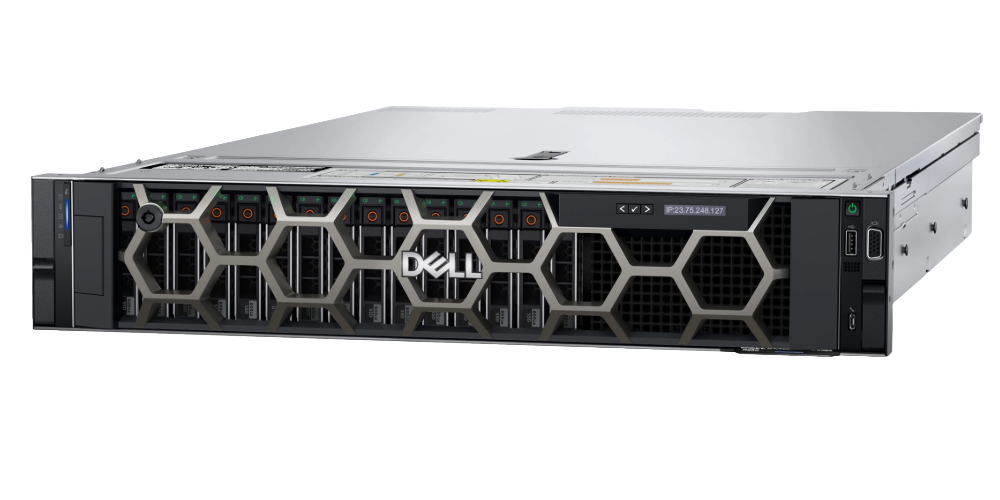
- Locking bezelA keyed bezel keeps drives from being pulled in transit or at shared sites. Specify it for servers headed forward.
- Drive baysDrives are installed, loaded with the mission configuration, and tested before the server ships (Paragon Micro, n.d.-e).
- Chain of custodyEvery system is logged and tracked from intake to delivery and handled only by vetted U.S. citizens (Paragon Micro, n.d.-e).
- Dell Technologies FederalParagon Micro is a Dell Technologies Federal Platinum Partner. See our Dell Technologies Federal partnership.
- Front panel displayIt shows the server's management address. Confirm out of band management works over a degraded link before the server deploys.
- Front portsUSB and VGA ports give local console access when the network is down. Decide under your security baseline whether to disable them.
Operator endpoints
Ground control stations and operator laptops take the same abuse as edge servers. Dell's Pro Rugged laptops cover this category (Dell Technologies, n.d.). Specify screen readability in direct sun, use with gloves, battery life on a full shift, and the same encryption standard as the network.
What to specify for compute
- Environmental test evidence to MIL-STD-810H and, where the platform requires it, electromagnetic interference testing to MIL-STD-461G.
- Operating temperature range, depth, weight, and input power (AC, DC, or vehicle power) for the actual installation.
- GPU class matched to the job: inference cards at the edge, training class GPUs in the data center.
- A hardware root of trust, secure boot, TPM 2.0, and a tested sanitization procedure.
- Out of band management that still works over a degraded link.
- Spares and a refresh plan sized to the deployment, because replacing failed hardware at a forward site is slow.
Paragon Micro builds, images, and tests these systems in its 55,000 plus square foot System Readiness Center, so units receive configured, documented hardware ready to install (Paragon Micro, n.d.-e).
Chapter 3
Comms that hold up in contested spectrum
Losses to jamming
10,000
Drones Ukraine may lose each month, mostly to jamming, by a Royal United Services Institute estimate
In Ukraine, jamming is the main way drones are lost (Pultarova, 2025).
Two responses have spread. Some drones now finish their missions on onboard optical navigation after radio and satellite navigation links are jammed. Others are flown over spools of optical fiber 20 kilometers or more from the controller (Pultarova, 2025).
Autonomy reduces link dependence for the last part of a strike. Command and control, video, retasking, deconfliction, and swarm coordination still need links, and those links will be contested from the first day.
Plan the network in layers
Layer 1
Unit level mesh
Mobile ad hoc network (MANET) radios connect operators, drones, and edge nodes within line of sight and reroute traffic when a node drops.
Layer 2
Beyond line of sight
SATCOM terminals carry reachback to higher echelons and the enterprise.
Layer 3
Fixed sites
Wired and fiber links at bases and forward sites carry bulk data transfers.
Layer 4
Store and forward
Edge nodes hold data and send it when a link returns.
Treat denied, degraded, intermittent, and limited (DDIL) conditions as normal operations when you design the network.
Questions to ask about any radio or terminal
- Which bands does it cover, and how fast can it change frequency under jamming?
- What does it do to reduce the chance of being intercepted or located?
- How many nodes can one mesh support before throughput drops, and what is the measured throughput at range?
- Does it work with the waveforms and network management tools your unit already uses?
- Is its cryptographic module validated under FIPS 140-3? For classified traffic, is it a Type 1 device or part of an NSA Commercial Solutions for Classified (CSfC) architecture?
- What are its size, weight, and power draw on the actual platform?
Encryption rules changed on September 21, 2026
NIST's Cryptographic Module Validation Program moved FIPS 140-2 certificates to its Historical List on September 21, 2026. Federal agencies could accept FIPS 140-2 modules for protecting controlled unclassified information (CUI) only through that date (NIST, n.d.).
Action: call for FIPS 140-3 validated modules in new purchases, and check existing radio, laptop, and storage fleets.
For classified data, NSA's CSfC program lets agencies protect national security systems with layered commercial products, configured under its capability packages and selected from its components list (National Security Agency [NSA], n.d.).
Keep banned telecom equipment out
FAR 52.204-25, which implements Section 889, prohibits providing equipment or services that use covered telecommunications or video surveillance equipment from Huawei, ZTE, Hytera, Hikvision, Dahua, and related entities as a substantial or essential component (48 C.F.R. § 52.204-25, 2021). That can reach network gear, cameras, and modules inside radios and terminals.
Paragon Micro has supplied handheld, manpack, and mesh radio systems, SATCOM terminals, and tactical networking equipment to customers (Paragon Micro, n.d.-f). Which radio families are available depends on the contract vehicle and the order, so confirm with our DoW team before you write the requirement.
Chapter 4
Data that makes each mission better than the last
Autonomous systems improve when data from one mission reaches the people retraining models for the next. That loop breaks in three places: at the edge, where data piles up with no link; in transit, where bandwidth is scarce; and at the enterprise, where data arrives in formats no one can use.
What the department now requires
The AI Strategy's data decrees require a federated data catalog within 30 days and a justification to the Under Secretary within 7 days for any denial of data access. The strategy also folds the Advana platform into a central War Data Platform (Lee et al., 2026).
The acquisition memo calls for module level competition under a modular open systems approach (MOSA), using machine readable interfaces that let third parties add components without the original manufacturer (Barna, 2025). DAWG is pushing common standards and control interfaces across formations (“Truly Concerns Me,” 2026).
Build the data path before the first flight
- Collect
Video, telemetry, detections, and electronic warfare observations land on the edge node, tagged with time, location, platform, and classification.
- Triage
The edge node keeps what the next sortie needs and compresses or discards the rest.
- Move
Data syncs to the enterprise by priority whenever a link allows.
- Label and retrain
Enterprise teams label the data, retrain models, and test them in simulation.
- Return
Updated models go back to edge nodes and drones with version control and a way to roll back.
Zero trust reaches the edge in 2027
The department's deadline to reach target level zero trust is the end of FY2027, September 30, 2027, covering 91 capability outcomes. DoD's chief information officer at the time acknowledged that applying zero trust beyond IT, to weapon systems and operational technology, would be "a bit of a lift" (Easley, 2024).
That deadline falls one day before AutoWarCom's target date. Edge nodes and ground control stations bought now should support identity based access that still works when disconnected, encryption of data at rest and in transit, and logs that sync when the link returns.
Questions to ask any autonomy vendor about data
- What formats do your logs, video, and detections use, and are the interfaces documented and machine readable?
- Who owns the data and the trained models under the contract?
- How much storage does a typical sortie generate, and how long can the edge node run without a link?
- How are model updates signed, verified, and rolled back?
Chapter 5
Supply chain and compliance rules for unmanned systems
Every layer above carries rules, and several deadlines fall inside the AutoWarCom timeline.
Drones and drone parts
FAR 52.240-1 and Blue UAS
FAR 52.240-1 bars contractors from delivering unmanned aircraft systems made or assembled by American Security Drone Act covered foreign entities and from using federal funds to buy or operate them. Starting December 22, 2025, it also bars operating those systems in performance of a contract (48 C.F.R. § 52.240-1, 2024).
The July 2025 memo directed the Blue UAS list of approved systems and components to move to the Defense Contract Management Agency (Harper, 2025). DroneXL reports that the Drone Dominance Program bars Chinese motors and batteries starting in Phase II (Kesteloo, 2026).
Semiconductors in servers and radios
Section 5949: December 23, 2027
Section 5949 of the FY2023 National Defense Authorization Act bars executive agencies from buying products that contain semiconductors from SMIC, YMTC, or CXMT, starting December 23, 2027.
The FAR Council's proposed rule, released February 17, 2026, would require contractors to make a "reasonable inquiry," certify, and flow the prohibition down to subcontractors. It would reach commercial off the shelf items and purchases below the micro purchase threshold (Wagner et al., 2026). The rule was not final as of this writing, so check its status before you write contract language.
CUI
CMMC Phase 2: November 10, 2026
From November 10, 2026, Level 2 certification by a third party assessment organization (C3PAO) becomes the default for new contracts involving CUI (Fitzgerald, 2026).
Mission data, configurations, and test results for autonomous programs will often be CUI, so every supplier that handles them needs to be ready.
Chain of custody and counterfeit risk
Buying in volume invites gray market parts and unauthorized substitutions. Paragon Micro verifies components, logs every system and configuration step, enforces Trade Agreements Act compliance on hardware it receives and ships, and limits handling to vetted U.S. citizens (Paragon Micro, n.d.-e). The company earned AS9120 certification for aerospace and defense distribution in June 2026 (Paragon Micro, 2026).
For advanced projects
Sensitive programs need segmented build areas, access controlled by zone, and secure packaging with custody records (Paragon Micro, n.d.-e). Ask any supplier to show where your systems will sit, who can enter that area, and which records you receive at delivery.
Chapter 6
How to buy it, and a readiness checklist
Contract vehicles
Army
ITES-4H
Who can orderArmy and other federal agencies
PeriodOrdering through 2035
ScopeServers, data center infrastructure, storage, end user devices, networking, and lifecycle services (Paragon Micro, n.d.-b)
Missile Defense Agency
MDA SHIELD IDIQ
ContractHQ0859-26-D-E455
PeriodDecember 28, 2025 to December 28, 2035
ScopeIT infrastructure, hardware, system integration, and lifecycle support under a $151 billion shared ceiling (Paragon Micro, n.d.-c)
Governmentwide
NASA SEWP V
ContractNNG15SD91B
PeriodExtended by NASA through January 31, 2027
ScopeCommercial IT products and product based services (National Aeronautics and Space Administration [NASA], n.d.; Paragon Micro, n.d.-d)
Governmentwide
GSA MAS products
Who can orderFederal agencies
PathParticipating dealer and team arrangements with EC America (GS-35F-0511T) and Synnex Corporation (GS-35F-0563U) (Paragon Micro, n.d.-a)
Paragon Micro is a Dell Technologies Federal Platinum Partner. For radios, SATCOM terminals, and other OEMs, the right vehicle depends on the product, so confirm with our team before you write the requirement.
Readiness checklists
Checklist
For Federal System Integrators
- The two qualified source standard means primes need a second source for critical content unless it is waived (Barna, 2025). A multi OEM hardware partner can qualify alternates and stage both.
- Have hardware built, imaged, and tested before it reaches your integration lab, with configuration records your authorization package can use.
- Work with a partner whose CUI handling and chain of custody are already documented, so CMMC and Section 5949 questions have written answers.
Checklist
For advanced projects teams
- Ask where the build happens, who has access, and whether the area is segmented from other customers' work.
- Require custody records for every handoff and secure packaging for transport.
- Test the full configuration before it ships so nothing has to change in the field.
Checklist
For program and contracting offices
- Write the requirement around the mission, the environment, and the interfaces, then let qualified OEMs compete.
- Specify FIPS 140-3 for every new cryptographic module.
- Require documented, machine readable data interfaces, and state who owns the data and trained models.
- Ask for environmental and electromagnetic interference test evidence for the platform where the hardware will sit.
- Size edge storage for the longest expected disconnected period.
- Require a sanitization procedure for edge nodes at risk of capture.
- Get FAR 52.240-1, FAR 52.204-25, and Trade Agreements Act compliance in writing, and ask how the supplier is preparing for Section 5949.
- Confirm the supplier's CMMC status for any work that starts after November 10, 2026.
- Buy spares and plan the refresh up front.
- Pick a vehicle whose ordering period covers the program, and check its expiration date before you plan task orders.
Timeline
Key dates through 2027
About Oct 30, 2026
Project Agincourt 30 day plan due to the Chairman of the Joint Chiefs of Staff
(Kesteloo, 2026)
Nov 10, 2026
CMMC Phase 2 begins
(Fitzgerald, 2026)
Jan 28, 2027
Project Meridian findings due
(Trevithick, 2026)
Jan 31, 2027
NASA SEWP V extension ends
(NASA, n.d.)
Sep 30, 2027
Zero trust target level deadline
(Easley, 2024)
Oct 1, 2027
AutoWarCom target date
(Trevithick, 2026)
Dec 23, 2027
Section 5949 semiconductor prohibition takes effect
(Wagner et al., 2026)
AutoWarCom will be judged by how many autonomous systems reach units and how well they work under jamming. That depends on compute that survives at forward sites, links that hold in contested spectrum, and data that gets back to the people improving the models.
Work with Paragon Micro
Equipping a program for autonomous operations?
Tell us what your mission needs to run. Paragon Micro's DoW team can help you specify, source, stage, and deliver edge compute, comms, and data infrastructure through ITES-4H, MDA SHIELD, NASA SEWP V, and GSA.
Talk to our Department of War solutions team
See the System Readiness Center Tactical and Rugged Equipment All contract vehicles
Related reading
Sources
References
Barna, S. (2025, December 3). From DAS to WAS: Secretary Hegseth's acquisition overhaul and what it means for industry. Covington & Burling LLP. https://www.covingtonblogs.com/2025/12/03/from-das-to-was-secretary-hegseths-acquisition-overhaul-and-what-it-means-for-industry/
Dell Technologies. (n.d.). Rugged laptops. Retrieved October 1, 2026, from https://www.dell.com/en-us/shop/scc/sr/laptops/rugged-laptops
Dell Technologies. (2024, October). PowerEdge XR8000 specification sheet [Data sheet]. https://www.delltechnologies.com/asset/en-us/products/servers/technical-support/poweredge-xr8000-spec-sheet.pdf
Easley, M. (2024, April 4). With 2027 deadline looming, DOD moves into implementation phase of zero trust transformation. DefenseScoop. https://defensescoop.com/?p=87754
Easley, M. (2026, June 11). Senate pushes DOD to create new combatant command for unmanned systems. DefenseScoop. https://defensescoop.com/2026/06/11/senate-pushes-dod-to-create-new-combatant-command-for-unmanned-systems/
Eric G. (2026, September 25). Drone Dominance Program announces Gauntlet II results. Soldier Systems Daily. https://soldiersystems.net/2026/09/25/drone-dominance-program-announces-gauntlet-ii-results/
Fitzgerald, A. (2026, March 4). CMMC Phase 2: What to expect and how to prepare [2026]. Secureframe. https://secureframe.com/blog/cmmc-phase-2-preparation
Harper, J. (2025, July 10). Hegseth directive on 'unleashing U.S. military drone dominance' includes deadlines for major overhauls. DefenseScoop. https://defensescoop.com/2025/07/10/hegseth-memo-unleashing-us-military-drone-dominance-deadlines/
Harper, J. (2026, March 9). British company tops leaderboard for Pentagon's Drone Dominance Program. DefenseScoop. https://defensescoop.com/2026/03/09/dod-drone-dominance-program-gauntlet-i-results/
Kesteloo, H. (2026, October 1). Hegseth orders four-star drone command, Congress has to build it. DroneXL. https://dronexl.co/2026/10/01/hegseth-autonomous-warfare-command-project-agincourt/
Lee, N., Barna, S., Huffman, R., Burnette, R., Chapman, K., & Cho, E. (2026, February 3). Pentagon releases artificial intelligence strategy. Inside Government Contracts. https://www.insidegovernmentcontracts.com/2026/02/pentagon-releases-artificial-intelligence-strategy/
National Aeronautics and Space Administration. (n.d.). Solutions for Enterprise-Wide Procurement (SEWP). Retrieved October 1, 2026, from https://www.sewp.nasa.gov/
National Institute of Standards and Technology. (n.d.). Cryptographic Module Validation Program. Retrieved October 1, 2026, from https://csrc.nist.gov/projects/cryptographic-module-validation-program
National Security Agency. (n.d.). Commercial Solutions for Classified Program (CSfC). Retrieved October 1, 2026, from https://www.nsa.gov/Resources/Commercial-Solutions-for-Classified-Program/
Oliverio, N. (2026, September 30). Hegseth announces new four-star command for autonomous warfare. Military Times. https://www.militarytimes.com/news/your-military/2026/09/30/hegseth-announces-new-four-star-command-for-autonomous-warfare/
Paragon Micro. (n.d.-a). GSA. Retrieved October 1, 2026, from https://www.paragonmicro.us/contracts/gsa/
Paragon Micro. (n.d.-b). ITES-4H. Retrieved October 1, 2026, from https://www.paragonmicro.us/contracts/ites-4h/
Paragon Micro. (n.d.-c). MDA SHIELD IDIQ. Retrieved October 1, 2026, from https://www.paragonmicro.us/contracts/mda-shield-idiq/
Paragon Micro. (n.d.-d). NASA SEWP V. Retrieved October 1, 2026, from https://www.paragonmicro.us/contracts/nasa-sewpv/
Paragon Micro. (n.d.-e). Secure integration and staging facility. Retrieved October 1, 2026, from https://www.paragonmicro.us/about-us/facility/
Paragon Micro. (n.d.-f). SOF. Retrieved October 1, 2026, from https://www.paragonmicro.us/who-we-serve/department-of-war/sof/
Paragon Micro. (2026, June 30). Paragon Micro achieves AS9120 certification for aerospace and defense distribution. https://www.paragonmicro.us/paragon-micro-achieves-as9120-certification-for-aerospace-defense-distribution/
Prohibition on Contracting for Certain Telecommunications and Video Surveillance Services or Equipment, 48 C.F.R. § 52.204-25 (2021). https://www.acquisition.gov/far/52.204-25
Prohibition on Unmanned Aircraft Systems Manufactured or Assembled by American Security Drone Act-Covered Foreign Entities, 48 C.F.R. § 52.240-1 (2024). https://www.acquisition.gov/far/52.240-1
Pultarova, T. (2025, June 2). How Ukraine's killer drones are beating Russian jamming. IEEE Spectrum. https://spectrum.ieee.org/ukraine-killer-drones
Trevithick, J. (2026, September 30). Vision for new Autonomous Warfare Command laid out by Pentagon. The War Zone. https://www.twz.com/news-features/vision-for-new-autonomous-warfare-command-laid-out-by-pentagon
‘Truly concerns me’: DAWG director warns funding lapse could kill ‘momentum.’ (2026, September). Breaking Defense. https://breakingdefense.com/2026/09/truly-concerns-me-dawg-director-warns-funding-lapse-could-kill-momentum/
Wagner, M., Cassidy, S. B., Burnette, R., & Cho, E. (2026, February 26). FAR Council issues notice of proposed rulemaking to implement prohibition on acquisition of certain semiconductors. Inside Government Contracts. https://www.insidegovernmentcontracts.com/2026/02/far-council-issues-notice-of-proposed-rulemaking-to-implement-prohibition-on-acquisition-of-certain-semiconductors/