
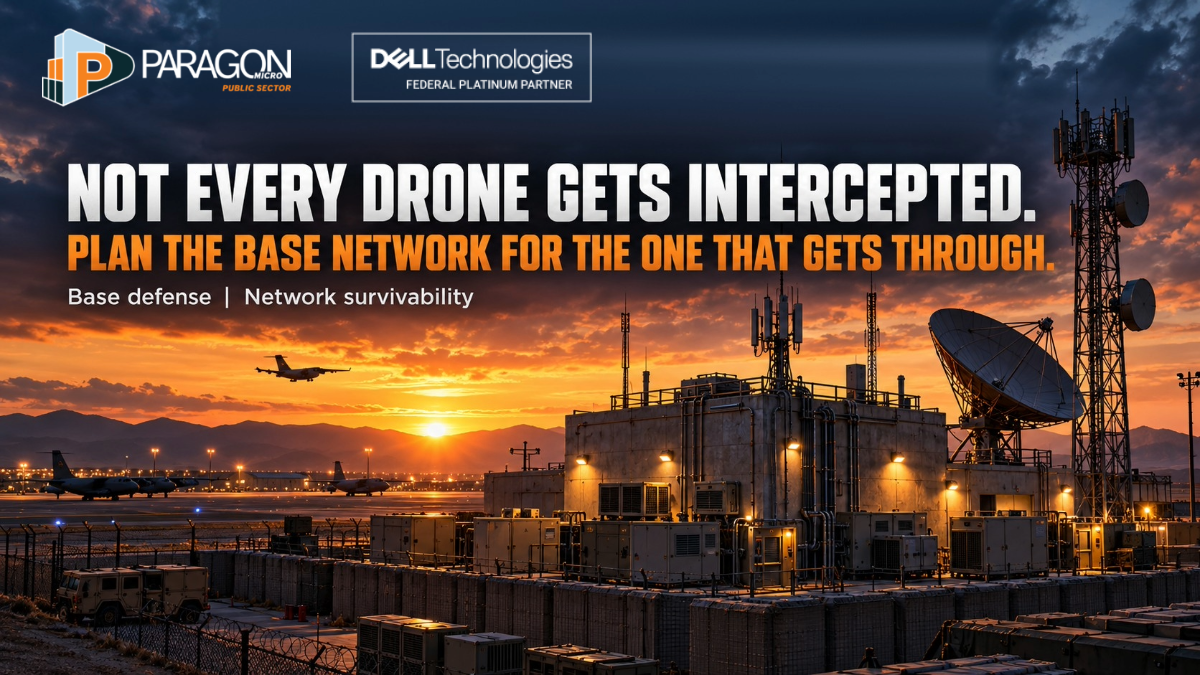
Base defense | Network survivability
Some strikes will reach the base. The comms room, server room, and command node have to keep working after one does.
Since the Iran war began on February 28, 2026, missiles and drones have hit U.S. bases in the Middle East, and officials and analysts describe interceptor stocks that will take years to rebuild. Air defense belongs to commanders. This article covers the part a program office and a base communications team control: whether the network still works after a hit.
01 | The threat
What the public record says about what gets through
In July, a U.S. official told The Intercept that Patriot and THAAD interceptor stocks were so depleted that U.S. forces were not shooting down every incoming missile and drone, and were letting some through when a strike was judged not to endanger U.S. lives.
The same official estimated that Iran had fired 8,000 to 9,000 drones and missiles across the Middle East since the war began, and had attacked at least 9 U.S. outposts since July 9. U.S. Central Command declined to comment on battle damage.
Think tank estimates point the same way. In May, CSIS estimated it would take 3 or more years to rebuild Patriot and THAAD inventories to prewar levels. In July, CSIS estimated the Patriot stockpile had fallen by about 65% during the war. Pentagon spokesman Sean Parnell said the United States "has everything it needs to execute" the president's orders.
These figures come from an anonymous official and from outside analysts, and the department has not confirmed them. This article takes no position on air defense policy or on the war. It starts from a planning assumption that holds either way: some strikes may reach a base, and the base's IT should be built to keep working after one does.
The record so far
February 28, 2026
The war begins.
Early March 2026
Iranian strikes hit AWS data centers in Bahrain and the UAE. In September, AWS said it cannot restore access to resources hosted only in its Bahrain region or only in 1 UAE availability zone.
March 27, 2026
An Iranian missile and multiple drones hit Prince Sultan Air Base in Saudi Arabia. Initial reports said at least 10 service members were wounded and refueling aircraft and an E-3 Sentry were damaged.
July 17 and 18, 2026
Iranian missile and drone attacks on Muwaffaq Salti Air Base in Jordan kill 3 U.S. soldiers, all from air defense units.
October 21, 2026
CBS News reports that the U.S. military has quietly reduced its presence at Middle East posts because of threats from Iran and the Houthis.
October 22, 2026
Iran's Revolutionary Guard warns it could extend the confrontation to U.S. bases in the region.
The question for your base
If the building with your core switch took a hit tonight, what would still work by morning?
The answer is set by design decisions made long before the strike.
02 | Bases at home
Drones already reach the airspace over U.S. installations.
U.S. Northern Command told Breaking Defense in October 2025 that drone sightings over military installations rose about 82% in a year, to roughly 420 from September 2024 to September 2025. Its commander, Gen. Gregory Guillot, put the rate at about 1 to 2 incursions per day.
Sightings are different from strikes. They do show that drones reach the airspace over U.S. bases, and FORTRESS America names installation hardening and cyber resilience as 1 of its 5 pillars. A base network built to survive a hit in the Gulf is built the same way at home.
03 | What doctrine expects
The Air Force already plans to lose connectivity.
Air Force Doctrine Note 1-21, Agile Combat Employment, describes a scheme of maneuver executed within threat timelines "to increase resiliency and survivability while generating combat power." It is blunt about communications.
Expect the loss
Connectivity will drop
"It should be expected and anticipated that force elements conducting ACE will lose connectivity with operational C2."
Build for it
Communications that survive
The note says ACE "requires communications that are mobile, survivable, secure, and sustainable across the electromagnetic spectrum."
Plan the fallbacks
Primary, alternate, contingency, emergency
When communications are challenged, the note points to plans set in advance for primary, alternate, contingency, and emergency communications, using more than 1 mode.
Layer the control
Redundant command and control
"Redundant and resilient C2 methods enable effective ACE execution."
Dispersed forces still reach back to the main base for directories, authentication, applications, and data. The same planning logic has to cover the fixed network that serves them.
04 | The plan
6 decisions that set base network survivability
| Decision | What it covers | What good looks like |
|---|---|---|
| 1. Separate the critical services | Directory and authentication, name resolution, command and control applications, and the data they depend on | Each runs in at least 2 buildings, far enough apart that 1 strike cannot take both |
| 2. Diversify the paths | Links between buildings and off the base | Different cable routes and different media, with primary, alternate, contingency, and emergency paths written down |
| 3. Power each node separately | Backup power for every building that hosts a critical service | Each node rides out a power loss on its own generator or battery, sized to measured load |
| 4. Stock configured spares | Switches, servers, and radios that would take longest to replace | Spares on hand, loaded with current configurations, stored away from the rooms they would replace |
| 5. Store configurations off site | Device configurations, backups, and the network diagram | Current copies kept where a strike on the base cannot reach them, with a tested restore |
| 6. Rehearse the failover | Moving a service from 1 node to the other | Done on a schedule, timed, and written up, so the first real failover is the second time anyone has done it |
Pick an alternate site type for each service
NIST SP 800-34, the federal contingency planning guide, gives the vocabulary. A cold site has space and infrastructure. A warm site holds some or all of the system hardware. A hot site is sized and configured to take over. A mirrored site is fully redundant, with automated real time mirroring.
Directory, authentication, and command and control services are the ones to consider for hot or mirrored sites, since the base stops without them. A training system or an archive may be fine as a cold site. Making that call service by service keeps the cost where the risk is.
The lesson from the cloud strikes
AWS said it cannot restore resources that lived in only 1 struck location. Data kept in 1 place shares that place's fate.
05 | Spares and second sources
Count a spare only if it is on hand and ready.
After a strike, the replacement that matters is the one already on the base with the current configuration loaded. A part that has to be ordered starts its lead time on the day it is needed.
Second sources help here. If the second node uses equipment from a different manufacturer, a supply problem with 1 product line does not stall both the repair and the rebuild. That is the reasoning behind the multi-vendor designs in chapter 14 of our Dell Federal guide, and FORTRESS America makes supply chain and industrial base resilience another of its 5 pillars.
Running 2 manufacturers adds work: 2 sets of firmware, 2 support contracts, and a configuration baseline for each. That work belongs in the design and the sustainment plan from the start.
06 | How we help
Where Dell Federal and Paragon Micro fit

As a Dell Technologies Federal Platinum Partner and multi-vendor technology provider, we design and integrate multi OEM environments meant to stay operational despite outages, disruptions, or vendor specific failures. Every architecture is validated in controlled staging before deployment.
2 sites, 1 system
Tinker Air Force Base
For the Air Force's 76th Software Engineering Group, we delivered a 1,600 user virtual desktop system across 2 operational sites, with active active management clusters and 800 users per site.
Built before it ships
The System Readiness Center
In our 55,000 plus square foot secure facility, we validate configurations and stage and test systems. Every action is logged and traceable from build through secure delivery.
Second sources
More than 1 manufacturer
Our multi OEM work includes data center projects with redundancy and failover designed in, and supply chain risk reduction through sourcing from more than 1 OEM.
Records that last
Documentation and sustainment
Our lifecycle support covers ongoing sustainment, documentation, and upgrade planning, so the configuration records stay current after delivery.
Staging both nodes together before shipment is the cheapest place to test a failover, with every product on the same bench and the configurations recorded as they pass.
From order to support
If your team doesn't have the people to install the second node and the wireless link that gives it a second path, we can do that work with you.
- 01
We sell it
The servers, storage, switches, and wireless equipment for the second node, plus configured spares
- 02
We install and integrate it
Staged together in our System Readiness Center, then installed in the second building and connected to the base network
- 03
We train your team
Your staff rehearse the failover with us before go live, timed and written up
- 04
We support it after
Lifecycle sustainment, current configuration records, and upgrade planning after delivery
Paragon Micro | Dell Federal
Find the single points of failure before a strike does.
Send us your base network diagram, the services that have to survive, and your current spares list. We can help identify the single points of failure, design and stage the second node, and document configurations for storage off site.
Army organizations and other federal agencies can order through ITES-4H. The Missile Defense Agency and other Department of War organizations can order through MDA SHIELD, and federal buyers can also use GSA. The right path depends on scope, eligibility, and ordering rules.
Keep reading
FORTRESS America: installation IT that stays up
Chapter 15 of our Dell Federal guide covers the 5 FORTRESS pillars, our FORTRESS America article covers installation IT and security, and our counter UAS article covers the sensor and edge side.
Answers for base planners
Base network survivability: common questions
What is base network survivability?
It is the ability of a base's network, servers, and command and control systems to keep working after part of them is physically damaged. It comes from separating critical services across buildings, diversifying links, powering each node separately, keeping configured spares, storing configurations off site, and rehearsing failover.
Why plan for strikes that get through air defenses?
In July 2026, a U.S. official told The Intercept that Patriot and THAAD stocks were depleted enough that U.S. forces were not intercepting every incoming missile and drone. CSIS estimated in May 2026 that rebuilding those inventories to prewar levels would take 3 or more years. These are unconfirmed and outside estimates, and the Pentagon has said the United States has what it needs.
Does this apply to bases in the United States?
Yes. U.S. Northern Command reported about 420 drone sightings over military installations from September 2024 to September 2025, and FORTRESS America names installation hardening and cyber resilience as 1 of its 5 pillars.
What does Air Force doctrine say about losing connectivity?
Air Force Doctrine Note 1-21, Agile Combat Employment, says forces should expect to lose connectivity with operational command and control, and calls for communications that are mobile, survivable, secure, and sustainable, with primary, alternate, contingency, and emergency plans.
How far apart should redundant nodes be?
It depends on the threat assessment and the base layout, so the distance is a decision for the base's engineers and mission assurance planners. The starting point is separate buildings with separate power and separate cable routes, far enough apart that 1 strike cannot take both.
How does Paragon Micro help?
We design and integrate multi OEM environments meant to stay operational through outages and vendor specific failures, validate them in controlled staging before deployment, and document their configurations. For Tinker Air Force Base, we delivered a 1,600 user system across 2 operational sites with active active management clusters.
Reference desk
Sources and further reading
Public sources as reviewed October 22, 2026. Reporting on the Iran war changes daily, and several figures here come from anonymous officials and outside estimates, so confirm current conditions before you plan around them.
ViewHide 17 sourcesPrimary and supporting references
Al Jazeera. (2026, October 22). Iran war live: IRGC threatens US bases if tankers continue 'illegal' routes. https://www.aljazeera.com/news/liveblog/2026/10/22/iran-war-live-irgc-vows-invasion-as-defence-doctrine-turns-offensive
Boccia, C., & Martinez, L. (2026, July 30). US Patriot interceptor stockpile diminished by some 65% during Iran war, think tank estimates. ABC News. https://abcnews.com/Politics/us-patriot-interceptor-stockpile-diminished-65-iran-war/story?id=135198306
Cancian, M. F., & Park, C. H. (2026, May 27). Rebuilding U.S. missile inventory: A multiyear project. Center for Strategic and International Studies. https://www.csis.org/analysis/rebuilding-us-missile-inventory-multiyear-project
CBS News. (2026, October 22). Iran war updates: U.S. reduces troop footprint in Mideast as indirect talks with Iran continue [Live updates]. https://cbsnews.com/live-updates/iran-war-trump-us-ceasefire-talks-ongoing
Gordon, C. (2026, March 27). US forces at Saudi air base suffer Iranian attack. Air & Space Forces Magazine. https://www.airandspaceforces.com/us-forces-saudi-arabia-iran-attack/
Marrow, M. (2025, October 10). With daily drone incursions over bases, NORTHCOM takes aim through Falcon Peak. Breaking Defense. https://breakingdefense.com/2025/10/drone-incursions-us-military-falcon-peak-2025-cuas/
Paragon Micro. (n.d.-a). Dell Federal. https://www.paragonmicro.us/partners/dell-federal/
Paragon Micro. (n.d.-b). Resilient multi OEM architectures. https://www.paragonmicro.us/solutions/resilient-multi-oem-architectures/
Paragon Micro. (n.d.-c). Secure integration & staging facility. https://www.paragonmicro.us/about-us/facility/
Paragon Micro. (n.d.-d). USAF VDI modernization at Tinker AFB: 1,600 user hyperconverged deployment. https://www.paragonmicro.us/past-performance/usaf-vdi-modernization-at-tinker-afb-1600-user-hyperconverged-deployment/
Paragon Micro. (2026a, February 24). Edge AI in the battlefield for counter UAS operations. https://www.paragonmicro.us/edge-ai-in-the-battlefield-for-counter-uas-operations/
Paragon Micro. (2026b). Dell Federal and Paragon Micro: How the partnership is positioned for FORTRESS America, Project Meridian, and the Autonomous Warfare Command. https://www.paragonmicro.us/dell-federal-paragon-micro-dow-initiatives/
Paragon Micro. (2026c, October 2). FORTRESS America: What independent bases need from their IT and security systems. https://www.paragonmicro.us/fortress-america-installation-it-security/
Swanson, M., Bowen, P., Phillips, A. W., Gallup, D., & Lynes, D. (2010, May; updated 2010, November 11). Contingency planning guide for federal information systems (NIST SP 800-34 Rev. 1). National Institute of Standards and Technology. https://nvlpubs.nist.gov/nistpubs/Legacy/SP/nistspecialpublication800-34r1.pdf
Swinhoe, D. (2026, September 16). AWS "unable to restore access" to data centers hit by Iran strikes. Data Center Dynamics. https://www.datacenterdynamics.com/en/news/aws-unable-to-restore-access-to-data-centers-hit-by-iran-strikes/
Turse, N. (2026, July 28). Iran has figured out how to overwhelm U.S. air defenses. The Intercept. https://theintercept.com/2026/07/28/iran-missiles-drones-us-air-defenses/
U.S. Air Force. (2022, August 23). Agile combat employment (Air Force Doctrine Note 1-21). Curtis E. LeMay Center for Doctrine Development and Education. https://www.doctrine.af.mil/Portals/61/documents/AFDN_1-21/AFDN%201-21%20ACE.pdf