




Department of War | Dell Technologies Federal partnership
FORTRESS America, Project Meridian, and the Autonomous Warfare Command all run on hardware. Here is what Dell and Paragon Micro can supply for them.
A 20 chapter guide to Dell's federal capabilities and products, what Paragon Micro adds as a Dell Technologies Federal Platinum Partner, and how the 2 companies fit the 3 initiatives Secretary of War Pete Hegseth announced on September 30, 2026.
01
Supply chain security, zero trust, servers, rugged systems, networking, and data protection
02
Platinum Partner status, the System Readiness Center, and past performance
03
What FORTRESS, Meridian, and AutoWarCom each ask of the hardware
04
ITES-4H, MDA SHIELD, NASA SEWP V and VI, and GSA
On September 30, 2026, Secretary of War Pete Hegseth announced 6 initiatives at Marine Corps Base Quantico. FORTRESS America, Project Meridian, and the Autonomous Warfare Command, 3 of the 6, will be decided in large part by hardware: the servers in base data centers, the rugged systems at forward sites, the laptops in vehicles, and the storage that holds mission data.
Paragon Micro is a Dell Technologies Federal Platinum Partner and a multi-vendor federal IT solutions integrator. Dell provides the infrastructure. Paragon Micro sizes it, checks the bill of materials, configures and tests it in its own facility, and delivers it under chain of custody through contract vehicles DoW buyers already hold.
This guide covers 3 things: what Dell Technologies Federal brings, what Paragon Micro adds, and how the 2 fit each initiative. It cites Dell's own specifications, press releases, and technical notes, the Department of War's memos and releases, and the regulations that apply. Where a claim is a company's own marketing statement, the text says so. Every source is listed in the references at the end of the guide.
Key takeaways
- Dell describes a federal business with a supply chain built for government accountability and lists ITES-4H, NASA SEWP V, NASA SEWP VI, and CIO-CS as its federal contract vehicles. Paragon Micro holds ITES-4H, SEWP V, and SEWP VI, plus MDA SHIELD and GSA.
- Dell announced on April 2, 2025 that Project Fort Zero had completed the department's Target Level zero trust validation as an on premises private cloud. The department's own zero trust deadline is September 30, 2027.
- Dell's PowerEdge XR servers are MIL-STD tested and NEBS Level 3 certified, with select XR8000 configurations rated from minus 20 to 65 degrees Celsius. Its Pro Rugged 13 Extreme and Pro Rugged 14 laptops went on sale October 1, 2026 with what Dell calls quantum resistant protections.
- Paragon Micro was named Dell Technologies' 2025 Federal Server Sales Partner of the Year, by its own account, and has delivered 28,835 Dell desktops to the FBI in a single refresh and a 1,600 user Dell VxRail VDI system to Tinker Air Force Base.
- Dell systems Paragon Micro stages for DoW programs pass through its 55,000 plus square foot System Readiness Center, where they are built, tested, logged, and handled only by vetted U.S. citizens, with Trade Agreements Act compliance enforced on everything received and shipped.
- Dates to plan around: CNSA 2.0 for new National Security System acquisitions on January 1, 2027, Project Meridian findings on January 28, 2027, the zero trust deadline on September 30, 2027, AutoWarCom on October 1, 2027, and the Section 5949 chip prohibition on December 23, 2027. CMMC Phase 2, which was due November 10, 2026, has been suspended since July 13, 2026 pending a department review.
Chapter 1
3 initiatives, 1 hardware problem
Hegseth's State of the Force address announced the Autonomous Warfare Command, Project Meridian, FORTRESS America, a new Corps of Cadets, the Next Great American Base, and the Office of Religious Affairs. Paragon Micro has published a guide to each of the 3 that depend on IT. This chapter sets out what each asks of hardware, so the rest of the guide can show where Dell products and Paragon Micro services answer it.
FORTRESS America
Installations that generate their own power and hold up against cyberattacks, sabotage, and drones
Established as a Department of War program by memo on September 30, 2026, with a program office due within 30 days, on October 30, 2026. Its 5 pillars are energy independence, supply chain and defense industrial base resilience, a strategic defense reserve, installation hardening and cyber resilience, and resilience in space and spectrum. Hardware need: base data centers, control system networks, cameras and sensors, and edge compute that keep running on backup power.
Project Meridian
A 120 day study of future warfare, with findings due January 28, 2027
Commissioned the same day, codirected by Elon Musk, Palmer Luckey, and Newt Gingrich, and charged with identifying capability gaps and proposing actionable solutions to start developing, testing, and fielding new capabilities. Hardware need: training compute for AI, test environments, and edge systems for whatever the department decides to field.
Autonomous Warfare Command
A four star command for autonomous and robotic systems, targeted for October 1, 2027
Hegseth described its job as scaling autonomous and robotic capabilities across the military, and Congress has to act before it stands up. Hardware need: forward edge nodes, operator endpoints, contested spectrum links, and a data path from the edge back to the people retraining models.
The common thread is that drones, AI models, and microgrids all depend on commercial hardware that someone has to source, configure, secure, and deliver under federal rules. That is the work Dell and Paragon Micro would divide between them on a Dell based program, as the next 19 chapters show. For the detail on each initiative, see FORTRESS America: What Independent Bases Need From Their IT and Security Systems, What Project Meridian Means for DoW Programs, and Ready for the Autonomous Warfare Command.
Chapter 2
The rules every build has to meet
Before any product discussion, 6 rules shape what a DoW buyer can accept. Each shows up again in the chapters that follow.
Acquisition
Warfighting Acquisition System
Hegseth's November 7, 2025 memo made commercial products the preferred approach, required at least 2 qualified sources for critical program content unless waived, and called for modular open systems with competition at the module level.
Data and AI
The department's AI strategy
The January 9, 2026 strategy commits "substantial resources" to department data centers, requires access to the latest model versions within 30 days of public release, and calls for faster authorizations to operate.
Cyber
Zero trust by September 30, 2027
The department's deadline to reach target level zero trust is the end of FY2027. Its chief information officer at the time said extending zero trust to weapon systems and operational technology would be "a bit of a lift".
Encryption
FIPS 140-3 and CNSA 2.0
NIST accepted FIPS 140-2 certificates only through September 21, 2026, after which they move to its Historical List. From January 1, 2027, CNSA 2.0 algorithms are required in all new National Security System acquisitions.
Supply chain
Section 889 and Section 5949
FAR 52.204-25 bars covered telecommunications and video surveillance equipment. Section 5949 bars products with semiconductors from SMIC, YMTC, or CXMT starting December 23, 2027. The rule proposed in February 2026 would reach commercial off the shelf items, with a temporary exception to December 23, 2028 for commercial products that have no alternative source, and would require offerors to certify that they made a reasonable inquiry.
Controlled unclassified information
CMMC Phase 2, suspended
Phase 2 was due November 10, 2026 and would have made third party Level 2 certification the default for new contracts involving CUI. The department suspended it on July 13, 2026 pending a 60 day review; Level 2 self assessments and DFARS 252.204-7012 still apply. No replacement date had been announced as of October 21, 2026. Mission data, configurations, and test results for these programs will often be CUI.
Installations face 2 more. UFC 4-010-06 sets cybersecurity requirements for facility related control systems, which include building control systems, utility control systems, electronic security systems, and fire and life safety systems. And the Trade Agreements Act governs country of origin for products sold on federal vehicles, which is why Paragon Micro enforces it on every piece of hardware it receives and ships.
Chapter 3
What Dell Technologies Federal is
Dell Technologies Federal is the part of Dell that sells to and supports U.S. federal agencies. Dell's federal page says the company helps federal agencies modernize legacy environments, protect their data, and "deploy AI capabilities on infrastructure built for federal compliance standards," and describes a supply chain built for government accountability and a decades long record of federal deployment.
The page groups Dell's federal work into 4 areas: AI for federal agencies, technology for the federal workforce, data center and multicloud, and cyber resiliency and security. It names the Dell AI Factory and the AI Data Platform as "a trusted, governed AI environment built for security and compliance," points to the Dell Pro Precision with GB300 for secure, data intensive federal workloads, and describes Dell Rugged devices as built for "military and field workers".
What Dell says about compliance and delivery
Dell's federal page gives 3 answers that matter for DoW buyers. On compliance, Dell says its solutions "can help agencies address federal cybersecurity and compliance requirements, including applicable FedRAMP and NIST frameworks, depending on the solution, configuration and deployment environment." On its supply chain, Dell says its direct selling model "provides visibility into how systems are configured and delivered." On security, Dell says systems can include hardware based protections, secure firmware features, Secure BIOS and Secure Boot, and "delivery processes designed to support supply chain integrity," such as tamper evident packaging and controlled chain of custody practices "where applicable".
Those are Dell's own statements. The qualifiers, "depending on the solution" and "where applicable," are the reason a partner has to confirm each against the specific configuration a program buys. That confirmation is part of what Paragon Micro does in chapters 11 and 12.
Contract vehicles Dell lists
Dell's federal page lists 4 vehicles: Army ITES-4H, NASA SEWP V, NASA SEWP VI, and CIO-CS. Paragon Micro holds ITES-4H, SEWP V, and SEWP VI, which puts the 2 companies on the same paper for most DoW hardware orders. Chapter 19 covers each vehicle.
On September 30, 2026, the day of the Quantico address, Dell also announced that it had joined the Alliance for Critical Infrastructure "alongside leaders from across the nation's lifeline sectors," saying that national security depends on resilient critical infrastructure. The 2 announcements were separate, but the overlap in subject is the reason chapter 15 treats installation resilience as a Dell question as much as a base question.
Chapter 4
Supply chain security built into the product
FORTRESS America's second pillar is supply chain and defense industrial base resilience. For IT hardware, that starts with how the manufacturer controls its own supply chain. Dell publishes the detail.
From supplier to factory to truck
Dell's supply chain white paper describes supplier onboarding that ends in an on site quality process audit with a security assessment, a secure development lifecycle that follows NIST SP 800-218, and factories that must meet physical security standards including TAPA. Dell says it directly manages about half of its global manufacturing sites, procures parts directly from the original design or component manufacturer, and holds Tier 3 status with U.S. Customs and Border Protection's Customs Trade Partnership Against Terrorism.
In transit, Dell describes tamper evident packaging, cargo locks and seals, pallet loads secured with a serial numbered bolt seal that the customer verifies on arrival, GPS and other tracking devices, and logistics providers that must conform to TAPA freight security requirements.
Secured Component Verification
Dell's Secured Component Verification, or SCV, is the control a receiving site can run itself. For PowerEdge servers, Dell's technical note describes the process: at manufacture, each critical part is analyzed and a unique identifier recorded, the as built configuration is captured in a cryptographic certificate bound to that server, and the certificate is signed by a Dell Certificate Authority and stored in iDRAC. When the server arrives, the customer runs the SCV validation application, which compares the current hardware against the factory record and reports "either a perfect match, or a list of components not in compliance with those used at time of build".
The same note lists the broader measures behind Dell's secure supply chain for servers: chain of custody tracking and anti tamper packaging, third party access restrictions and staff checks at the point of manufacture, code signing, chain of trust for critical components, and hardware intrusion detection that records enclosure breaches during shipment. Dell says these measures matter "especially in the Federal" sector, among others.
For client systems, Dell sells SafeSupply Chain as a set of paid options: SCV platform certificates for PCs, tamper evident seals on the system, tape on the box, and pallet seals, and device sanitization to NIST SP 800-88 with reimaging to contract specifications. Tamper evidence and sanitization are available only in North America.
What this means at receipt
A server that arrives with an SCV certificate can be checked against its factory build before it is racked. Paragon Micro verifies components at intake and logs every system, and for servers that ship with an SCV certificate that intake check can include the SCV validation, recorded in the custody file, so the unit's integrity is documented before it ships to the base and again when it is received. The receiving site keeps the last word: SCV is a tool the customer runs, and the records are theirs.
Chapter 5
Zero trust: Project Fort Zero and the department's validation
On April 2, 2025, Dell announced that Project Fort Zero had achieved the Department of Defense's validation for replicating the department's zero trust architecture. The department has since been renamed the Department of War. Dell said the solution completed all the security controls required for the department's Target Level validation as a sovereign, on premises private cloud, after an assessment in which it "was tested to withstand sophisticated cyberattacks".
Dell's framing is that the architecture is complex enough that someone has to do the integration work up front. Herb Kelsey, Dell's industry chief technology officer for government, said Dell had brought together a group of partners and taken on "the technology integration of this complex architecture".
A caution: the release said "Availability to be announced." We did not find a later availability announcement in Dell's newsroom as of October 21, 2026, so ask Dell or Paragon Micro for the current status before you plan around it.
Why the validation matters to the 3 initiatives
- FORTRESS America's fourth pillar is installation hardening and cyber resilience. A validated zero trust private cloud is a reference design for a base that has to keep its own data center running during an attack.
- The department's target level deadline is September 30, 2027, 1 day before the Autonomous Warfare Command's target date. Edge nodes and ground control stations bought now will have to fit a zero trust architecture.
- Paragon Micro's zero trust and cyber resilience work covers microsegmentation to limit lateral movement, multifactor authentication with device trust validation, and backup, failover, and recovery planning. On Dell programs, its Dell Federal page adds zero trust design, authority to operate documentation, and control mapping.
Chapter 6
PowerEdge servers for data centers and AI
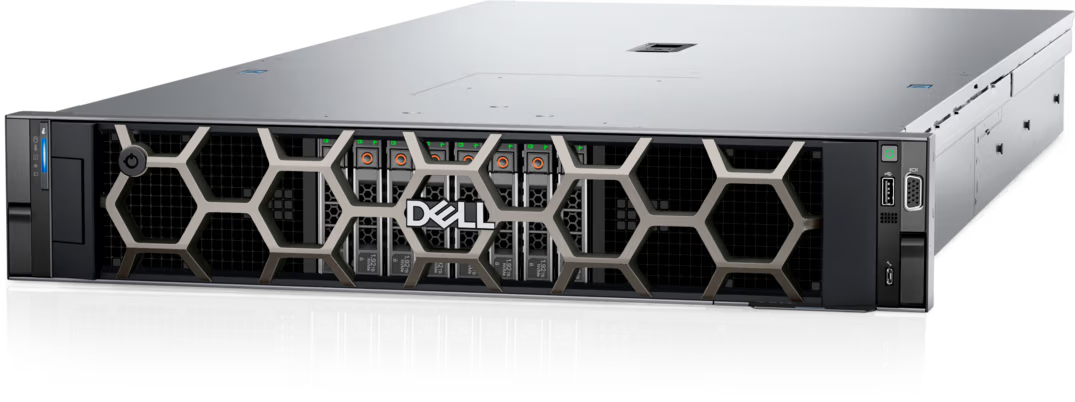
Dell PowerEdge is the server line Paragon Micro would propose for the base data centers, training clusters, and virtual desktop systems in all 3 initiatives. Paragon Micro's Dell Federal page shows the PowerEdge R760xa as its example of a GPU server, so this chapter uses Dell's specification sheet for that model.
Data center example
Dell PowerEdge R760xa
Form factor
2U rack server, dual socket, air cooled
Processors
Up to 2 5th Gen Intel Xeon Scalable processors with up to 64 cores each
GPUs
Up to 4 double width 400 W cards, or up to 12 single width 75 W cards
Memory
32 DDR5 DIMM slots, up to 8 TB
Security
Silicon root of trust, Secure Boot, TPM 2.0 FIPS, Secure Erase, System Lockdown
Workloads Dell names
AI training and inference, digital twins and rendering, virtualization and VDI graphics
System Lockdown requires iDRAC9 Enterprise or Datacenter.
The Dell AI Factory
Dell's AI infrastructure is sold as the Dell AI Factory with NVIDIA. On October 16, 2026, Dell said more than 6,500 customers had adopted it, up from 5,000 the quarter before, by Dell's own count of customer order data. The same announcement covered 4 pieces of hardware that bear on DoW programs:
- The Dell Modular Data Center with NVIDIA DSX POD, a containerized AI factory with compute, storage, networking, rack level power, and liquid cooling, built to connect to prepared power, with a reference design due in early 2027.
- The PowerEdge R8822, an air cooled 2 socket NVIDIA Vera CPU server for standard 19 inch racks with support for up to 4 double width GPUs, available this month.
- The PowerEdge XE9810, a rack scale inference system with 16 liquid cooled compute trays, due in Q1 CY27.
- Dell Pro Precision with GB10 in a 64 GB unified memory configuration, available October 23, and Pro Precision with GB300 on Windows, with up to 748 GB of coherent memory, coming soon.
The release also described a security architecture for AI agents built on the AI Factory that covers the runtime, network, data, and infrastructure. For a program office, the practical point is that a containerized AI factory that plugs into prepared power is a different buying decision from a rack of servers, and chapter 16 returns to it for Project Meridian.
What Paragon Micro adds on PowerEdge
Paragon Micro's Dell Federal page lists 4 services for PowerEdge deployments: sizing systems to mission demand, mapping configurations to federal security controls for audits and approvals, checking bills of materials for accuracy, compatibility, contract compliance, and lifecycle sustainability, and planning deployments to limit downtime. On the Tinker Air Force Base project in chapter 13, that meant more than 25 design revisions before the order was placed.
Chapter 7
PowerEdge XR servers for the edge
The PowerEdge XR series is Dell's rugged, short depth server line, and it is the family a FORTRESS sensor site, a Meridian test range, or an AutoWarCom forward node could draw on. Dell's XR series specification sheet, revised in January 2026, describes the line as "MIL-STD tested and NEBS Level 3 and IEC 61850-3 certified for durability," with a standard operating range of minus 5 to 55 degrees Celsius and extended ranges from minus 20 to 65 degrees Celsius on select XR8000 configurations.
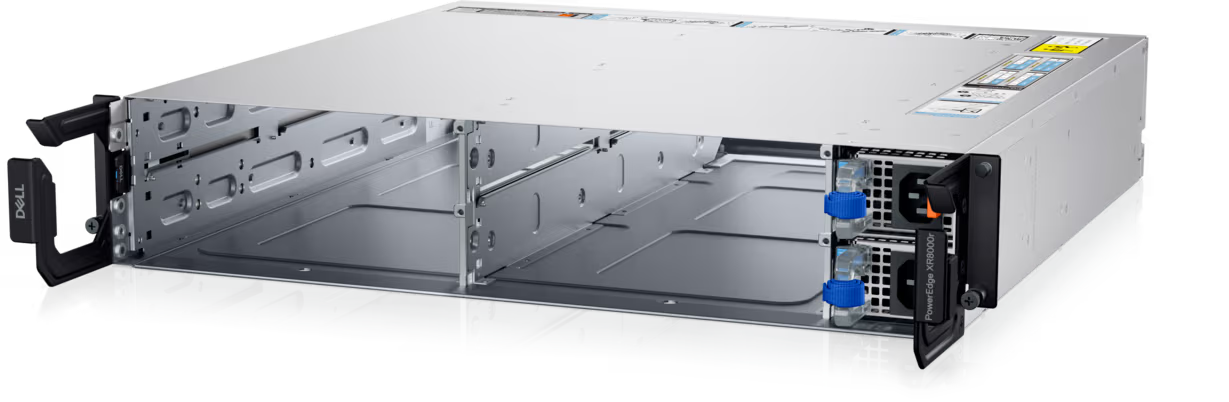
Modular, up to 4 nodes
PowerEdge XR8000
Chassis87.05 mm tall, 430 mm deep, with 1U and 2U sleds
Processors4th or 5th Gen Intel Xeon Scalable per sled, or Intel Xeon 6 with up to 72 cores in the XR8720t sled
PowerAC, 240 V HVDC, and minus 48 to minus 60 V DC options
TemperatureExtended range on select configurations
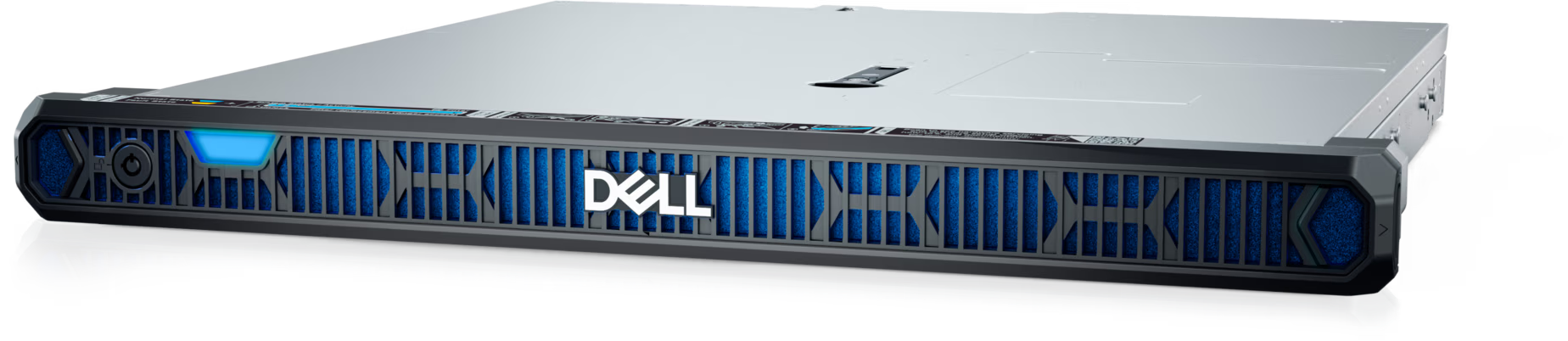
Short depth 1U
PowerEdge XR5610
Depth400 mm to the rear wall
Processors1 4th or 5th Gen Intel Xeon Scalable processor
GPUsUp to 2 single width 75 W cards
PowerAC, HVDC, and minus 48 to minus 60 V DC options
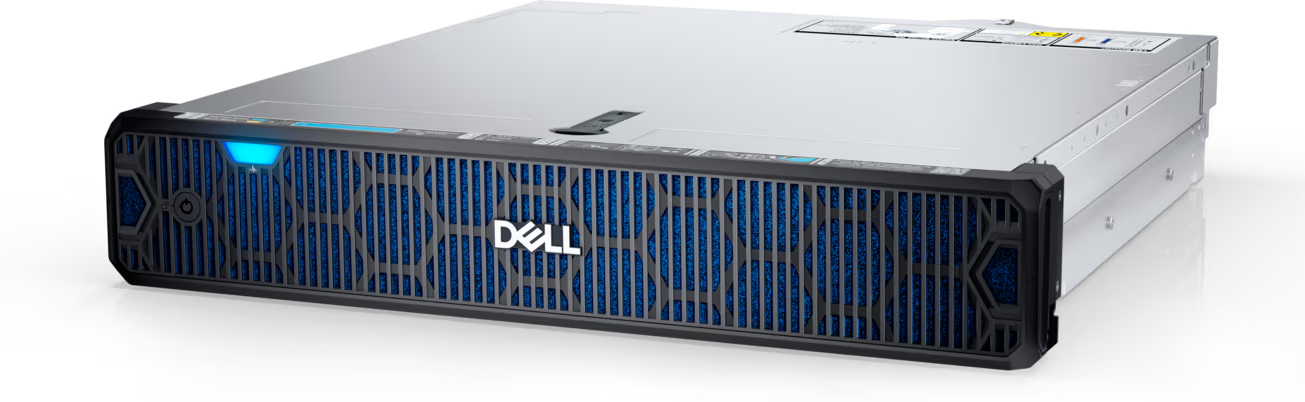
Short depth 2U
PowerEdge XR7620
Depth448.8 mm to the rear wall
Processors2 5th Gen Intel Xeon Scalable with up to 16 cores each, or 2 4th Gen with up to 32 cores each
GPUsUp to 2 double width 350 W cards, or 4 single width 75 W cards plus 1 low profile card
PowerAC, HVDC, and minus 48 to minus 60 V DC options
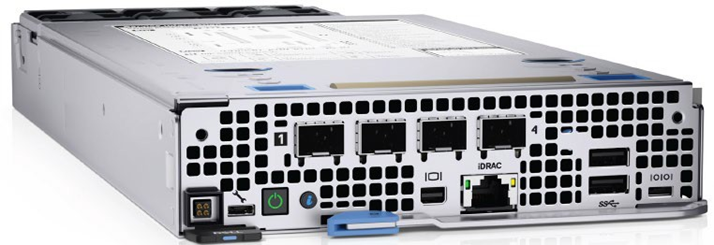
Multi node, front accessible
PowerEdge XR4000
ChassisRackable or stackable chassis, 455 mm deep with bezel
Processors1 3rd Gen Intel Xeon D with up to 20 cores per compute sled
GPUsXR4520c sled: up to 2 single width 150 W cards or 1 double width 250 W card
PowerAC, HVDC, and minus 48 to minus 60 V DC options
Confirm the exact configuration, GPU support, and temperature rating for the sled you order.
Security on every XR model
The specification sheet lists the same security set across the line: cryptographically signed firmware, Secure Boot, Secure Erase, Silicon Root of Trust, System Lockdown with iDRAC9 Enterprise or Data Center, and TPM 2.0 FIPS, with data at rest encryption through self encrypting drives on the XR5610 and XR7620. For a forward site, Secure Erase is the feature to test: if a node is at risk of capture, the unit needs a tested procedure for sanitizing it, and someone has to be able to trigger it.
Paragon Micro's tactical edge AI work packages PowerEdge XR7620 and XR4000 servers with NVIDIA Spectrum-X networking and power in ruggedized transit cases, so a unit can run language and vision models locally when a link back to the continental United States is slow or gone. Its tactical and rugged equipment practice covers the solar, generator, vehicle, and battery power platforms those cases run on.
Chapter 8
Dell Pro Rugged laptops for the field
On October 1, 2026, the day after the Quantico address, Dell announced 2 rugged laptops: the Dell Pro Rugged 13 Extreme and the Dell Pro Rugged 14. Dell says both are "MIL-STD-810H certified" with a temperature range of minus 20 to 145 degrees Fahrenheit, displays that work with gloves and in wet conditions, Intel Core Ultra Series 3 processors, optional private 5G, Wi-Fi 7, GPS, hot swappable batteries, and an optional 5 megapixel camera with infrared. Both are available now.
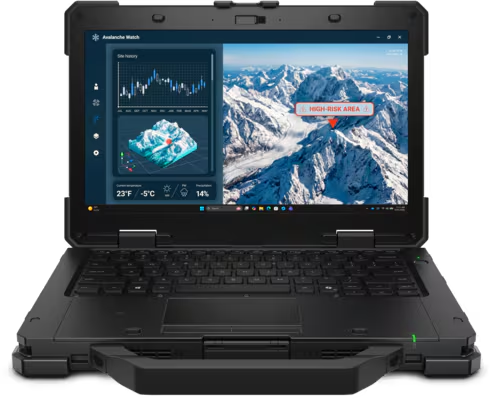
Fully rugged
Dell Pro Rugged 13 Extreme
ProtectionIP66 rating and drop tested from 6 feet
Display13.3 inch FHD at 1,400 nits for direct sunlight
Memory and storageUp to 64 GB LPDDR5X, with removable SSD and self encrypting drive options
GraphicsIntel Arc graphics
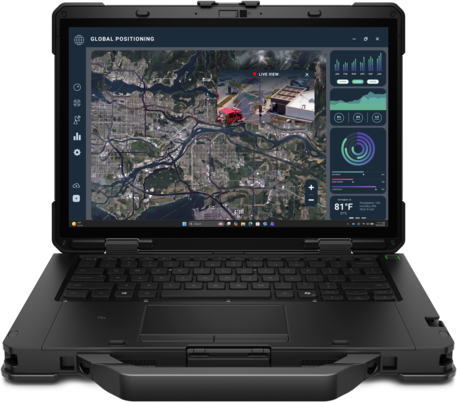
Semi rugged
Dell Pro Rugged 14
ProtectionIP53 rating and 3 foot drop protection, about 4.7 pounds
Display14 inch 16:10 FHD at up to 1,100 nits
GPU and memoryNVIDIA RTX PRO 500 Blackwell laptop GPU, LPCAMM2 memory up to 64 GB
DockingRedesigned vehicle docking with quad passthrough
Dell's claims that these are the most powerful and smallest in their classes rest on its own internal analysis from August 2026.
The Paragon Micro store lists the catalog generation of both lines today, the Pro Rugged 14 (RB14250) and the Pro Rugged 13 (RA13250); the October 2026 models were not listed as of October 21, 2026. Chapter 19 has the store links and images.
Security features that matter for DoW endpoints
Dell lists TPM 2.0, contacted and contactless smart card readers, fingerprint readers, infrared cameras for facial recognition, and Dell SafeID with ControlVault, and says the laptops are now further hardened with what it calls quantum resistant protections. A contacted smart card reader is the type used with a Common Access Card; confirm the reader on the configuration you buy. The quantum resistant claim is Dell's, and it does not by itself establish CNSA 2.0 compliance for a National Security System; ask for the specific algorithms and validation status before you rely on it for the January 1, 2027 date in chapter 18.
For the Autonomous Warfare Command, these are the operator endpoints and ground control stations that chapter 17 covers. For FORTRESS, they are the laptops security forces and utility crews carry on a base that has lost its network. Paragon Micro carries the Pro Rugged line in its Dell catalog and checks rugged configurations against the environmental conditions of the deployment before they ship.
Chapter 9
Networking and Dell Federal 5G
Dell has 2 networking lines that apply here. PowerSwitch is the wired switching that Paragon Micro positions for core to edge connectivity, tactical and enterprise network integration, and "granular segmentation that limits lateral movement across the network, in support of Zero Trust principles". Dell Federal 5G is the private wireless system Dell introduced on October 8, 2025.
Dell Federal 5G
Dell describes Federal 5G as a complete system "designed and manufactured in North America," delivered through the Dell Secure Supply Chain, and O-RAN compliant. Its parts are the Dell Private Wireless Orchestrator for zero touch provisioning and monitoring, PowerEdge XR8000 servers that run the radio access network and core software, a RAN accelerator card, Dell RAN software developed in North America, Dell and partner radios across 3GPP bands, and a 5G standalone core.
The use cases Dell lists read like a FORTRESS and AutoWarCom requirements list: a secure perimeter built from 5G connected drones, cameras, and ground sensors; airfield logistics that track fuel trucks and generators; vessels with their own private network for ship to boat to aircraft data; and live fire ranges with 5G connected targets.
Where it fits
A base that generates its own power under FORTRESS still needs a network that stays up with it. A private 5G system running on XR8000 servers in the base data center, on the same backup circuits as the servers, keeps cameras, sensors, and vehicles connected when the commercial carrier is down. Chapter 15 covers the backup power planning that makes that true.
What Paragon Micro adds on networking
Paragon Micro plans Dell networking to work with existing multi OEM environments, applies security configurations that reduce attack surface, tests performance and reliability before systems go live, and plans sustainment and growth. Its tactical and rugged practice also covers secure radios, edge networking, SATCOM, and cyber hardened systems from other OEMs, so a Dell wired or 5G network can be quoted with the radios a unit already uses.
Chapter 10
Edge operations and cyber recovery
Hardware at the edge needs software to deploy and manage it, and data in the base data center needs a copy an attacker cannot reach. Dell covers both with NativeEdge and PowerProtect Cyber Recovery.
Dell NativeEdge
NativeEdge is Dell's edge operations software. Dell describes it as running virtual machines and containers on everything from compact gateways to GPU clusters, with zero touch onboarding of devices, high availability clustering, centralized authentication through LDAP and OpenID Connect, and support for non Dell hardware. It ships with blueprints for NVIDIA frameworks such as Metropolis for vision and Riva for speech.
Dell cites an Enterprise Strategy Group analysis, which Dell commissioned, that put the time saved on deploying and managing edge infrastructure at up to 79%. Treat that as a vendor sponsored figure. The capability that matters for a distributed program is onboarding a node at a remote site without sending an engineer, then pushing an application update to hundreds of nodes from 1 console.
PowerProtect Cyber Recovery
Dell's cyber recovery system "creates an operational air gap by isolating critical data in a separately governed vault with its own controls, credentials and management plane," so recovery stays trusted "when production, identity, or backup systems are in doubt." Its Cyber Detect software analyzes full content, including files, databases, and virtual machines, to find corruption before a restore, and produces forensic reports that show the blast radius and the last known good backup.
Paragon Micro's Dell Federal page groups PowerProtect Data Domain with this work and lists what it adds: zero trust design around federal strategies, authority to operate documentation and control mapping, planning for continued operations during an incident, and building security into operating procedures.
For a FORTRESS installation, the question is simple. If the base's control system network is compromised the way CISA, NSA, and FBI warned Volt Typhoon had positioned itself to do, is there a copy of the microgrid controller configurations, the video management system, and the access control database that the attacker could not touch? A vault with its own credentials and management plane is the answer Dell sells. Chapter 15 covers how it fits the base.
Chapter 11
Paragon Micro as a Dell Technologies Federal Platinum Partner
Paragon Micro describes itself as a Dell Technologies Federal Platinum Partner and a value added reseller, with more than 15 years of Dell partnership and more than 20 years of architect experience in Dell environments. It also says Dell named it the 2025 Federal Server Sales Partner of the Year. Those are Paragon Micro's statements about itself; the award and tier can be confirmed with Dell.
What a tier means
Dell's partner program overview lists 4 tiers for solution providers: Authorized, Gold, Platinum, and Titanium. Dell says benefits "increase with greater commitment to the program," and the higher tiers carry revenue and training requirements. That overview is from 2021, so the current thresholds may differ. The practical meaning for a buyer is that a Platinum partner has met Dell's sales and training bar and has access to Dell resources that an Authorized reseller does not.
What Paragon Micro does on a Dell program
Paragon Micro's Dell Federal page describes 5 steps: assess mission requirements, architect Dell based solutions, validate compliance and security, deploy with minimal disruption, and sustain, refresh, and evolve systems. Across those steps it lists the services below.
- Size
Size platforms to workload demand so programs avoid unused capacity and overbuilt racks.
- Validate the BOM
Check bills of materials for accuracy, compatibility, contract compliance, and lifecycle sustainability.
- Map controls
Map technical configurations to federal security and regulatory controls, and support ATO documentation and risk mitigation.
- Build and test
Configure, harden, and test systems in the System Readiness Center before they ship.
- Sustain
Plan spares, refresh cycles, and sustainment to limit downtime in long deployments.
Dell is 1 of many OEMs Paragon Micro represents, so Dell systems can be quoted alongside the rest of a program's hardware. That matters under the Warfighting Acquisition System's 2 source rule, which chapter 14 covers.
Paragon Micro's federal identifiers are UEI E41LV9AJGHQ1 and CAGE 4ZHT8. Its Department of War practice covers the Army, Navy, Marine Corps, Air Force, Space Force, special operations forces, and the Fourth Estate, and its Federal System Integrators practice supports primes that need a hardware partner on their team.
Chapter 12
The System Readiness Center: where OEM solutions get built
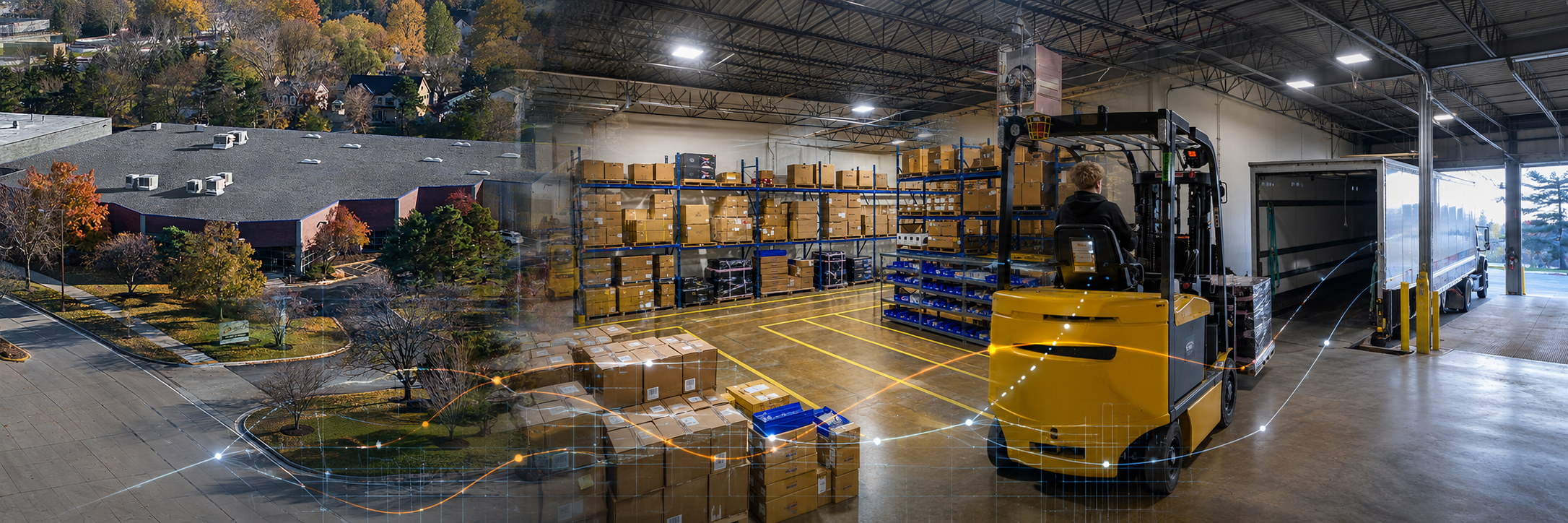
Dell systems Paragon Micro delivers to DoW programs are staged, validated, and deployed from its System Readiness Center, a 55,000 plus square foot secure integration facility. Paragon Micro describes it as operating in full compliance with NIST SP 800-171, with FIPS 140-2 validated physical and data security, controlled access zones, role based entry, visitor logging and escort, and segmented environments for sensitive programs.
Inside the facility
What happens to a Dell order between the factory and the base
Receive and verify
Hardware is logged on arrival, components are verified against the order, and Trade Agreements Act compliance is enforced on everything received. Servers that ship with SCV certificates can be validated against their factory build (chapter 4).
Record producedIntake log and custody record
Build and configure
Rack builds, cable management, physical customization, and edge, core, or hybrid configurations are done in house to exact government specifications, with mission specific labeling and documentation.
Record producedConfiguration documentation for the authorization package
Test and stage
Systems are tested under real operational conditions, including performance and interoperability, then staged as complete environments ready to install.
Record producedTest results and staging checklist
Pack and ship
Secure packaging with full chain of custody, every handoff controlled and auditable, and handling limited to vetted U.S. citizens.
Record producedAuditable custody records to delivery
The facility also works as a live demonstration and evaluation environment where customers can test performance and interoperability before they buy.
Paragon Micro announced its AS9120 certification for aerospace and defense distribution on June 30, 2026. AS9120 is the quality management standard for distributors in that sector, and it adds a third party audited process to the custody and verification steps above.
Why this matters for Dell specifically: Dell's transit controls run to delivery, where the customer verifies the bolt seal. The System Readiness Center takes custody at that point, so a program gets a continuous record from Dell's factory to the rack on base. Paragon Micro's article Protect the Mission Before It Ships covers the custody model in detail.
Chapter 13
Past performance on Dell programs
The 2 published case studies below show the partnership at work at opposite scales: a nationwide desktop refresh and a 2 site hyperconverged system.
Federal Bureau of Investigation
28,835 Dell desktops in 1 refresh
VehicleNASA SEWP V, delivery order 15F06723F0002329
Value$10,473,287.78, firm fixed price
PeriodSeptember 27, 2023 to February 1, 2024
Scope190 line items across 33 CLINs, shipped to multiple CONUS locations
Result100% of technical and schedule requirements, no deviations, no waivers
Paragon Micro was 1 of 3 companies invited to bid, proposed Dell systems based on its Platinum federal partner status, and its engineers helped the FBI build the bill of materials before award. The case study says Dell was selected in part for its supply chain security controls and federal compliance safeguards.
U.S. Air Force, 76th Software Engineering Group
1,600 user VDI on Dell VxRail at Tinker Air Force Base
VehicleGSA 2GIT BPA 47QTCA21A001Z, call FA813623F0073
Value$2,890,000, firm fixed price
PeriodMay 23, 2023 to July 31, 2023
DesignDell VxRail hyperconverged infrastructure with VMware vSAN, multi site active active management clusters, 800 users per site, encrypted data at rest
Result100% technical and schedule compliance, no deviations, delivered within the budget
The first competition stalled when pricing exceeded funding. Over 12 months, Paragon Micro completed more than 25 design revisions, tested processor tiers, memory, and storage density, and coordinated validation with Dell, Cisco, VMware, Nvidia, and Thales.
Both results are Paragon Micro's own account of its performance. What they show for the 3 initiatives is a supplier that can handle a 33 CLIN bulk buy on a fixed schedule and a design that had to be reworked 25 times to fit a budget. Most FORTRESS refreshes and AutoWarCom buys will look like 1 of those 2 jobs. See all past performance.
Chapter 14
Multi-vendor builds with Dell inside
The Warfighting Acquisition System requires at least 2 qualified sources for critical program content unless the requirement is waived, and it calls for modular open systems with competition at the module level. A single OEM architecture cannot meet that on its own. Paragon Micro's resilient multi OEM architectures practice is built around the problem: "Mission systems cannot depend on a single vendor, platform, or supply chain".
In those designs, Dell can fill specific places: PowerEdge and VxRail for compute, PowerSwitch for switching, Pro Rugged for endpoints, PowerProtect for recovery. Around them sit the products Dell does not make, such as secure radios, edge networking, and SATCOM, which Paragon Micro sources from the other OEMs it represents. Every architecture, Paragon Micro says, "is validated in controlled staging before deployment".
Principle
Second sources
Where a program's critical content is compute or storage, Paragon Micro can qualify an alternate to the Dell configuration and stage both, so the 2 source rule is met without redesign.
Principle
Open interfaces
The acquisition memo calls for machine readable interfaces so third parties can add modules without the original manufacturer. Document them at design time.
Principle
Lifecycle timing
Multi OEM designs account for end of life timelines and sourcing risk, so a refresh does not depend on 1 vendor's schedule.
The Tinker Air Force Base design in chapter 13 is the working example: Dell VxRail with VMware vSAN at the center, Cisco switching evaluated for the design, and solution validation coordinated with Cisco, VMware, Nvidia, and Thales before the order. Paragon Micro's article OEM Architecture for Wartime Readiness covers the design approach.
Chapter 15
FORTRESS America: installation IT that stays up
FORTRESS America's memo organizes the program around 5 pillars and puts its program office under the Under Secretary of War for Acquisition and Sustainment, with a Senior Executive Service member running day to day operations and a two star military advisor. Of the 5 pillars, 4 touch installation IT directly. The table below maps each to the Dell products and Paragon Micro services in the earlier chapters.
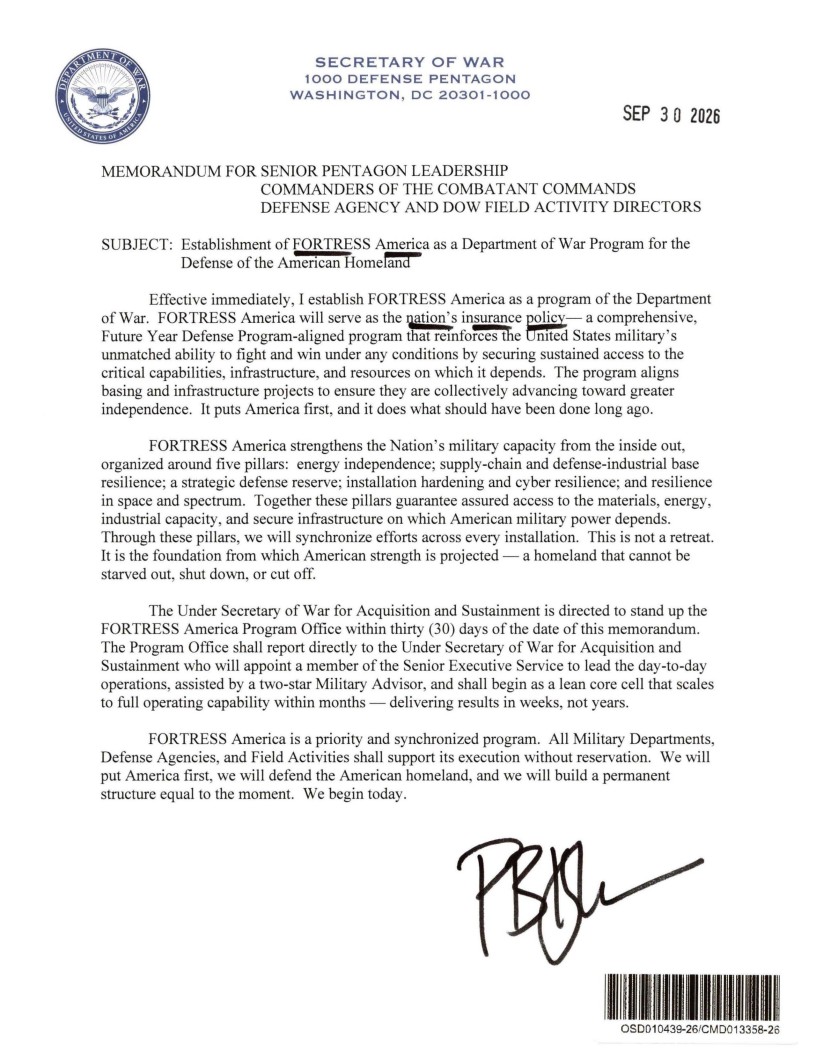
Primary source
The memo that created FORTRESS America
Dated September 30, 2026, and signed by Hegseth, the memo establishes FORTRESS America as a Department of War program and describes it as a comprehensive program, tied to the Future Years Defense Program, to secure the capabilities, infrastructure, and resources the military depends on. It goes to senior Pentagon leaders, combatant commanders, and defense agency and field activity directors.
- Program office
- The Under Secretary of War for Acquisition and Sustainment stands it up within 30 days, which puts the deadline at October 30, 2026.
- Leadership
- A Senior Executive Service member runs day to day operations, with a two star military advisor.
- Ramp
- The office starts as a lean core cell and grows to full operating capability within months.
- Support
- All military departments, defense agencies, and field activities must support its execution.
“A homeland that cannot be starved out, shut down, or cut off.”
Secretary of War Pete Hegseth, September 30, 2026
1
Energy independence
Installations generate their own power, independent of the civilian grid. Grid cut exercises at 33 installations found failed batteries, unserviced generators, and air conditioning left off backup circuits.
Dell and Paragon MicroPowerEdge XR servers with DC power options for sites fed by batteries or vehicles; Paragon Micro's tactical practice includes solar, generator, vehicle, and lithium ion battery power platforms for remote sites.
2
Supply chain and defense industrial base resilience
Production of critical materials returns to the United States, and buyers face Section 5949 on December 23, 2027.
Dell and Paragon MicroDell's direct supply chain, C-TPAT Tier 3, and Secured Component Verification; Paragon Micro's TAA enforcement, component verification, and AS9120 certified distribution.
3
Strategic defense reserve
The memo names a strategic defense reserve as a pillar, and news reports describe reserves of munitions, fuel, medicine, and blood. The same logic applies to configured spares for installation IT.
Dell and Paragon MicroParagon Micro plans spares and has secure storage areas where configured systems can be held.
4
Installation hardening and cyber resilience
Bases are protected against cyberattacks, sabotage, and drones. Volt Typhoon held access in some victim networks for at least 5 years and could reach camera systems.
Dell and Paragon MicroProject Fort Zero's validated zero trust design, PowerSwitch segmentation, and a PowerProtect vault with its own credentials; Paragon Micro's zero trust design and ATO support.
5
Resilience in space and spectrum
Satellite and communications resilience, so the base can still talk when terrestrial links fail.
Dell and Paragon MicroDell Federal 5G on XR8000 servers for an on base private network; SATCOM and secure radios from Paragon Micro's other OEMs.
The base as a control system network
UFC 4-010-06 treats utility control systems and electronic security systems as facility related control systems that fall under the Risk Management Framework. Drone sightings over installations rose to about 420 in the year ending September 2025, so counter drone sensors, video, and edge compute are part of that network too. Paragon Micro's video surveillance and physical security practice and its article Edge AI in the Battlefield for Counter-UAS Operations cover the sensor and edge side.
A FORTRESS build on Dell
- Base data center: PowerEdge or VxRail on backup circuits sized to measured load, with cooling and network closets on the same circuits.
- Control system network: PowerSwitch segmentation between utility controls, security systems, and business IT, with monitored crossing points.
- Recovery: PowerProtect Cyber Recovery vault holding offline copies of controller configurations, video management, and access control.
- Sensor sites: PowerEdge XR nodes near cameras and counter drone sensors, so tracking continues if the backbone link drops.
- Private wireless: Dell Federal 5G for cameras, sensors, and vehicles across the installation.
- Field endpoints: Pro Rugged laptops for security forces and utility crews.
- Receipt and custody: the SCV check at intake where the server ships with a certificate, and custody records from the System Readiness Center to the base.
The program office is due by October 30, 2026. Installations that have assigned their critical IT loads to backup circuits, separated their control networks, and documented their supply chain will be ready when its first requirements arrive. See the FORTRESS America guide for the full specification lists.
Chapter 16
Project Meridian: develop, test, and field
Project Meridian's memo names 5 technologies it says are changing warfare: artificial intelligence, autonomy, directed energy, robotics, and biotechnology. It asks the study to propose actionable solutions "to start developing, testing and fielding these capabilities," with findings due January 28, 2027. The release says the study covers "the full spectrum of future warfighting domains, from subterranean depths to the cislunar frontier".
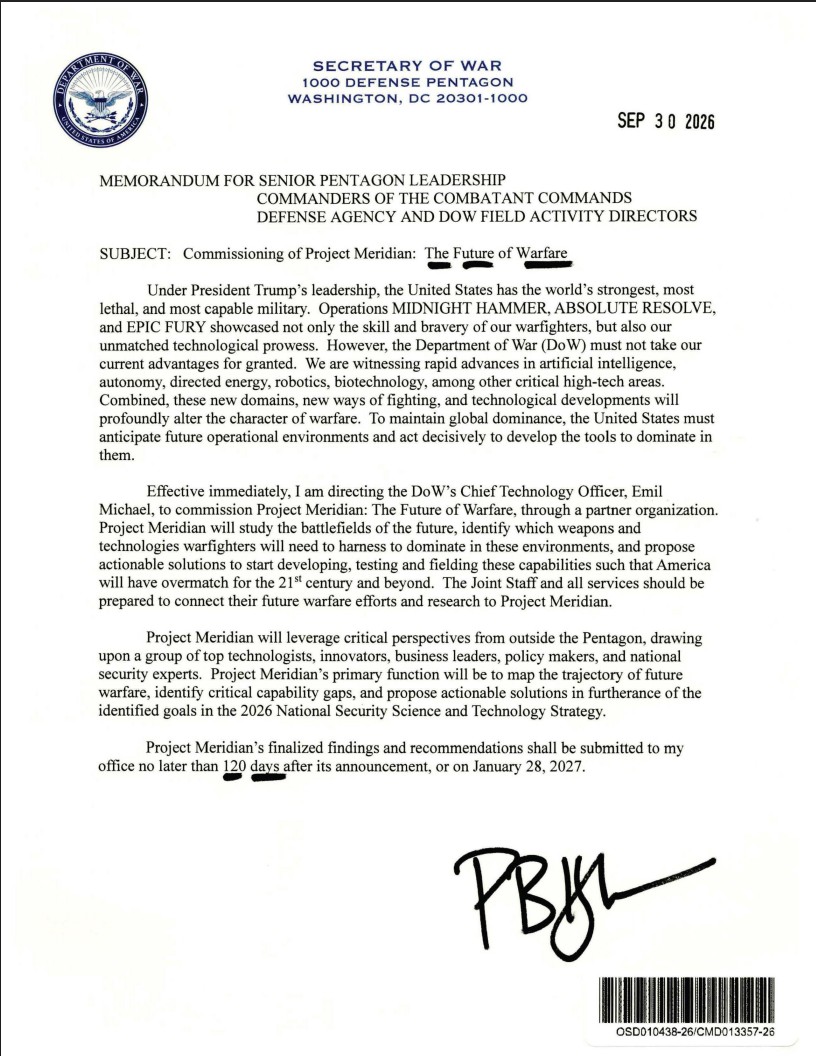
Primary source
The memo that commissioned Project Meridian
Dated September 30, 2026, and signed by Hegseth, the memo directs the department's chief technology officer, Emil Michael, to commission Project Meridian: The Future of Warfare through a partner organization.
- Charge
- Study the battlefields of the future, identify the weapons and technologies warfighters will need, and propose actionable solutions to start developing, testing, and fielding them.
- Input
- Perspectives from outside the Pentagon: top technologists, innovators, business leaders, policy makers, and national security experts.
- Services
- The Joint Staff and all services should be prepared to connect their future warfare efforts and research to the study.
- Deadline
- Findings and recommendations go to the Secretary's office within 120 days, on January 28, 2027.
“Project Meridian will study the battlefields of the future.”
Secretary of War Pete Hegseth, September 30, 2026
Paragon Micro is not part of the study, and neither company has a role in what it recommends. The reason to plan now is that any develop, test, and field work the department starts afterward would run under the Warfighting Acquisition System, which prefers commercial products, and 4 of the 5 technology areas run on compute.
After the findings
Where Dell hardware fits each stage
Develop
AI models are trained and tested in simulation on GPU dense servers in accredited facilities. The AI strategy commits "substantial resources" to department data centers. Dell's PowerEdge R760xa covers this tier today, and in October 2026 Dell announced the R8822, the XE9810, and the Modular Data Center with NVIDIA DSX POD for sites with prepared power. For AI work at a desk, Dell's federal page lists the Pro Precision with GB300 for secure federal workloads.
Paragon MicroSizes the cluster to the workload and maps the configuration to the authorization package.
Test
Prototypes move to ranges and test sites where power, dust, and temperature are the limits. PowerEdge XR servers with NativeEdge for remote onboarding, and Pro Rugged endpoints for the test team.
Paragon MicroBuilds and tests the configuration in the System Readiness Center, then packages it in transit cases with power.
Field
Production at scale under the 2 source rule and modular open systems, with every unit tracked. The Secured Component Verification check at receipt and custody records to the unit.
Paragon MicroQualifies a second source for critical content and stages both.
The department's own research priorities already point the same way. In November 2025, Research and Engineering cut its critical technology areas to 6: applied AI, biomanufacturing, contested logistics technology, quantum battlefield information dominance, scaled directed energy, and scaled hypersonics. AI appears on the memo's list, the White House strategy's list, and R&E's list, and so does directed energy. Whatever Meridian recommends in January, the compute to train and run models will be in demand first.
See What Project Meridian Means for DoW Programs for the study's timeline and checklists, and the Advanced Projects page for how Paragon Micro supports sensitive programs.
Chapter 17
Autonomous Warfare Command: compute, comms, and data
The Autonomous Warfare Command is targeted for October 1, 2027, and Project Agincourt prepares the ground until Congress acts. Drones are bought to be expended. The servers, radios, endpoints, and data systems around them have to last the deployment. Paragon Micro's AutoWarCom guide breaks that into 3 layers. Here is where Dell fits in each.
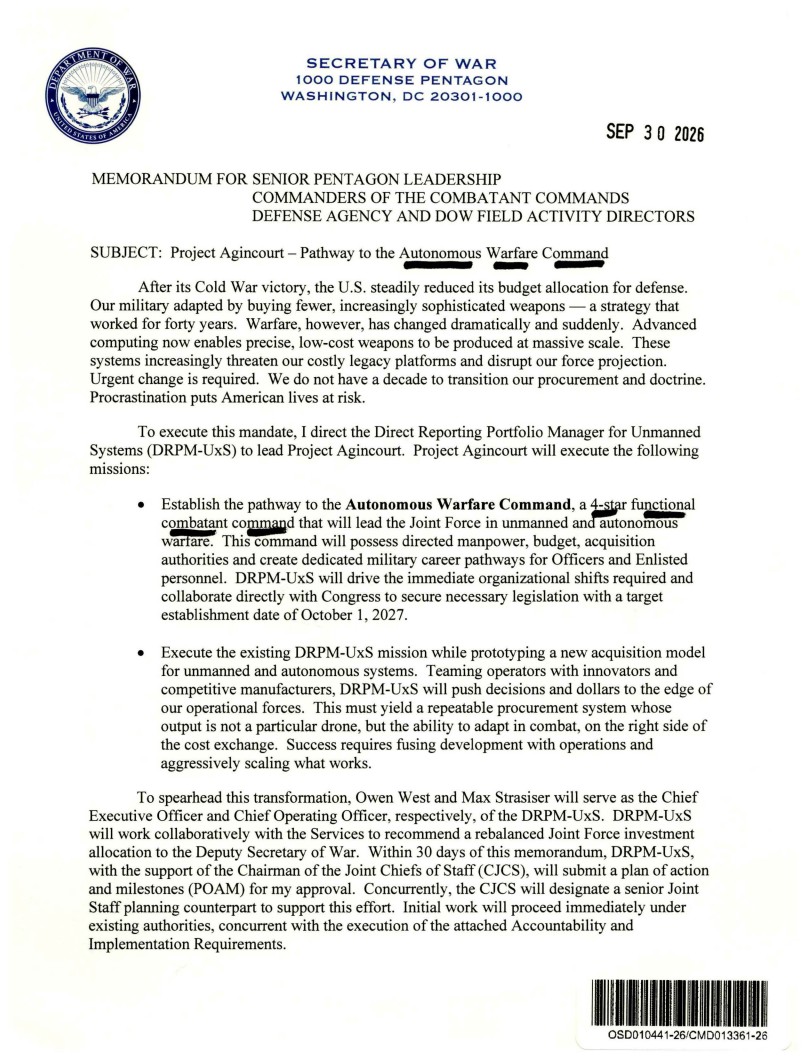
Primary source
The memo that set the path to the Autonomous Warfare Command
Dated September 30, 2026, and signed by Hegseth, the memo directs the Direct Reporting Portfolio Manager for Unmanned Systems, DRPM-UxS, to lead Project Agincourt. It goes to senior Pentagon leaders, combatant commanders, and defense agency and field activity directors.
- The command
- A four star functional combatant command to lead the Joint Force in unmanned and autonomous warfare, with its own manpower, budget, acquisition authorities, and career paths for officers and enlisted personnel.
- Target date
- DRPM-UxS works directly with Congress to secure the legislation, with a target establishment date of October 1, 2027.
- Acquisition
- DRPM-UxS keeps its existing mission while prototyping an acquisition model that pushes "decisions and dollars to the edge of our operational forces."
- Plan
- Within 30 days, DRPM-UxS and the Chairman of the Joint Chiefs of Staff submit a plan of action and milestones for the Secretary's approval, which puts that deadline at October 30, 2026.
“We do not have a decade to transition our procurement and doctrine.”
Secretary of War Pete Hegseth, September 30, 2026
Layer 1
Compute
Training cluster: PowerEdge R760xa and the newer Vera CPU and rack scale systems in the Dell AI Factory.
Forward edge node: PowerEdge XR8000 or XR7620, with Secure Erase and System Lockdown tested before deployment.
Operator endpoint: Pro Rugged 13 Extreme in the vehicle, Pro Rugged 14 at the command post, both with hot swappable batteries and optional 5G.
Layer 2
Comms
Private wireless: Dell Federal 5G on XR8000 servers, O-RAN compliant, with Dell and partner radios.
Mesh, SATCOM, and fixed links: radios and terminals from other OEMs that Paragon Micro supplies with the Dell network.
Rule: FIPS 140-3 validated modules for new purchases.
Layer 3
Data
Collect and triage at the edge: XR nodes with storage sized for the longest disconnected period, managed under NativeEdge so application updates can be pushed from a central console.
Retrain at the enterprise: AI Factory clusters, with the AI strategy's data catalog and 30 day model access rules.
Protect: PowerProtect Cyber Recovery for the enterprise copy.
The money is moving on its own track. The FY2027 request for the Defense Autonomous Warfare Group is $54.6 billion, most of it through reconciliation, so expect orders in phases as funding clears. The Gauntlet II round at Fort Carson planned orders for 60,000 drones. Each of those drones needs a ground control station, an edge node, and a link.
The tactical edge AI case
Paragon Micro's tactical edge AI package puts PowerEdge XR7620 and XR4000 servers, NVIDIA Spectrum-X networking, and power into ruggedized transit cases so a unit can run language and vision models locally, for tasks such as real time comms translation and target identification, without waiting for a round trip to the continental United States. It is the same hardware an autonomous unit could use to fuse feeds from many drones and plan the next sortie.
See Ready for the Autonomous Warfare Command for the questions to ask any radio, terminal, or autonomy vendor.
Chapter 18
Compliance across all 3: who provides what
Each rule from chapter 2 lands on a Dell product feature, a Paragon Micro process, or both. This table is the division of labor for a program's compliance file.
Trade Agreements Act
Country of origin
Dell: direct selling model with visibility into how systems are configured and delivered.
Paragon Micro: enforces TAA compliance on all hardware received, staged, configured, and shipped.
Section 889
FAR 52.204-25
Dell: Paragon Micro says its Dell program is built around Section 889 and TAA.
Paragon Micro: confirms cameras, switches, and modules inside radios and terminals are free of the covered equipment the clause lists.
Section 5949
Chips from SMIC, YMTC, CXMT
Dell: ask for certification on each product before December 23, 2027.
Paragon Micro: component verification at intake, with written answers for the contract file on request.
Supply chain integrity
As built equals as received
Dell: Secured Component Verification certificate signed at the factory and stored in iDRAC.
Paragon Micro: can run the validation at receipt; custody records follow from there.
Encryption
FIPS 140-3 and CNSA 2.0
Dell: TPM 2.0 FIPS on PowerEdge and XR, self encrypting drive options, and quantum resistant protections on the new Pro Rugged line, by Dell's description.
Paragon Micro: specifies FIPS 140-3 validated modules and confirms CNSA 2.0 status for National Security System buys after January 1, 2027, the date in NSA's FAQ.
Zero trust
Target level by September 30, 2027
Dell: Project Fort Zero validated at the department's Target Level.
Paragon Micro: zero trust design, microsegmentation, and ATO documentation.
CUI
CMMC Phase 2
Dell: not the contractor of record on your order.
Paragon Micro: confirm its current CMMC self assessment status, since Phase 2 third party certification is suspended, and ask how CUI such as configurations and test results is handled in the System Readiness Center.
Control systems
UFC 4-010-06
Dell: PowerSwitch segmentation and PowerProtect recovery for the control system network.
Paragon Micro: designs to the control system criteria and plans offline configuration copies into the recovery plan.
The CNSA 2.0 line deserves its own note. NSA's FAQ, revised in October 2026, says that by January 1, 2027, CNSA 2.0 algorithms "will be required in all new acquisitions for NSS," that by December 31, 2030, equipment and services that cannot support CNSA 2.0 "must be phased out unless otherwise granted an exception," that by December 31, 2031, CNSA 2.0 algorithms are mandated for use in National Security Systems, and that moving fielded equipment "may require a hardware refresh". Product by product CNSA 2.0 status is outside this guide, and it changes as vendors ship updates. The buying rule is simple: for any National Security System order placed after January 1, 2027, get the CNSA 2.0 status of each cryptographic component in writing.
Chapter 19
How to buy Dell through Paragon Micro
Dell lists ITES-4H, NASA SEWP V, NASA SEWP VI, and CIO-CS as its federal vehicles. Paragon Micro holds all 4, although its CIO-CS page shows that contract extended only through October 29, 2026, and it adds MDA SHIELD and GSA. NASA SEWP VI is new: Paragon Micro's contract, 80TECH26D2050 in Category A, runs from November 2026 to November 2036, while SEWP V's ordering period was extended through September 30, 2026 with 2 option periods, the first running to January 31, 2027 and the second to April 30, 2027.
Army
ITES-4H
Who can orderArmy and other federal agencies
PeriodOrdering through 2035
ScopeServers, data center infrastructure, storage, end user devices, networking, and lifecycle services
Missile Defense Agency
MDA SHIELD IDIQ
ContractHQ0859-26-D-E455
PeriodDecember 28, 2025 to December 28, 2035
ScopeIT infrastructure, hardware, system integration, and lifecycle support under a $151 billion shared ceiling
Governmentwide
NASA SEWP VI
Contract80TECH26D2050, Category A
PeriodNovember 2026 to November 2036
ScopeIT, communications, and audio visual products and services, with a 0.34% surcharge
Governmentwide
NASA SEWP V
ContractNNG15SD91B
PeriodExtended by NASA through September 30, 2026, with option periods to January 31, 2027 and April 30, 2027
ScopeCommercial IT products and product based services
Governmentwide
GSA MAS products
Who can orderFederal agencies
PathParticipating dealer and team arrangements with EC America (GS-35F-0511T) and Synnex Corporation (GS-35F-0563U)
Confirm CIO-CS status with the team before you plan an order there. For a Dell order, the shortest path is to send the configuration, quantities, and delivery sites through the Dell Federal page's strategy session form, and Paragon Micro will recommend the vehicle. See all contract vehicles.
Dell products in this guide and where to buy them
The servers and rugged laptops in this guide are configured to order: send the requirement through the Dell Federal strategy session form and Paragon Micro returns a configuration, a vehicle, and a delivery plan. Stock Dell items, including PowerSwitch models, are listed in Paragon Micro's commercial store at paragonmicro.com. Store pages show manufacturer list prices, and contract pricing comes from an account executive, so no prices are repeated here.
Chapter 6 | Configure to order
2U dual socket GPU server with up to 4 double width cards and 8 TB of memory, the data center and training tier in chapters 6 and 16.
Request a configuration R760xa from every angle Dell spec sheet
Chapter 7 | Configure to order
Modular short depth chassis with 1U and 2U sleds, up to 4 nodes, with AC, HVDC, and minus 48 V DC power options.
Chapter 7 | Configure to order
Short depth 1U server, 400 mm to the rear wall, with 1 processor and up to 2 single width GPUs for sensor sites and comms closets.
Chapter 7 | Configure to order
Short depth 2U server with 2 processors and up to 2 double width GPUs, the tactical edge AI node in chapter 17.
Chapter 7 | Configure to order
Rackable or stackable multi node chassis with front accessible sleds, including the XR4520c GPU sled.
Chapter 8 | Configure to order
Fully rugged 13.3 inch notebook with an IP66 rating, 6 foot drop testing, and a 1,400 nit display, announced October 1, 2026. The store lists the catalog generation, the Pro Rugged 13 (RA13250).
Request a configuration Pro Rugged 13 (RA13250) in the store Dell announcement
Chapter 8 | Configure to order
Semi rugged 14 inch notebook with an IP53 rating, 3 foot drop protection, and an RTX PRO 500 GPU, announced October 1, 2026. The store lists the catalog generation, the Pro Rugged 14 (RB14250).
Request a configuration Pro Rugged 14 (RB14250) in the store Dell announcement
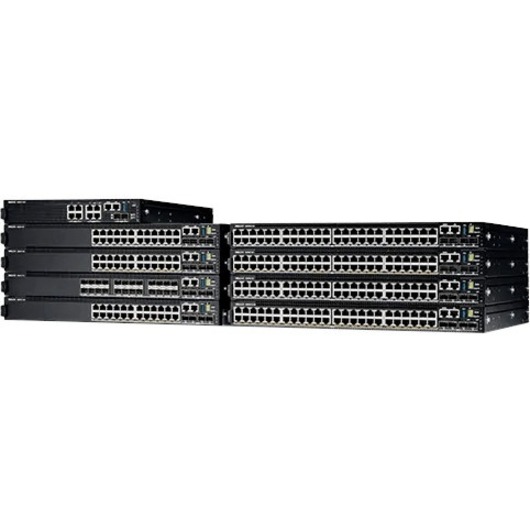
Chapter 9 | In the store
Campus and data center switching: the N3248P-ON is a 48 port 1 GbE access switch with 10 GbE uplinks, and the S5224F-ON is a 24 port 25 GbE top of rack switch with 100 GbE uplinks.
N3248P-ON in the store S5224F-ON in the store All Dell switches
Quoted as solutions
- Dell Pro Precision with GB10 and GB300 are built to order. Stock Dell workstations are under Dell workstations in the store.
- VxRail, PowerProtect Cyber Recovery, NativeEdge, Dell Federal 5G, and the Modular Data Center are sized with the System Readiness Center team and quoted as solutions. Request a strategy session or contact Paragon Micro.
- The store's Dell servers category lists stock PowerEdge models such as the R660xs and R7725 for orders that do not need a configured system.
Chapter 20
What to do now
Most of the preparation for all 3 initiatives can be done before the first requirement is written. The checklists below are drawn from the chapters above.
Checklist
For DoW program and installation offices
- Map critical IT loads, cooling, and network closets to backup circuits, and specify input power for every edge node.
- Write requirements around the mission, environment, and interfaces, then let qualified OEMs compete.
- Specify FIPS 140-3 for every new cryptographic module and CNSA 2.0 status for National Security System orders after January 1, 2027.
- Require Secured Component Verification or equivalent at receipt, and custody records from the supplier.
- Get FAR 52.204-25, Trade Agreements Act, and Section 5949 answers in writing.
- Plan the zero trust architecture the hardware has to fit by September 30, 2027.
Checklist
For Federal System Integrators
- Bring a Dell Platinum partner into the design early, so the bill of materials is validated before award.
- Qualify a second source for critical content and stage both configurations.
- Have hardware built, imaged, and tested before it reaches your integration lab, with configuration records your authorization package can use.
- Confirm the supplier's CMMC self assessment status, and watch for the department's decision on Phase 2, which has been suspended since July 13, 2026.
- Pick a vehicle whose ordering period covers the program: SEWP V's first option period ends January 31, 2027 with a possible second to April 30, 2027, and SEWP VI runs to November 2036.
Checklist
For advanced projects teams
- Ask where systems are built and stored, who has access, and whether the area is segmented from other customers' work.
- Require custody records for every handoff and secure packaging for transport.
- Test Secure Erase and System Lockdown on edge nodes before they deploy.
- Plan for sensitive sites to run on local power, local recording, and local access control if links are cut.
The hardware decisions made in the next 12 months set what FORTRESS installations, Meridian follow on programs, and the Autonomous Warfare Command inherit. Dell builds the products, publishes the specifications, and controls its supply chain to the pallet. Paragon Micro takes custody from there. Request a Dell strategy session to start with a configuration, or talk to the Department of War solutions team about the program.
FAQ
Frequently asked questions
Is Paragon Micro an authorized Dell partner for federal agencies?
Paragon Micro describes itself as a Dell Technologies Federal Platinum Partner and value added reseller with more than 15 years of Dell partnership, and says Dell named it the 2025 Federal Server Sales Partner of the Year. Platinum is the third of 4 tiers in Dell's partner program overview.
What does Dell Technologies Federal provide?
Dell describes its federal business as helping agencies modernize legacy environments, protect data, and deploy AI on infrastructure built for federal compliance standards, with a supply chain built for government accountability. It lists ITES-4H, NASA SEWP V, NASA SEWP VI, and CIO-CS as its contract vehicles.
Which Dell servers work at the tactical edge?
The PowerEdge XR series: the modular XR8000, the 1U XR5610, the 2U XR7620, and the multi node XR4000. Dell says the line is MIL-STD tested and NEBS Level 3 certified, with select XR8000 configurations rated from minus 20 to 65 degrees Celsius and DC power options across the line.
Has the Department of War validated Dell's zero trust solution?
Dell announced on April 2, 2025 that Project Fort Zero completed the department's Target Level validation as an on premises private cloud. Availability was to be announced, and we found no later availability notice as of October 21, 2026.
How does Paragon Micro secure Dell hardware between the factory and the base?
Systems go through the System Readiness Center, where they are logged, verified, configured, tested, and packed under chain of custody by vetted U.S. citizens, with Trade Agreements Act compliance enforced. Servers that ship with Dell Secured Component Verification certificates can be validated against their factory build.
Can DoW buyers order Dell through Paragon Micro for programs tied to FORTRESS America, Project Meridian, or the Autonomous Warfare Command?
Yes, through Army ITES-4H, MDA SHIELD, NASA SEWP V during its option periods, NASA SEWP VI from November 2026, and GSA dealer arrangements. Paragon Micro is not part of the Project Meridian study, and nothing is bought for the study itself; programs that follow its findings would buy through vehicles like these.
Does Paragon Micro sell other OEMs alongside Dell?
Yes. Dell is 1 of many OEMs it represents, and its multi OEM architectures combine Dell compute, storage, and networking with radios, SATCOM, encryptors, power, and cameras from other manufacturers, which can satisfy the 2 source rule in the Warfighting Acquisition System.
Are Dell's new rugged laptops CNSA 2.0 compliant?
Dell says the Pro Rugged 13 Extreme and Pro Rugged 14 are further hardened with what it calls quantum resistant protections. That is Dell's description, and CNSA 2.0 compliance for a National Security System depends on the specific algorithms and validations, so ask for them in writing before the January 1, 2027 date.
Timeline
Key dates
Oct 30, 2026
FORTRESS America program office due
Nov 10, 2026
Original CMMC Phase 2 start date, suspended since July 13, 2026
Nov 2026
Paragon Micro's NASA SEWP VI period begins
Jan 1, 2027
CNSA 2.0 required for new National Security System acquisitions
Jan 28, 2027
Project Meridian findings due
Jan 31, 2027
NASA SEWP V first option period ends; a second runs to April 30, 2027
Sep 30, 2027
Zero trust target level deadline
Oct 1, 2027
Autonomous Warfare Command target date
Dec 23, 2027
Section 5949 chip prohibition takes effect
Dec 31, 2030
Equipment that cannot support CNSA 2.0 must be phased out
Dec 31, 2031
CNSA 2.0 algorithms mandated for use in National Security Systems
Each date lands on a piece of hardware somewhere: a cryptographic module, a chip, a configuration record, an edge node. Programs that know which Dell product answers each, and who holds custody of it, will have fewer orders to rework in 2027.
Work with Paragon Micro
Planning a Dell build for a DoW program?
Send us the mission, the environment, and the quantities. Paragon Micro's Dell Federal team will size the configuration, validate the bill of materials, build and test it in the System Readiness Center, and deliver it through ITES-4H, MDA SHIELD, NASA SEWP V and VI, or GSA.
Request a Dell strategy session
Dell Technologies Federal mission infrastructure System Readiness Center All contract vehicles Contact Paragon Micro
Related reading
Sources
References
View allHide 58 sources
Barna, S. (2025, December 3). From DAS to WAS: Secretary Hegseth's acquisition overhaul and what it means for industry. Covington & Burling LLP. https://www.covingtonblogs.com/2025/12/03/from-das-to-was-secretary-hegseths-acquisition-overhaul-and-what-it-means-for-industry/
Chiodelli, P. (2025, May 20). Unlocking the edge: The latest innovations from Dell NativeEdge. Dell Technologies. https://www.dell.com/en-us/blog/unlocking-the-edge-the-latest-innovations-from-dell-nativeedge
Dell Technologies. (n.d.-a). Dell Technologies Federal. Retrieved October 21, 2026, from https://www.dell.com/en-us/dt/industry/federal/federal-government-it.htm
Dell Technologies. (n.d.-b). PowerProtect Cyber Recovery solutions. Retrieved October 21, 2026, from https://www.dell.com/en-us/shop/powerprotect-cyber-recovery/sf/powerprotect-cyber-recovery
Dell Technologies. (2021, October 13). Partner program guide for solution providers. https://www.delltechnologies.com/content/dam/digitalassets/active/en/unauth/quick-reference-guides/partner/Partner_Program_Overview.pdf
Dell Technologies. (2024, July). PowerEdge R760xa specification sheet [Data sheet]. https://www.delltechnologies.com/asset/en-us/products/servers/technical-support/poweredge-r760xa-spec-sheet.pdf
Dell Technologies. (2025a). Dell supply chain resilience [White paper]. https://www.delltechnologies.com/asset/en-us/solutions/business-solutions/industry-market/dell-supply-chain-security-white-paper.pdf
Dell Technologies. (2025b, April 2). Dell Technologies achieves US Department of Defense validation for zero trust solution [Press release]. https://www.dell.com/en-us/dt/corporate/newsroom/announcements/detailpage.press-releases~usa~2025~04~dell-technologies-achieves-us-department-of-defense-validation-for-zero-trust-solution.htm
Dell Technologies. (2026a). Dell SafeSupply Chain [Data sheet]. https://www.delltechnologies.com/asset/en-us/solutions/business-solutions/technical-support/dell-safesupply-chain-datasheet.pdf
Dell Technologies. (2026b, January). PowerEdge XR-Series specification sheet (Rev. A01) [Data sheet]. https://www.delltechnologies.com/asset/en-us/products/servers/technical-support/poweredge-xr-rugged-spec-sheet.pdf
Dell Technologies. (2026c, September 30). Dell Technologies joins the Alliance for Critical Infrastructure [Press release]. https://www.dell.com/en-us/dt/corporate/newsroom/announcements/detailpage.press-releases~usa~2026~09~dell-technologies-joins-the-alliance-for-critical-infrastructure.htm
Dell Technologies. (2026d, October 1). Dell Technologies introduces new rugged laptops built for the most demanding field environments [Press release]. https://www.dell.com/en-us/dt/corporate/newsroom/announcements/detailpage.press-releases~usa~2026~10~dell-technologies-introduces-new-rugged-laptops-built-for-the-most-demanding-field-environments.htm
Dell Technologies. (2026e, October 16). Dell Technologies advances enterprise agentic AI from the deskside to data center with NVIDIA [Press release]. https://www.dell.com/en-us/dt/corporate/newsroom/announcements/detailpage.press-releases~usa~2026~10~dell-technologies-and-nvidia-advance-enterprise-agentic-ai-from-the-deskside-to-data-center.htm
Easley, M. (2024, April 4). With 2027 deadline looming, DOD moves into implementation phase of zero trust transformation. DefenseScoop. https://defensescoop.com/2024/04/04/dod-zero-trust-implementations-phase-2027/
Eric G. (2026, September 25). Drone Dominance Program announces Gauntlet II results. Soldier Systems Daily. https://soldiersystems.net/2026/09/25/drone-dominance-program-announces-gauntlet-ii-results/
Fabry-Asztalos, T. (2025, October 8). Introducing Dell Federal 5G: Secure wireless for critical missions. Dell Technologies. https://www.dell.com/en-us/blog/introducing-dell-federal-5g-secure-wireless-for-critical-missions
Foy, K. (2025, September 22). Power-outage exercises strengthen the resilience of US bases. MIT News. https://news.mit.edu/2025/power-outage-exercises-strengthen-resilience-us-bases-0922
Greig, J. (2024, February 7). CISA, FBI warn of China-linked hackers pre-positioning for 'destructive cyberattacks against US critical infrastructure.' The Record. https://therecord.media/cisa-fbi-warn-of-china-linked-hackers-targeting-critical-us-infrastructure
Hastings, A. B., Funaro, D., Whitman, S., Klein, M., & Tanchyk, A. (2026, July 16). Department of War suspends CMMC Phase II requirements but cybersecurity obligations remain [Client alert]. Morgan Lewis. https://www.morganlewis.com/pubs/2026/07/department-of-war-suspends-cmmc-phase-ii-requirements-but-cybersecurity-obligations-remain
Hegseth, P. (2026a, September 30). Commissioning of Project Meridian: The future of warfare [Memorandum]. U.S. Department of War. https://media.defense.gov/2026/Sep/30/2004009287/-1/-1/1/COMMISSIONING-OF-PROJECT-MERIDIAN.PDF
Hegseth, P. (2026b, September 30). Establishment of FORTRESS America as a Department of War program for the defense of the American homeland [Memorandum]. U.S. Department of War. https://media.defense.gov/2026/Sep/30/2004009303/-1/-1/1/ESTABLISHMENT-OF-FORTRESS-AMERICA-AS-A-DEPARTMENT-OF-WAR-PROGRAM-FOR-THE-DEFENSE-OF-THE-AMERICAN-HOMELAND.PDF
Hegseth, P. (2026c, September 30). Project Agincourt: Pathway to the Autonomous Warfare Command [Memorandum]. U.S. Department of War. https://media.defense.gov/2026/Sep/30/2004009304/-1/-1/1/PROJECT-AGINCOURT-PATHWAY-TO-THE-AUTONOMOUS-WARFARE-COMMAND.PDF
Kesteloo, H. (2026, October 1). Hegseth orders four-star drone command, Congress has to build it. DroneXL. https://dronexl.co/2026/10/01/hegseth-autonomous-warfare-command-project-agincourt/
Lee, N., Barna, S., Huffman, R., Burnette, R., Chapman, K., & Cho, E. (2026, February 3). Pentagon releases artificial intelligence strategy. Inside Government Contracts. https://www.insidegovernmentcontracts.com/2026/02/pentagon-releases-artificial-intelligence-strategy/
Lopez, C. T. (2025, November 20). War Department narrows technology development focus to half dozen areas. Joint Base San Antonio. https://www.jbsa.mil/News/News/Article/4338401/war-department-narrows-technology-development-focus-to-half-dozen-areas/
Marrow, M. (2025, October). With daily drone incursions over bases, NORTHCOM takes aim through Falcon Peak. Breaking Defense. https://breakingdefense.com/2025/10/drone-incursions-us-military-falcon-peak-2025-cuas/
National Aeronautics and Space Administration. (n.d.). Contract, clauses & SOW [SEWP contract information]. Retrieved October 21, 2026, from https://www.sewp.nasa.gov/contract_info.shtml
National Institute of Standards and Technology. (n.d.). Cryptographic Module Validation Program. Retrieved October 21, 2026, from https://csrc.nist.gov/projects/cryptographic-module-validation-program
National Security Agency. (2026, October). Commercial National Security Algorithm Suite 2.0 and quantum computing frequently asked questions (Ver. 2.2) [Cybersecurity information sheet]. https://media.defense.gov/2022/Sep/07/2003071836/-1/-1/1/CSI_CNSA_2.0_FAQ_.PDF
Office of Science and Technology Policy. (2026, August). National security science and technology strategy. The White House. https://www.whitehouse.gov/wp-content/uploads/2026/08/NSSTS-082026.pdf
Oliverio, N. (2026, September 30). Hegseth announces new four-star command for autonomous warfare. Military Times. https://www.militarytimes.com/news/your-military/2026/09/30/hegseth-announces-new-four-star-command-for-autonomous-warfare/
Paragon Micro. (n.d.-a). Dell Federal. Retrieved October 21, 2026, from https://www.paragonmicro.us/partners/dell-federal/
Paragon Micro. (n.d.-b). Dell networking. Retrieved October 21, 2026, from https://www.paragonmicro.us/solutions/tactical-and-rugged-equipment/dell-networking/
Paragon Micro. (n.d.-c). Dell Technologies Federal mission infrastructure. Retrieved October 21, 2026, from https://www.paragonmicro.us/about-us/dell-technologies-federal/
Paragon Micro. (n.d.-d). Department of War. Retrieved October 21, 2026, from https://www.paragonmicro.us/who-we-serve/department-of-war/
Paragon Micro. (n.d.-e). FBI SEWP GSS enterprise tech refresh. Retrieved October 21, 2026, from https://www.paragonmicro.us/past-performance/fbi-sewp-gss-enterprise-tech-refresh/
Paragon Micro. (n.d.-f). GSA. Retrieved October 21, 2026, from https://www.paragonmicro.us/contracts/gsa/
Paragon Micro. (n.d.-g). ITES-4H. Retrieved October 21, 2026, from https://www.paragonmicro.us/contracts/ites-4h/
Paragon Micro. (n.d.-h). MDA SHIELD IDIQ. Retrieved October 21, 2026, from https://www.paragonmicro.us/contracts/mda-shield-idiq/
Paragon Micro. (n.d.-i). NASA SEWP V. Retrieved October 21, 2026, from https://www.paragonmicro.us/contracts/nasa-sewpv/
Paragon Micro. (n.d.-j). NASA SEWP VI. Retrieved October 21, 2026, from https://www.paragonmicro.us/contracts/nasa-sewp-vi/
Paragon Micro. (n.d.-k). Resilient multi-OEM architectures for government. Retrieved October 21, 2026, from https://www.paragonmicro.us/solutions/resilient-multi-oem-architectures/
Paragon Micro. (n.d.-l). Secure integration & staging facility. Retrieved October 21, 2026, from https://www.paragonmicro.us/about-us/facility/
Paragon Micro. (n.d.-m). Tactical & rugged equipment. Retrieved October 21, 2026, from https://www.paragonmicro.us/solutions/tactical-and-rugged-equipment/
Paragon Micro. (n.d.-n). USAF VDI modernization at Tinker AFB: 1,600 user hyperconverged deployment. Retrieved October 21, 2026, from https://www.paragonmicro.us/past-performance/usaf-vdi-modernization-at-tinker-afb-1600-user-hyperconverged-deployment/
Paragon Micro. (n.d.-o). Zero trust & cyber resilience for government. Retrieved October 21, 2026, from https://www.paragonmicro.us/solutions/zero-trust-and-cyber-resilience/
Paragon Micro. (2026a, February 24). Edge AI in the battlefield for counter-UAS operations. https://www.paragonmicro.us/edge-ai-in-the-battlefield-for-counter-uas-operations/
Paragon Micro. (2026b, June 30). Paragon Micro achieves AS9120 certification for aerospace and defense distribution. https://www.paragonmicro.us/paragon-micro-achieves-as9120-certification-for-aerospace-defense-distribution/
Paragon Micro. (2026c, October 2). FORTRESS America: What independent bases need from their IT and security systems. https://www.paragonmicro.us/fortress-america-installation-it-security/
Paragon Micro. (2026d, October 2). Ready for the Autonomous Warfare Command: Compute, comms, and data for unmanned operations. https://www.paragonmicro.us/autonomous-warfare-command-compute-comms-data/
Paragon Micro. (2026e, October 2). What Project Meridian means for DoW programs and the companies that supply them. https://www.paragonmicro.us/project-meridian-explained/
Phelps, C., Kinahan, K., Khatri, M., & Young, J. (2023, January 13). Dell Technologies supply chain security: Secured Component Verification for PowerEdge. Dell Technologies Info Hub. https://infohub.delltechnologies.com/en-us/p/dell-technologies-supply-chain-security-secured-component-verification-for-poweredge/
Prohibition on Contracting for Certain Telecommunications and Video Surveillance Services or Equipment, 48 C.F.R. § 52.204-25 (2021). https://www.acquisition.gov/far/52.204-25
Trevithick, J. (2026, September 30). Vision for new Autonomous Warfare Command laid out by Pentagon. The War Zone. https://www.twz.com/news-features/vision-for-new-autonomous-warfare-command-laid-out-by-pentagon
‘Truly concerns me’: DAWG director warns funding lapse could kill ‘momentum.’ (2026, September). Breaking Defense. https://breakingdefense.com/2026/09/truly-concerns-me-dawg-director-warns-funding-lapse-could-kill-momentum/
U.S. Department of Defense. (2023). Cybersecurity of facility-related control systems (UFC 4-010-06). https://www.wbdg.org/FFC/DOD/UFC/ufc_4_010_06_2023.pdf
U.S. Department of War. (2026, September 30). Secretary Hegseth announces six major initiatives at Quantico speech [Press release]. https://www.war.gov/News/Releases/Release/Article/4615424/secretary-hegseth-announces-six-major-initiatives-at-quantico-speech/
Wagner, M., Cassidy, S. B., Burnette, R., & Cho, E. (2026, February 26). FAR Council issues notice of proposed rulemaking to implement prohibition on acquisition of certain semiconductors. Inside Government Contracts. https://www.insidegovernmentcontracts.com/2026/02/far-council-issues-notice-of-proposed-rulemaking-to-implement-prohibition-on-acquisition-of-certain-semiconductors/