

Department of War | Installation resilience
Every major installation is set to make its own power. The IT inside has to be ready for it.
FORTRESS America covers power generated on base, protection against cyberattacks, sabotage, and drones, and domestic supply chains. Here is what it asks of the servers, networks, cameras, and sensors that run a base.
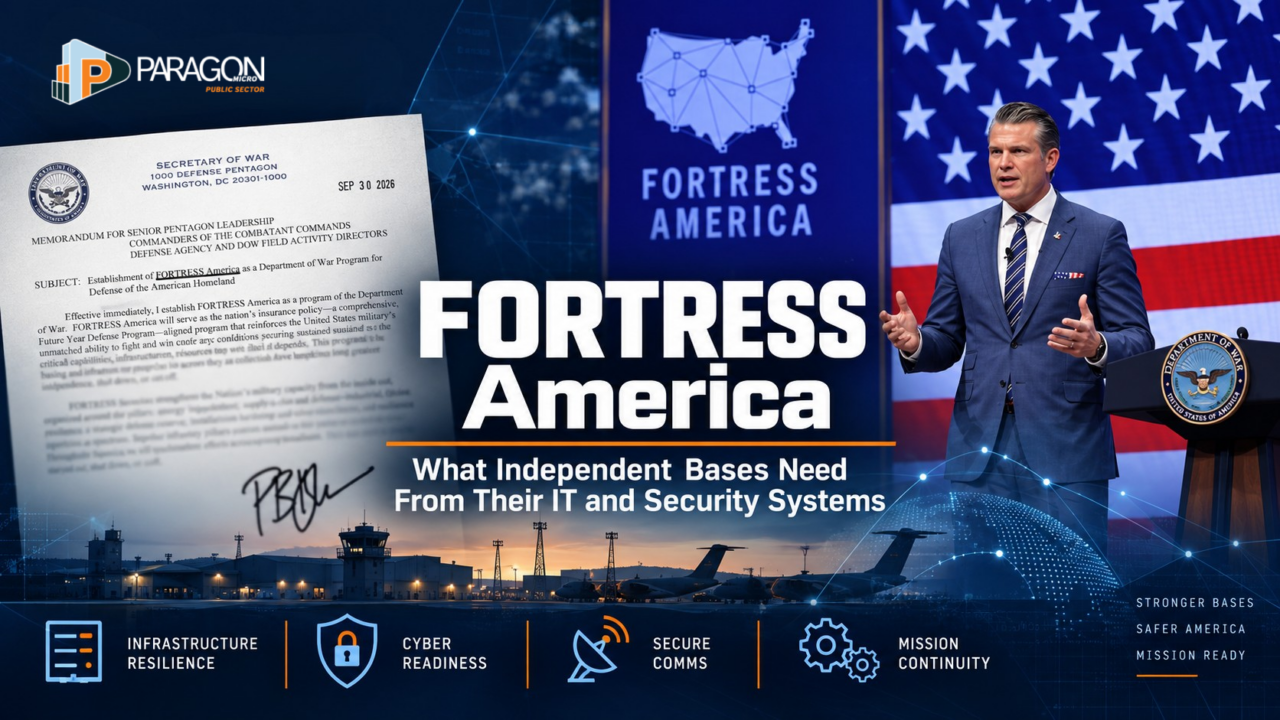
On September 30, 2026, at Marine Corps Base Quantico, Secretary of War Pete Hegseth announced FORTRESS America, short for Federal Operations for Resilience, Troop Resources, Energy, Supply and Survivability. It calls for installations to generate their own power, for production of rare earths, specialty metals, semiconductors, and propellants to return to the United States, for larger reserves of munitions, fuel, medicine, and blood, and for protection of bases against cyberattacks, sabotage, and drones (Edwards, 2026). A memo he signed, dated the same day, establishes it as a Department of War program (Hegseth, 2026).
"If an adversary takes down the grid by cyber attack, by sabotage, or by any means, our bases stay lit, our aircraft keep flying, our command centers never go dark," Hegseth said. The memo gives the Under Secretary of War for Acquisition and Sustainment 30 days to stand up a FORTRESS America Program Office, led by a Senior Executive Service member with a two star military advisor (Hegseth, 2026). Newsweek reported that budgets and permanent staffing for the program are still to be developed (Parry & Stevenson, 2026).
FORTRESS arrived alongside Project Meridian and the Autonomous Warfare Command (Edwards, 2026). Each of its goals runs through installation IT: the servers in the base data center, the network that carries video and sensor feeds, the controllers that run the microgrid, and the supply chain behind every part.
Key takeaways
- The September 30, 2026 memo organizes FORTRESS around 5 pillars: energy independence, supply chain and defense industrial base resilience, a strategic defense reserve, installation hardening and cyber resilience, and resilience in space and spectrum. Its program office is due within 30 days (Hegseth, 2026).
- Grid cut exercises at 33 installations found failed batteries, unserviced generators, and air conditioning left off backup circuits, which let equipment overheat (Foy, 2025). Cooling and network gear need the same backup plan as servers.
- Cameras, access control, and utility controls such as microgrid controllers are facility related control systems under UFC 4-010-06 (U.S. Department of Defense, 2023). Volt Typhoon gained access to critical infrastructure networks and, in some cases, camera systems (Greig, 2024).
- Drone sightings over installations rose 82% to about 420 in the year ending September 2025 (Marrow, 2025). Detection and response depend on sensors, networks, and edge compute working together.
- The 2027 magnet rule exempts electronic devices unless a contract says otherwise. The chip rule, Section 5949, does reach IT hardware starting December 23, 2027 (48 C.F.R. § 252.225-7052, 2024; Wagner et al., 2026).
Chapter 1
What FORTRESS America covers
Hegseth made 2 commitments when he announced the program. On power: "Every major military installation in America is going to generate its own power. Independent of the civilian grid." On supply: "We are bringing our critical supply chains home. The rare earths, the specialty metals, the semiconductors, the propellants" (Arora, 2026).
Primary source
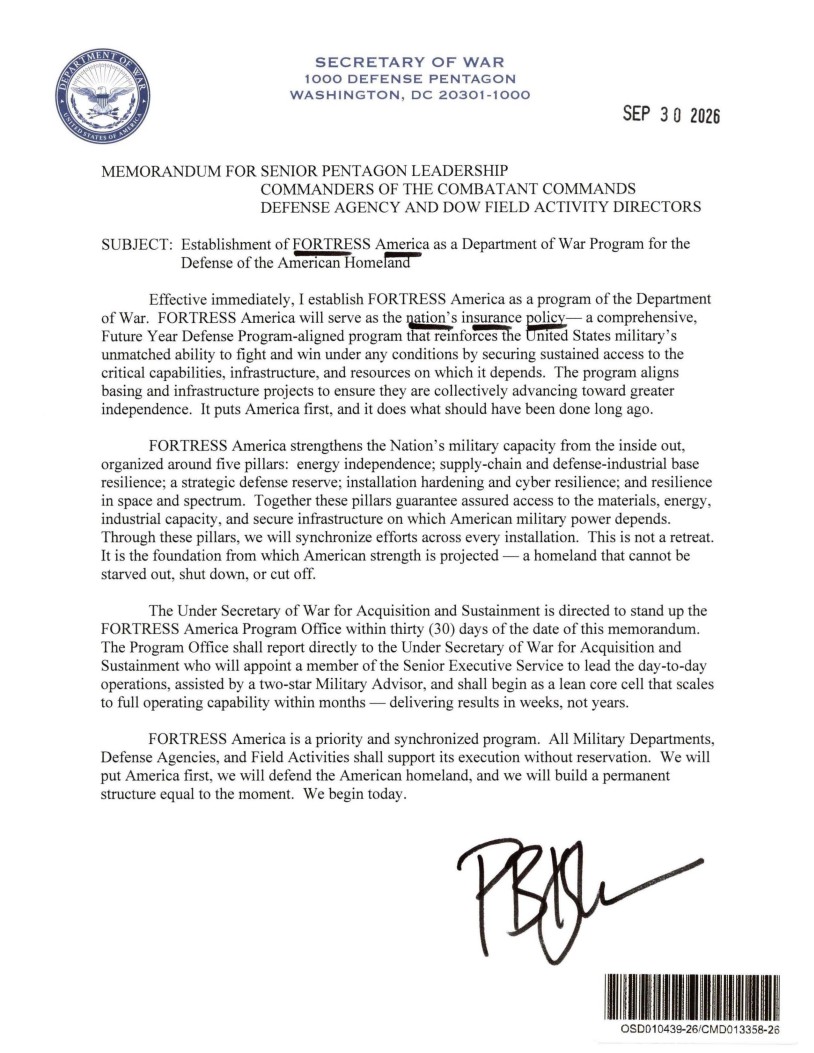
The memo that created FORTRESS America
Dated September 30, 2026, and signed by Hegseth, the memo establishes FORTRESS America as a Department of War program for the defense of the American homeland. It goes to senior Pentagon leaders, combatant commanders, and defense agency and field activity directors (Hegseth, 2026).
- Program office
- The Under Secretary of War for Acquisition and Sustainment must stand it up within 30 days, which puts the deadline at October 30, 2026.
- Leadership
- A Senior Executive Service member runs day to day operations, with a two star military advisor.
- Ramp
- The office starts as a lean core cell and grows to full operating capability within months.
- Support
- All military departments, defense agencies, and field activities must support its execution.
“A homeland that cannot be starved out, shut down, or cut off.”
Secretary of War Pete Hegseth (2026, para. 2)
The 5 pillars
The memo organizes FORTRESS around 5 pillars and says the department will use them to synchronize efforts across every installation (Hegseth, 2026). Each row lists what the pillar covers and where this article addresses it.
1
Energy independence
Installations generate their own power, independent of the civilian grid (Arora, 2026). The Air Force is pursuing microreactors at bases such as Eielson in Alaska and looking at solar and geothermal plants to build microgrids (Gordon & Hadley, 2026).
Covered inChapter 2: Power
2
Supply chain and defense industrial base resilience
Production of rare earths, specialty metals, semiconductors, and propellants returns to the United States (Edwards, 2026).
Covered inChapter 5: Supply chain
3
Strategic defense reserve
FORTRESS calls for larger reserves of munitions, fuel, medicine, and blood (Edwards, 2026).
Covered inReserves for installation IT
4
Installation hardening and cyber resilience
Bases are protected against cyberattacks, sabotage, and drones (Edwards, 2026).
Covered inChapter 3: Cyber
Chapter 4: Drones5
Resilience in space and spectrum
Newsweek’s coverage of the address described stronger satellite and communications resilience (Parry & Stevenson, 2026).
Covered inChapter 2, for SATCOM terminals and radios on backup power only
The same address announced the Next Great American Base, a new installation spanning hundreds of thousands of acres with independent power generation, autonomous systems, and air defenses (Edwards, 2026), sized for 15,000 to 25,000 service members (Gordon & Hadley, 2026). The new base is planned with the power and defenses that FORTRESS asks existing bases to add.
The policy trail behind FORTRESS
Each part of FORTRESS builds on directives, programs, and incidents since early 2024. Each one changes what buyers will ask suppliers for.
February 7, 2024
CISA, NSA, and FBI warn that Volt Typhoon gained access to U.S. critical infrastructure networks, including in Guam, ahead of any conflict (Greig, 2024).
For buyers: base utilities and security systems are targets.
February 13, 2025
NORTHCOM commander Gen. Gregory Guillot reports 350 drone detections over 100 installations in 2024 (Harper, 2025).
For buyers: drone detection becomes a base requirement.
May 2025
Executive Order 14299 directs an Army regulated reactor at a domestic installation by September 30, 2028 (Fork & Hammond, 2025; Hauptman, 2025).
For buyers: onsite generation plans start to include nuclear.
July 10, 2025
The Pentagon agrees to a $400 million equity stake in MP Materials and a 10 year price floor for its rare earth products (MP Materials, 2025).
For buyers: a domestic magnet supply starts to form.
August 28, 2025
JIATF-401 replaces the Pentagon's earlier joint counter drone office (Altman, 2025).
For buyers: a single task force now coordinates counter drone efforts.
October 14, 2025
The Army and Department of Energy announce the Janus program for commercially owned microreactors on bases (Hauptman, 2025).
For buyers: some new generation will be commercially owned and sited on base land.
December 18, 2025
The FY2026 NDAA writes JIATF-401 into law, amends Section 130i, and includes the SAFER SKIES Act (Kesteloo, 2026; McNabb, 2025).
For buyers: counter drone events now carry public reporting requirements.
February 11, 2026
An executive order directs the Secretary of War to seek long term coal power purchase agreements for installations (The White House, 2026).
For buyers: power sources for bases keep diversifying.
March 9 to 15, 2026
Waves of 12 to 15 drones fly over sensitive areas of Barksdale Air Force Base (Altman, 2026).
For buyers: incursions now come in coordinated waves.
May 6, 2026
JIATF-401 picks 5 bases for a directed energy counter drone pilot (Stassis, 2026).
For buyers: new effectors need power, networks, and sensor data.
September 30, 2026
Hegseth announces FORTRESS America and signs the memo establishing it as a Department of War program (Edwards, 2026; Hegseth, 2026).
For buyers: resilience becomes a named program with its own office.
Chapter 2
Power: when the base runs on its own generation
The Army describes a microgrid as a local electrical system "with the controls to manage multiple generation sources and loads" that can "operate independently from the grid during times of emergency response." Its microgrid at Joint Forces Training Base Los Alamitos was designed to sustain critical missions for at least 14 days during a grid outage (Surash & Hughes, 2022).
New generation sources are coming. Executive Order 14299 directs the Army to begin operating an Army regulated reactor at a domestic military installation no later than September 30, 2028 (Fork & Hammond, 2025). The Janus program puts commercially owned microreactors on Army bases, with the Defense Innovation Unit and the Department of Energy as partners (Hauptman, 2025). A February 2026 executive order directs the Secretary of War to seek long term power purchase agreements with coal plants that serve military installations (The White House, 2026).
What grid cut tests found
33
Installations that have hosted energy resilience readiness exercises, affecting more than 800,000 people (Foy, 2025)
In these exercises, a base is cut off from the utility grid to test its backup power and its people. MIT Lincoln Laboratory, which developed them, reported these findings (Foy, 2025):
- Battery systems failed or ran down early because of age or generator problems.
- Generators failed because they had not been serviced or refueled.
- Air conditioning left off backup circuits let equipment overheat.
- Communications dropped where they had no battery support.
Congress requires each military department to run at least 5 of these exercises a year, a mandate MIT reports was reauthorized through 2032 (Foy, 2025).
Backup power has to cover the whole stack
Each layer depends on the one beneath it. Equipment on backup power still fails if its cooling or network goes down.
Mission systems
Servers, video management, counter drone sensors, command applications
Fail when any layer beneath them fails
Network
Switches, firewalls, radios, SATCOM terminals
Exercises found communications dropped without battery support
Cooling
Air conditioning for server rooms and network closets
Left off backup circuits, it let equipment overheat
Power
Utility feed, onsite generation, UPS batteries
Batteries and generators failed without servicing
What to specify for power
- List every IT load a critical mission needs, including cooling, network closets, radios, and camera recorders, and confirm each one is on a backup circuit.
- Size UPS runtime to carry IT loads through the switch from utility power to onsite generation, and replace batteries on the manufacturer's schedule.
- Measure the actual power draw of each rack so the microgrid is sized to real loads.
- Test how equipment behaves during the switch to onsite power, including reboots and lost network links.
- Ask to include IT systems in the installation's next energy resilience readiness exercise.
- For remote and deployable sites, specify input power (AC, DC, vehicle, or battery) at purchase.
For tactical and remote sites, Paragon Micro supports solar, generator, vehicle power, and lithium ion battery platforms (Paragon Micro, n.d.-f). It builds, configures, and tests rack systems in its System Readiness Center before delivery (Paragon Micro, n.d.-e).
Chapter 3
Cyber: the base is a control system network
The systems FORTRESS depends on are computers. UFC 4-010-06 sets cybersecurity requirements for facility related control systems, which it groups as building control systems, utility control systems, electronic security systems, and fire and life safety systems (U.S. Department of Defense, 2023). Those groups include the microgrid controller, the base's cameras, and its access control.
The criteria apply the Risk Management Framework to control system design. They stress limiting network dependency and designing systems that fail gracefully (U.S. Department of Defense, 2023).
Why control systems are targets
In February 2024, CISA, NSA, and FBI warned that Chinese state sponsored actors were positioning themselves inside IT networks so they could launch destructive cyberattacks against U.S. critical infrastructure in a major crisis or conflict. The advisory said the actors kept footholds in some victim IT environments for at least 5 years, positioned themselves to move from IT networks to operational technology, and in certain instances could access camera surveillance systems at critical infrastructure facilities (Greig, 2024).
The department's deadline to reach target level zero trust is September 30, 2027. John Sherman, its chief information officer at the time, said extending zero trust beyond networks, to weapon systems, operational technology, and SCADA systems, would be "a bit of a lift" (Easley, 2024). Base control systems are part of that work.
What to specify for control system security
- Separate control system networks from business IT, with defined and monitored crossing points.
- Keep an inventory of every controller, camera, and access panel, with firmware versions.
- Replace default credentials and turn off unused services before systems go live.
- Monitor traffic between devices inside control networks, where an intruder moves after getting in.
- Keep offline copies of controller configurations so systems can be rebuilt after an attack.
- Make sure cameras keep recording and doors keep working if the network link to the base is cut.
- Specify FIPS 140-3 validated encryption for new purchases. FIPS 140-2 certificates moved to NIST's Historical List on September 21, 2026 (National Institute of Standards and Technology [NIST], n.d.).
Paragon Micro's zero trust and cyber resilience work covers microsegmentation to limit lateral movement, multifactor authentication with device trust validation and continuous authorization, and backup, failover, and recovery planning (Paragon Micro, n.d.-h).
Chapter 4
Drones: detection is a sensor and network problem
Drones over bases
420
Approximate drone sightings over DoW installations from September 2024 to September 2025, up from 230 the year before (Marrow, 2025)
NORTHCOM commander Gen. Gregory Guillot put the rate at 1 to 2 incursions per day at DoW installations (Marrow, 2025).
Between March 9 and 15, 2026, security forces at Barksdale Air Force Base saw multiple waves of 12 to 15 drones over sensitive areas, including the flight line. On March 19, 2026, Guillot told senators the military now defeats about a quarter of the drones it detects, up from almost none a year earlier (Altman, 2026).
Authority sets the limits
In February 2025, Guillot told senators that only about half of installations counted as covered installations under 10 U.S.C. 130i, the military's counter drone authority (Harper, 2025). The FY2026 NDAA, signed December 18, 2025, wrote JIATF-401 into law and amended Section 130i to add public annual reporting, and its SAFER SKIES Act provisions opened a path for trained federal, state, and local agencies to use counter drone authority (Kesteloo, 2026; McNabb, 2025).
At the Falcon Peak exercise, NORTHCOM deputy test director Jason Mayes put the constraint plainly: "We can't just shoot anything down just because it's over our installation" (Marrow, 2025).
JIATF-401, established August 28, 2025, can approve up to $50 million per counter drone initiative (Altman, 2025). In May 2026 it picked Fort Huachuca, Fort Bliss, Naval Base Kitsap, Grand Forks Air Force Base, and Whiteman Air Force Base for a pilot of high energy lasers and high power microwave systems. Its director, Brig. Gen. Matt Ross, said "there is no 'silver bullet' to address this challenge" (Stassis, 2026).
From detection to record
- Detect
Radio frequency, radar, acoustic, and camera sensors spot a drone. Bases combine sensor types because each covers different drones and conditions.
- Track
Edge compute fuses sensor feeds into a single track and holds it through maneuvers and altitude changes.
- Identify
Operators check the track against camera video and known flights to decide whether it is a threat.
- Decide
Commanders act within the authority the installation holds under 10 U.S.C. 130i.
- Record
Detections, video, and actions are stored for investigations and the annual reporting added to Section 130i (McNabb, 2025).
What to specify for counter drone and video systems
- Send every sensor into a single display and a single record of events.
- Place edge compute close to sensors so tracking keeps working if the backbone link drops.
- Give sensors, cameras, and recorders backup power and cooling sized for the longest outage the base plans for.
- Size storage to keep detection and video records for investigations and Section 130i reporting.
- Confirm cameras and network gear comply with FAR 52.204-25, which bars covered equipment from Hikvision, Dahua, and others (48 C.F.R. § 52.204-25, 2021).
- Confirm any drones the base flies comply with FAR 52.240-1 (48 C.F.R. § 52.240-1, 2024).
Paragon Micro's article Edge AI in the Battlefield for Counter-UAS Operations covers how edge AI turns raw sensor data into information operators can act on (Paragon Micro, 2026a). Its video surveillance and physical security work covers camera and sensor architectures, physical access control, and systems built with redundancy, secure networking, and protected storage to stay up during outages (Paragon Micro, n.d.-g).
Chapter 5
Supply chain: chips, magnets, and the parts inside base systems
FORTRESS ties installation resilience to domestic production. In July 2025, the Pentagon agreed to buy $400 million of MP Materials preferred stock, a stake that would make it the company's largest shareholder, and set a 10 year price floor of $110 per kilogram for MP's NdPr products. MP expects its total U.S. magnet manufacturing capacity to reach about 10,000 metric tons once its planned 10X facility is running, with commissioning starting in 2028 (MP Materials, 2025).
The 2027 magnet rule and IT hardware
DFARS 252.225-7052 restricts samarium cobalt magnets, neodymium iron boron magnets, tantalum, and tungsten tied to China, Russia, North Korea, and Iran. Starting January 1, 2027, the restriction covers material mined, refined, separated, melted, or produced in those countries (48 C.F.R. § 252.225-7052, 2024).
The clause excludes electronic devices unless the contract says otherwise. It also excludes commercially available off the shelf (COTS) items, and starting January 1, 2027, a COTS item loses that exception only if it is 50 percent or more covered material by weight (48 C.F.R. § 252.225-7052, 2024). Servers, switches, and cameras will usually fall under those exceptions, so confirm against your contract. The rule matters most for motors, actuators, and drone components.
As of June 2026, defense contractors were lobbying to postpone the January 1, 2027 date (Adamas Intelligence, 2026). Check its status before you rely on it.
The chip rule does reach IT hardware. Section 5949 of the FY2023 NDAA bars executive agencies from buying products that contain semiconductors from SMIC, YMTC, or CXMT, starting December 23, 2027. The FAR Council's proposed rule would apply to COTS items too (Wagner et al., 2026).
Chain of custody
Paragon Micro verifies components, logs every system and configuration step, enforces Trade Agreements Act compliance on hardware it receives and ships, and limits handling to vetted U.S. citizens (Paragon Micro, n.d.-e). It earned AS9120 certification for aerospace and defense distribution in June 2026 (Paragon Micro, 2026b).
Reserves for installation IT
FORTRESS calls for larger reserves of munitions, fuel, medicine, and blood (Edwards, 2026). The same logic applies to installation IT. A base that plans to run through a supply disruption needs spare drives, power supplies, switches, and radios on hand, configured before they are needed. Paragon Micro's facility includes secure build and storage areas (Paragon Micro, n.d.-e).
Questions to ask suppliers
- Do any chips in this product come from SMIC, YMTC, or CXMT, and how will you certify before December 23, 2027?
- Does any part of this order contain restricted magnets, and does our contract override the electronic device exception?
- Are cameras and network gear free of covered equipment under FAR 52.204-25?
- Is the hardware Trade Agreements Act compliant, and can you document chain of custody from receipt to delivery?
- Can you hold configured spares for critical systems?
Chapter 6
How to buy it, and readiness checklists
Contract vehicles
Army
ITES-4H
Who can orderArmy and other federal agencies
PeriodOrdering through 2035
ScopeServers, data center infrastructure, storage, end user devices, networking, and lifecycle services (Paragon Micro, n.d.-b)
Missile Defense Agency
MDA SHIELD IDIQ
ContractHQ0859-26-D-E455
PeriodDecember 28, 2025 to December 28, 2035
ScopeIT infrastructure, hardware, system integration, and lifecycle support under a $151 billion shared ceiling (Paragon Micro, n.d.-c)
Governmentwide
NASA SEWP V
ContractNNG15SD91B
PeriodExtended by NASA through January 31, 2027
ScopeCommercial IT products and product based services (National Aeronautics and Space Administration [NASA], n.d.; Paragon Micro, n.d.-d)
Governmentwide
GSA MAS products
Who can orderFederal agencies
PathParticipating dealer and team arrangements with EC America (GS-35F-0511T) and Synnex Corporation (GS-35F-0563U) (Paragon Micro, n.d.-a)
Paragon Micro is a Dell Technologies Federal Platinum Partner. For security, power, and counter drone equipment from other OEMs, the right vehicle depends on the product, so confirm with our team before you write the requirement.
Readiness checklists
Checklist
For Federal System Integrators
- Bring a hardware partner into energy resilience and control system security planning early, so equipment specs match the base's backup power and cooling.
- Use the UFC 4-010-06 process for any system that touches facility controls, cameras, or access control.
- Qualify a second source for critical parts, and stage configured spares.
Checklist
For advanced projects teams
- Ask where systems are built and stored, who has access, and whether the area is segmented from other customers' work.
- Require custody records for every handoff and secure packaging for transport.
- Plan for sensitive sites to run on local power, local recording, and local access control if links are cut.
Checklist
For installation and program offices
- Confirm every critical IT load, including cooling and network gear, is on a backup circuit.
- Include IT systems in the next energy resilience readiness exercise.
- Treat cameras, access control, and microgrid controllers as control systems under UFC 4-010-06.
- Separate control networks from business IT and monitor the crossing points.
- Feed counter drone sensors and cameras into a single record of events, with storage sized for investigations and Section 130i reporting.
- Specify FIPS 140-3 for new encryption modules.
- Get FAR 52.204-25, FAR 52.240-1, and Trade Agreements Act compliance in writing, and ask how the supplier is preparing for Section 5949.
- Read the magnet clause language in contracts for motors, actuators, and drones.
- Hold configured spares for critical systems.
- Confirm the supplier's CMMC status now. Phase 2 starts November 10, 2026, when applicable contracts begin to require Level 2 certification from a third party assessor (Fitzgerald, 2026).
Timeline
Key dates
Oct 30, 2026
FORTRESS America Program Office due
(Hegseth, 2026)
Nov 10, 2026
CMMC Phase 2 begins
(Fitzgerald, 2026)
Jan 1, 2027
Magnet rule extends to mining and refining
(48 C.F.R. § 252.225-7052, 2024)
Jan 31, 2027
NASA SEWP V extension ends
(NASA, n.d.)
Sep 30, 2027
Zero trust target level deadline
(Easley, 2024)
Dec 23, 2027
Section 5949 chip prohibition takes effect
(Wagner et al., 2026)
2028
MP Materials 10X magnet facility begins commissioning
(MP Materials, 2025)
Sep 30, 2028
Army regulated reactor at a domestic installation
(Fork & Hammond, 2025)
FORTRESS America will be tested on the day a base loses the grid, a controller is probed, or drones cross the fence line. Whether the base stays up depends on IT with backup power and cooling, control networks that hold, sensors that report to a single display, and parts that pass the supply chain rules.
Work with Paragon Micro
Preparing installation IT for FORTRESS America?
Tell us what your installation needs to keep running. Paragon Micro's DoW team can help you specify, source, stage, and deliver the servers, networks, and security systems behind it through ITES-4H, MDA SHIELD, NASA SEWP V, and GSA.
Video Surveillance and Physical Security Zero Trust and Cyber Resilience System Readiness Center
Related reading
Sources
References
Adamas Intelligence. (2026, June 5). U.S. defense contractors seek second DFARS delay as Pentagon's $200B 'Deal Team Six' mobilizes for rare earth independence. https://www.adamasintel.com/u-s-defense-contractors-seek-second-dfars-delay-as-pentagons-200b-deal-team-six-mobilizes-for-rare-earth-independence/
Altman, H. (2025, August 29). New Pentagon task force aims to accelerate drone defense at home and abroad. The War Zone. https://www.twz.com/air/new-pentagon-task-force-aims-to-accelerate-drone-defense-at-home-and-abroad
Altman, H. (2026, March 24). U.S. battled drone incursions over key bases at home after launch of Epic Fury. The War Zone. https://www.twz.com/news-features/u-s-battled-drone-incursions-over-key-bases-at-home-after-launch-of-epic-fury
Arora, K. (2026, October 1). What is FORTRESS America? US plan to keep military bases running through cyberattacks and sabotage. The Statesman. https://thestatesman.com/world/what-is-fortress-america-us-plan-to-keep-military-bases-running-through-cyberattacks-and-sabotage-1503645382.html
Easley, M. (2024, April 4). With 2027 deadline looming, DOD moves into implementation phase of zero trust transformation. DefenseScoop. https://defensescoop.com/2024/04/04/dod-zero-trust-implementations-phase-2027/
Edwards, J. (2026, October 1). Hegseth unveils Project Meridian & 5 other DOW initiatives. GovCon Wire. https://www.govconwire.com/articles/hegseth-project-meridian-dow-initiatives
Fitzgerald, A. (2026, March 4). CMMC Phase 2: What to expect and how to prepare [2026]. Secureframe. https://secureframe.com/blog/cmmc-phase-2-preparation
Fork, W. E., & Hammond, M. C. (2025, October 21). Implementation of Executive Order 14299 turns advanced nuclear deployment into a U.S. Army priority. Pillsbury Winthrop Shaw Pittman LLP. https://www.pillsburylaw.com/en/news-and-insights/executive-order-advanced-nuclear-deployment-us-army.html
Foy, K. (2025, September 22). Power-outage exercises strengthen the resilience of US bases. MIT News. https://news.mit.edu/2025/power-outage-exercises-strengthen-resilience-us-bases-0922
Gordon, C., & Hadley, G. (2026, September 30). Hegseth unveils new Autonomous Warfare Command in 'State of the Force' address. Air & Space Forces Magazine. https://www.airandspaceforces.com/hegseth-drones-autonomous-warfare-command-state-of-the-force/
Greig, J. (2024, February 7). CISA, FBI warn of China-linked hackers pre-positioning for 'destructive cyberattacks against US critical infrastructure.' The Record. https://therecord.media/cisa-fbi-warn-of-china-linked-hackers-targeting-critical-us-infrastructure
Harper, J. (2025, February 13). NORAD commander says hundreds of drone incursions were detected at US military installations. DefenseScoop. https://defensescoop.com/2025/02/13/drone-incursions-us-military-bases-norad-northcom-counter-small-uas/
Hauptman, M. (2025, October 14). New program aims to put nuclear generators on Army bases. Defense News. https://www.defensenews.com/land/2025/10/14/new-program-aims-to-put-nuclear-generators-on-army-bases/
Hegseth, P. (2026, September 30). Establishment of FORTRESS America as a Department of War program for the defense of the American homeland [Memorandum]. U.S. Department of War. https://www.paragonmicro.us/wp-content/uploads/2026/10/Fortress-America.jpg
Kesteloo, H. (2026, September 10). 1,500 US agencies are about to get counter-drone powers. DroneXL. https://dronexl.co/2026/09/10/1500-us-agencies-counter-drone-powers/
Marrow, M. (2025, October). With daily drone incursions over bases, NORTHCOM takes aim through Falcon Peak. Breaking Defense. https://breakingdefense.com/2025/10/drone-incursions-us-military-falcon-peak-2025-cuas/
McNabb, M. (2025, December 9). NDAA FY 2026: Key counter-UAS provisions explained. DroneLife. https://dronelife.com/2025/12/09/ndaa-fy-2026-key-counter-uas-provisions-explained/
MP Materials. (2025, July 10). MP Materials announces transformational public-private partnership with the Department of Defense to accelerate U.S. rare earth magnet independence [Press release]. https://mpmaterials.com/news/mp-materials-announces-transformational-public-private-partnership-with-the-department-of-defense-to-accelerate-u-s-rare-earth-magnet-independence/
National Aeronautics and Space Administration. (n.d.). Solutions for Enterprise-Wide Procurement (SEWP). Retrieved October 2, 2026, from https://www.sewp.nasa.gov/
National Institute of Standards and Technology. (n.d.). Cryptographic Module Validation Program. Retrieved October 2, 2026, from https://csrc.nist.gov/projects/cryptographic-module-validation-program
Paragon Micro. (n.d.-a). GSA. Retrieved October 2, 2026, from https://www.paragonmicro.us/contracts/gsa/
Paragon Micro. (n.d.-b). ITES-4H. Retrieved October 2, 2026, from https://www.paragonmicro.us/contracts/ites-4h/
Paragon Micro. (n.d.-c). MDA SHIELD IDIQ. Retrieved October 2, 2026, from https://www.paragonmicro.us/contracts/mda-shield-idiq/
Paragon Micro. (n.d.-d). NASA SEWP V. Retrieved October 2, 2026, from https://www.paragonmicro.us/contracts/nasa-sewpv/
Paragon Micro. (n.d.-e). Secure integration & staging facility. Retrieved October 2, 2026, from https://www.paragonmicro.us/about-us/facility/
Paragon Micro. (n.d.-f). Tactical & rugged equipment. Retrieved October 2, 2026, from https://www.paragonmicro.us/solutions/tactical-and-rugged-equipment/
Paragon Micro. (n.d.-g). Video surveillance & physical security solutions. Retrieved October 2, 2026, from https://www.paragonmicro.us/solutions/video-surveillance-and-physical-security/
Paragon Micro. (n.d.-h). Zero trust & cyber resilience for government. Retrieved October 2, 2026, from https://www.paragonmicro.us/solutions/zero-trust-and-cyber-resilience/
Paragon Micro. (2026a, February 24). Edge AI in the battlefield for counter-UAS operations. https://www.paragonmicro.us/edge-ai-in-the-battlefield-for-counter-uas-operations/
Paragon Micro. (2026b, June 30). Paragon Micro achieves AS9120 certification for aerospace and defense distribution. https://www.paragonmicro.us/paragon-micro-achieves-as9120-certification-for-aerospace-defense-distribution/
Parry, H., & Stevenson, S. (2026, September 30). Hegseth unveils 6 major US military changes in 'State of the Force' address. Newsweek. https://www.newsweek.com/hegseth-unveils-6-major-us-military-changes-12509906
Prohibition on Contracting for Certain Telecommunications and Video Surveillance Services or Equipment, 48 C.F.R. § 52.204-25 (2021). https://www.acquisition.gov/far/52.204-25
Prohibition on Unmanned Aircraft Systems Manufactured or Assembled by American Security Drone Act-Covered Foreign Entities, 48 C.F.R. § 52.240-1 (2024). https://www.acquisition.gov/far/52.240-1
Restriction on the Acquisition of Certain Magnets, Tantalum, and Tungsten, 48 C.F.R. § 252.225-7052 (2024). https://acquisition.gov/dfars/252.225-7052-restriction-acquisition-certain-magnets-tantalum-and-tungsten.
Stassis, C. (2026, May 11). 5 US bases selected for anti-drone pilot program. Military Times. https://www.militarytimes.com/industry/techwatch/2026/05/11/5-us-bases-selected-for-anti-drone-pilot-program/
Surash, J. E. J., & Hughes, R. (2022, April 12). Developing microgrids to deliver energy resilience. U.S. Army. https://www.army.mil/article/255597/developing_microgrids_to_deliver_energy_resilience
U.S. Department of Defense. (2023). Cybersecurity of facility-related control systems (UFC 4-010-06). https://www.wbdg.org/FFC/DOD/UFC/ufc_4_010_06_2023.pdf
Wagner, M., Cassidy, S. B., Burnette, R., & Cho, E. (2026, February 26). FAR Council issues notice of proposed rulemaking to implement prohibition on acquisition of certain semiconductors. Inside Government Contracts. https://www.insidegovernmentcontracts.com/2026/02/far-council-issues-notice-of-proposed-rulemaking-to-implement-prohibition-on-acquisition-of-certain-semiconductors/
The White House. (2026, February 11). Strengthening United States national defense with America's beautiful clean coal power generation fleet [Executive order]. https://www.whitehouse.gov/presidential-actions/2026/02/strengthening-united-states-national-defense-with-americas-beautiful-clean-coal-power-generation-fleet