


Middle East · USCENTCOM
Resilient base IT.Across the Middle East.
Since February 28, 2026, missiles and drones have hit U.S. bases in the region, drones hit 2 AWS data centers in the UAE, and Iranian officials have threatened the undersea cables under the Strait of Hormuz.

The challenge
Plan for the failure that gets through
Air defense belongs to commanders. A base communications team controls whether the network, the link home, and the mission data still work after a strike, a cable cut, or the loss of a cloud region.
What is different in the Middle East
Reporting since February 2026 shows what a base network has to survive: strikes that reach the base, threats to the cables, and cloud data that could not be restored.
This page takes no position on the war or on air defense policy.
- March 27, 2026An Iranian missile and multiple drones hit Prince Sultan Air Base in Saudi Arabia. In July, a U.S. official told The Intercept that Iran had fired 8,000 to 9,000 drones and missiles across the region; that estimate is unconfirmed.
- Command sites hitStrikes damaged the headquarters of U.S. Naval Forces Central Command (NAVCENT) and 5th Fleet, plus barracks and communication towers, at Naval Support Activity Bahrain, and the Chief of Naval Operations has said the Navy is not returning there anytime soon. Iranian missiles left the Combined Air Operations Center at Al Udeid Air Base inoperable; the air campaign was directed from a second center at Shaw Air Force Base, South Carolina.
- 7 cablesOn October 20, 2026, an IRGC spokesman said 7 undersea internet cables run beneath the Strait of Hormuz. After the 2024 Red Sea cuts, DE-CIX put typical cable repairs at 2 to 3 months.
- Data not restoredIn September 2026, AWS said it cannot restore access to resources hosted only in its Bahrain region or only in 1 UAE availability zone.
- StrikesSome reach the base.
- CablesThreatened, and 2 to 3 months to repair.
- CloudSome data could not be restored.
- The baseWhat the IT team controls.
The solution
Keep the base working after a hit
We build the second node, the local services, and the copy of mission data outside the threat range, and we test them together in our System Readiness Center before they go live.
- Second nodeCritical services in 2 buildings, far enough apart that 1 strike cannot take both.Learn more
- More than 1 pathDifferent cable routes and media, with backup paths written down.Learn more
- Local servicesIdentity, certificate checks, name resolution, time, and mission applications that run with the link down.Learn more
- Offsite copyMission data in a separate region or stateside, with its own credentials.Learn more
- Rehearsed failoverTimed and written up before you need it.Learn more
- Training and supportYour staff rehearse with us, and we sustain it after delivery.Learn more
What runs on site when the link is down
Each of these has to answer from the base itself, on both nodes, so people can log in and mission systems keep running while the link home is cut.
- IdentityA domain controller on site, plus a local copy of certificate revocation data, so smart card logins keep working while the link is down.
- TimeA local time server that keeps accurate time from a rubidium oscillator if GPS is jammed or spoofed.
- Name resolutionLocal DNS for the base's own services, so they resolve without an outside server.
- Mission applicationsThe applications and data the base needs, hosted on the second node as well as the first.
Plan for heat, dust, and power
Kuwait has recorded 53.9 °C (129 °F), fine dust gets into fans, power supplies, and optics, and a second node in a secondary building may not have the main data center's cooling. We specify equipment rated for higher operating temperatures, filtered or sealed enclosures, and UPS and cooling sized for the building each node sits in.
Mains power differs across the region, so we order power supplies, UPS units, and cords for each site.
| Location | Mains power | Plugs |
|---|---|---|
| Kuwait | 230 volts, 50 Hz | Type G |
| Qatar | 240 volts, 50 Hz | Type G |
| United Arab Emirates | 230 volts, 50 Hz | Type G |
| Saudi Arabia | 230 volts, 60 Hz | Type G |
| Jordan | 230 volts, 50 Hz | Types C, F, and G |
| Oman | 230 volts, 50 Hz | Type G |
From requirement to a base that keeps working
Plan for the day a strike lands, a cable is cut, or a cloud region is lost. Each step adds a second node, local services, and an offsite copy.
Assess
Single points of failure on base
Design
Second node & local services
Stage
Offsite copy & recovery runbook
Test
Restore tested before delivery
Field
Installed, trained & supported forward
Where we work · USCENTCOM
Middle East areas we cover
We work directly with U.S. installations and host nation sites in all 6 countries below, from Jordan to Oman, in the U.S. Central Command area. Select a country on the map to go to its list.
- 6Countries
- 11Installations and sites
6 of 6 areas shown
Kuwait
Country 14 sites
The U.S. Army Central (ARCENT) forward headquarters at Camp Arifjan, an Army training camp, and air bases used by U.S. forces.
- Army
- Camp Arifjan, Camp Buehring
- Air Force
- Ali Al Salem Air Base
- Host nation
- Ahmad al-Jaber Air Base
Qatar
Country 21 installation
Al Udeid Air Base, the forward headquarters of U.S. Central Command (USCENTCOM) and U.S. Air Forces Central (AFCENT).
- Air Force
- Al Udeid Air Base
United Arab Emirates
Country 31 installation
Al Dhafra Air Base near Abu Dhabi, which hosts a U.S. Air Force expeditionary wing.
- Air Force
- Al Dhafra Air Base
Saudi Arabia
Country 41 installation
Prince Sultan Air Base south of Riyadh, which hosts a U.S. Air Force expeditionary wing.
- Air Force
- Prince Sultan Air Base
Jordan
Country 51 installation
Muwaffaq Salti Air Base, which hosts U.S. Air Force expeditionary units.
- Air Force
- Muwaffaq Salti Air Base
Oman
Country 63 sites
Omani air bases and a port that U.S. forces use under an access agreement.
- Host nation
- Thumrait Air Base, Masirah Air Base, Port of Duqm
Don’t see your site?
This list covers major installations and sites. Tell us the location and the requirement, and our team will follow up.
Ask about your siteHost nation sites are operated by the host military; U.S. forces use them under access agreements. U.S. Central Command, U.S. Marine Corps Forces Central Command (MARCENT), and Special Operations Command Central (SOCCENT) are headquartered at MacDill Air Force Base in Tampa (Florida), and U.S. Army Central (ARCENT) and U.S. Air Forces Central (AFCENT) at Shaw Air Force Base (the Carolinas), both on our United States page.
Buying for a federal civilian agency or as an integrator? See Federal Civilian Services or Federal System Integrators.
Technology partners
We are a Dell Technologies Federal Platinum Partner, and we work multi-vendor, so each base gets the equipment that fits its mission.
Proof
Past performance
Work that applies to Middle East bases: systems that run across 2 sites, storage delivered to 2 facilities while operations continued, and deployable kits tested before they ship.
Related analysis
How to buy
Army organizations and other federal agencies can order through ITES-4H. The Missile Defense Agency and other Department of War organizations worldwide can order through MDA SHIELD, a fit for missile defense work. Federal buyers can also use GSA.
U.S. Air Forces Central units and other Air Force, Navy, and Marine Corps buyers can order through GSA today. Starting in November 2026, any federal agency can also order through NASA SEWP VI. The right path depends on scope, eligibility, and ordering rules.
See all contract vehiclesSources
Public sources as reviewed October 27, 2026. Conditions in the region change quickly, so confirm current reporting before you plan around them.
- Gordon, C. (2026, March 27). US forces at Saudi air base suffer Iranian attack. Air & Space Forces Magazine. https://www.airandspaceforces.com/us-forces-saudi-arabia-iran-attack/
- Turse, N. (2026, July 28). Iran has figured out how to overwhelm U.S. air defenses. The Intercept. https://theintercept.com/2026/07/28/iran-missiles-drones-us-air-defenses/
- Ceder, R., & Simkins, J. D. (2026, September 1). Navy not returning to damaged Bahrain base 'anytime soon,' top officer says. Navy Times. https://www.navytimes.com/news/your-navy/2026/09/01/navy-not-returning-to-damaged-bahrain-base-anytime-soon-top-officer-says/
- Gordon, C. (2026, June 5). US air operations center in Qatar was severely damaged by Iran. Air & Space Forces Magazine. https://www.airandspaceforces.com/us-air-operations-center-qatar-severely-damaged-iran/
- BERNAMA. (2026, October 20). IRGC cites seven internet cables under Strait of Hormuz, warns of 'new targets' [Anadolu report]. https://www.bernama.com/en/world/news.php?id=2622814
- Abedi, H. (2026, October 21). IRGC threatens undersea cables, but can it disrupt global internet? Iran International. https://www.iranintl.com/en/202610216166
- Weissberger, A. (2024, March 7). HGC Global Communications, DE-CIX & Intelsat perspectives on damaged Red Sea internet cables. IEEE ComSoc Technology Blog. https://techblog.comsoc.org/2024/03/07/hgc-global-communications-and-de-cix-perspective-on-damaged-red-sea-internet-cables/
- Murphy, D. (2026, April 1). Why Iran targeted Amazon data centers and what that does, and doesn't, change about warfare. Georgia Tech News. https://www.gatech.edu/news/2026/04/01/why-iran-targeted-amazon-data-centers-and-what-does-and-doesnt-change-about-warfare
- Swinhoe, D. (2026, September 16). AWS "unable to restore access" to data centers hit by Iran strikes. Data Center Dynamics. https://www.datacenterdynamics.com/en/news/aws-unable-to-restore-access-to-data-centers-hit-by-iran-strikes/
- Amazon Web Services. (n.d.). Availability Zones. AWS Fault Isolation Boundaries. https://docs.aws.amazon.com/whitepapers/latest/aws-fault-isolation-boundaries/availability-zones.html
- Times of Israel. (2026, March 14). Kuwait reports injuries and damage after drones target airbase used by US. https://www.timesofisrael.com/liveblog_entry/kuwait-reports-injuries-and-damage-after-drones-target-airbase-used-by-us/
- World Meteorological Organization. (2019, June 18). WMO verifies 3rd and 4th hottest temperature recorded on Earth. https://wmo.int/media/news/wmo-verifies-3rd-and-4th-hottest-temperature-recorded-earth
- World Standards. (n.d.). [Table of plug types, voltages, and frequencies by country]. https://worldstandards.eu/electricity/plug-voltage-by-country/
Middle East insights
DoW analysis for teams in the Middle East
For program offices and base teams supporting U.S. forces in the Gulf and Jordan: what new Department of War commands and studies mean for forward sites.

Explainer New
What Project Meridian means for DoW programs and the companies that supply them
Project Meridian has 120 days to study future warfare, with findings due to the Secretary's office by January 28, 2027. Our explainer covers who runs it, what it covers, and the develop, test, and field work programs and suppliers should plan for.
- 6 chapters
- Checklists and FAQ
- APA sourced

Analysis
Ready for the Autonomous Warfare Command: compute, comms, and data for unmanned operations
The new four star command has a target start date of October 1, 2027. Our guide covers what integrators, program offices, and advanced projects teams need at the edge, in the network, and in the data layer, plus the rules and contract vehicles that shape how it gets bought.
- 6 chapters
- Readiness checklists
- APA sourced
Guide
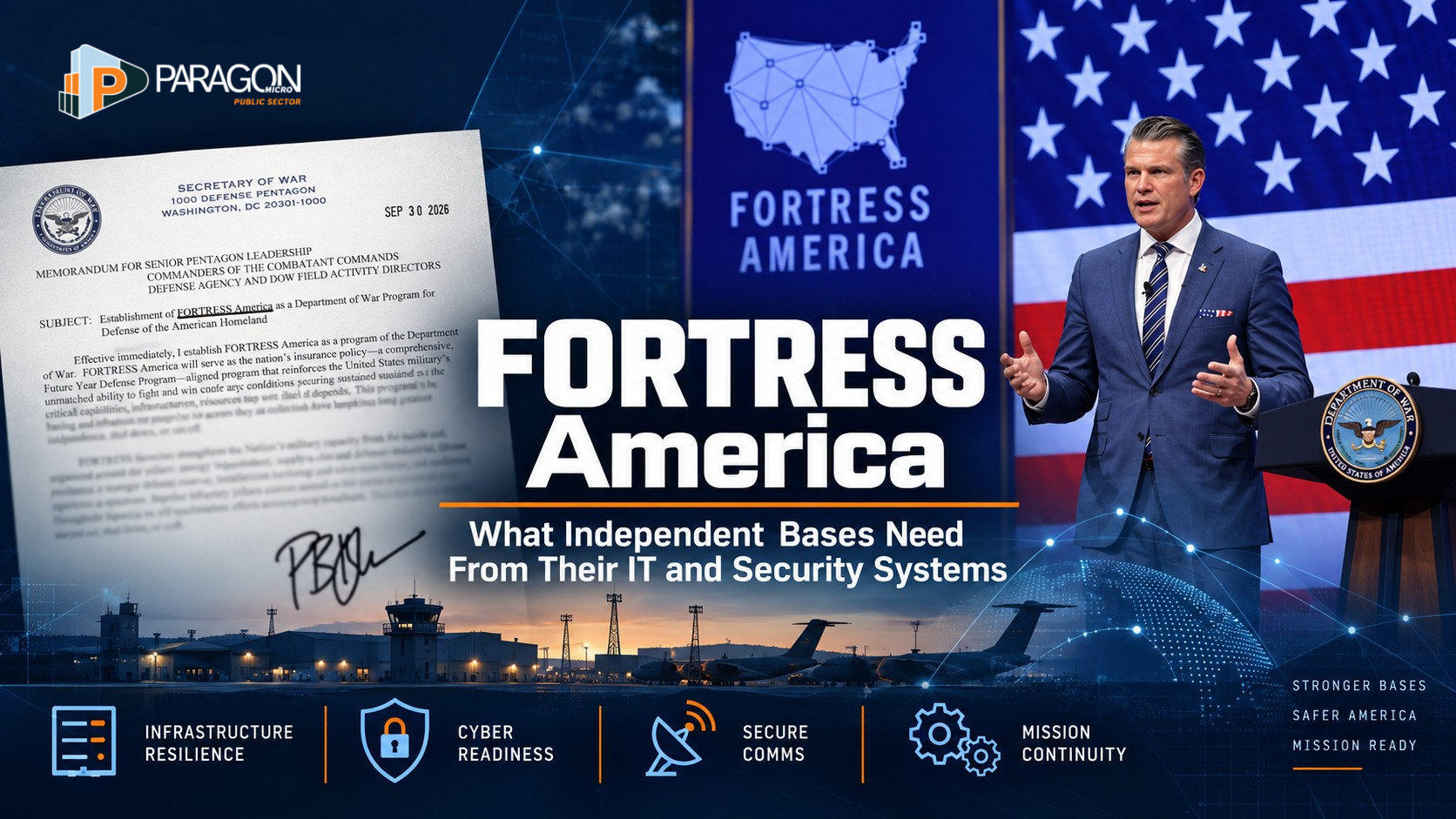
FORTRESS America: what independent bases need from their IT and security systems
FORTRESS America asks bases to make their own power and hold up against cyberattacks, sabotage, and drones. Our guide covers backup power and cooling, control system security, drone detection, and the chip and magnet rules behind base systems.
- 6 chapters
- Readiness checklists
- APA sourced
Contact
Discuss your mission challenge
Connect with Paragon Micro to discuss infrastructure for your mission, secure operating environments, and resilient technology.
Plan a survivable base network with our Department of War team.