


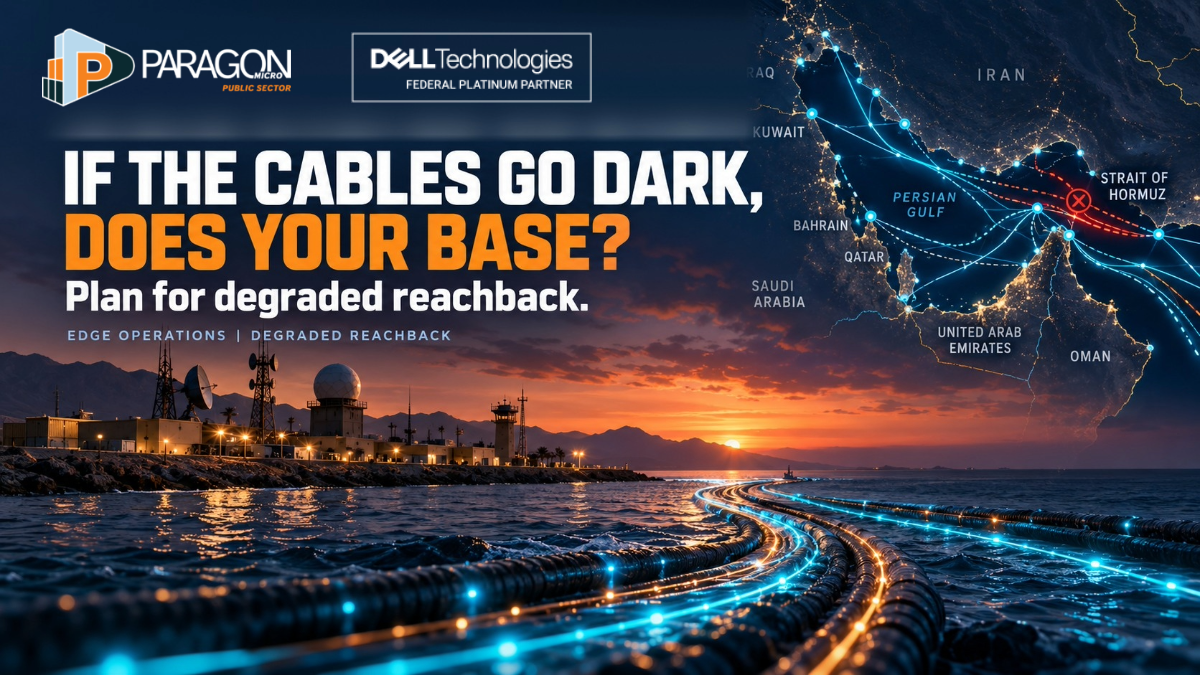
Edge operations | Degraded reachback
If the cables under the Strait are cut, the link home slows or stops. The base keeps working on what it holds locally.
On October 20 and 21, 2026, Iranian officials threatened the undersea internet cables under the Strait of Hormuz. Analysts note the strait carries a small share of global bandwidth, so a cut there would hit the region hardest, and U.S. posts in the Gulf sit in that region. Here is how to plan for degraded reachback: the condition where the link back to stateside networks is slow, intermittent, or gone.
01 | The threat
What Iranian officials said, and what analysts say a cut would do
On October 20, 2026, IRGC spokesman Hossein Mohebbi said 7 major undersea internet cables run beneath the Strait of Hormuz, claimed that all internet and commercial data traffic passes through them, and said "new targets will be unveiled."
The same report, carried by Anadolu, quoted Mohsen Rezaei, a senior Iranian official, saying Tehran could target undersea cables, data centers, and AI facilities linked to the United States if another war broke out. He added, "We have not yet included these assets among our targets."
On October 21, Brig. Gen. Yadollah Javani, political deputy to the IRGC's chief commander, told Al-Alam that U.S. and allied assets could be targeted if they "damaged Iran's infrastructure." Tasnim's headline presented the comments as a threat to the cables.
Iran International's analysis put the threat in proportion: the strait carries a fraction of global bandwidth, and damaging its cables "would not shut down the world's internet." The effect would be regional, and the region is where U.S. posts in the Gulf sit. The region's data infrastructure has already been hit once: in September 2026, AWS said it could not restore resources hosted only in its Bahrain region or only in 1 UAE availability zone after Iranian strikes.
These are threats, and none of the officials gave a timeline. This article takes no position on the war. It covers a planning question that applies whether or not a cable is ever touched.
The question for your base
If the link to stateside networks dropped tonight, which of your systems would still work tomorrow?
Find out on your own schedule, before a cut forces the answer.
02 | The precedent
The Red Sea has already run this test twice.
February 18, 2024
U.S. officials say the anchor of the Rubymar, a ship struck by a Houthi missile, likely severed 3 cables in the Red Sea.
March 2024
HGC Global Communications says about 25% of internet traffic in Asia, Europe, and the Middle East had to be rerouted, and calls 4 simultaneous cable failures "exceptionally rare." Intelsat sets up short term satellite service for affected customers.
March 2024
DE-CIX says cable repairs generally take 2 to 3 months because special ships are needed. 1 affected operator expects repairs to start in the second quarter, with permits, weather, and Yemen's civil war as possible delays.
September 6, 2025
Faults on the SMW4 and IMEWE cables near Jeddah. Microsoft warns that "network traffic traversing through the Middle East may experience increased latency" and reroutes it. Linode says cable operators have given no estimated time to resolution.
Both events show the same pattern. Traffic that can tolerate delay gets rerouted. Repairs take months and depend on ships, permits, and weather. Whatever a base needs during those months has to run on the base or reach home over a different path.
03 | The planning term
The department already plans for disconnected operations.
The performance work statement for the Joint Warfighting Cloud Capability, the department's enterprise cloud contract, names the condition: "Disconnected, Disrupted, Intermittent, and Limited (DDIL) environments." It requires the cloud offerings to be available in DDIL environments and on closed networks, and it describes tactical edge users as those whose DDIL bandwidth "restricts capabilities at the TE," the tactical edge.
Air Force Doctrine Note 1-21, Agile Combat Employment, says forces "will lose connectivity with operational C2" and should be ready for it, with primary, alternate, contingency, and emergency communication plans set in advance.
Degraded reachback is DDIL seen from a fixed base. The base may still have power, buildings, and people. What it loses is the fast, reliable path to the stateside networks and cloud services many of its applications expect.
04 | The 4 questions
Answer these before degraded reachback answers them for you
| Question | What to find out | What good looks like |
|---|---|---|
| 1. Which applications run locally? | Every application the base uses daily, and where each one actually runs and authenticates | Identity, name resolution, command and control applications, and the data they need all run on base, with maps and imagery cached locally |
| 2. How many days of local storage? | How much data the base creates and receives per day, from sensor video to logs | Storage sized for the longest disconnected period you plan for, with a rule for what syncs first when the link returns |
| 3. Which links fail over to which? | Every path off the base and what each one depends on | Primary, alternate, contingency, and emergency paths that use different providers, orbits, or media, tested on a schedule |
| 4. Who decides what traffic goes first? | Who has the authority to cut traffic, and what the priority list says | A named decision maker, a written priority list, and traffic rules configured in advance so command traffic goes first and updates and backups wait |
Then run the drill. Cut reachback on purpose for a set period, during an exercise, and record what stops. Each failure on that list is cheaper to fix in a drill than during a real outage.
Our rule of thumb
Size local storage and local services for the repair time of the slowest link you depend on. For an undersea cable, plan in months.
05 | What has to live on base
The quiet dependencies that stop a base
The obvious applications get planned. The ones that break first are often the services underneath them.
Identity
Logons
If users authenticate against a service that lives stateside, nobody logs on when the link drops. Keep an identity replica on base.
Time
Clocks that agree
In a Windows domain, Kerberos tolerates a 5 minute clock difference by default. A base that loses its outside time source needs a local one, or logons can start failing.
Licensing and updates
Software that phones home
Check whether any software has to reach a vendor service to start, stay licensed, or update. Pull patches and definitions ahead of time.
Data
What syncs first
When the link returns at limited bandwidth, decide in advance which queued data goes home first, so a backlog of video does not block command traffic.
06 | How we help
Where Dell Federal and Paragon Micro fit

As a Dell Technologies Federal Platinum Partner and multi-vendor technology provider, we build the local compute, storage, and communications that keep a site working when the link home is slow or gone.
Local compute
Processing where the mission is
We deliver rugged endpoints, systems built into vehicles, and deployable compute stacks that bring processing, storage, and analytics to the mission and reduce reliance on centralized cloud.
More than 1 path
Tactical communications
We integrate secure radios, edge networking, SATCOM, and cyber hardened systems for command, control, and data exchange in contested and degraded environments.
Past performance
2nd Air Support Operations Squadron
For the Air Force's 2nd Air Support Operations Squadron in Vilseck, Germany, we delivered a transit case kit with routing and switching, servers and virtualization, storage, WAN acceleration, and battery backed power, with 100% technical and schedule fulfillment.
Tested before fielding
The System Readiness Center
In our 55,000 plus square foot secure facility, we validate configurations and stage and test systems before they ship, so failover can be proven on a bench.
The goal is a site that degrades in a planned order: command traffic keeps moving, local applications keep running, and the backlog goes home when the link allows.
From order to support
If your team doesn't have the people to install the local servers and storage that keep sign in, files, and local applications running with the link down, we can do that work with you.
- 01
We sell it
Servers, storage, and networking sized for the longest disconnected period you plan for
- 02
We install and integrate it
Staged and tested in our System Readiness Center, then installed at the site and connected to the links home
- 03
We train your team
Your staff practice running the site with the link cut and sending the backlog home when it returns
- 04
We support it after
Lifecycle sustainment, current configuration records, and upgrade planning after delivery
Paragon Micro | Dell Federal
Find out what stops when the link does.
Send us the applications your site depends on and how each one reaches stateside networks. We can help sort what has to run locally, size local storage for your longest disconnected period, and build and test the failover paths before deployment.
Army organizations and other federal agencies can order through ITES-4H. The Missile Defense Agency and other Department of War organizations can order through MDA SHIELD, and federal buyers can also use GSA. The right path depends on scope, eligibility, and ordering rules.
Keep reading
Edge operations and cyber recovery
Chapter 10 of our Dell Federal guide covers edge operations, chapter 9 covers networking and private wireless, and chapter 17 covers the comms and data layers for the Autonomous Warfare Command.
Answers for base planners
Degraded reachback: common questions
What is degraded reachback?
It is the condition where a base or deployed site still has power, buildings, and people, but its link back to stateside networks and cloud services is slow, intermittent, or gone. The department's cloud contract calls these disconnected, disrupted, intermittent, and limited (DDIL) environments.
Could cutting the cables in the Strait of Hormuz take down the internet?
Not globally. Iran International's analysis noted the strait carries a fraction of global bandwidth and that damaging its cables would not shut down the world's internet. The effect would be regional, which is where U.S. posts in the Gulf sit.
How long does it take to repair an undersea cable?
DE-CIX said in March 2024 that repairs generally take 2 to 3 months because special ships are needed. After the 2024 Red Sea cuts, an affected operator cited permits, weather, and Yemen's civil war as possible causes of further delay.
What should run locally on a base?
Identity and authentication, name resolution, a local time source, command and control applications and their data, and cached maps and imagery. Check for software that has to reach a vendor service to start, stay licensed, or update, and pull patches ahead of time.
How do you decide what traffic goes first when bandwidth is limited?
Name a decision maker, write a priority list, and configure the traffic rules in advance so command traffic goes first and updates, backups, and bulk video wait. Then test it by cutting reachback on purpose during an exercise.
How does Paragon Micro help?
We deliver deployable compute and storage that reduce reliance on centralized cloud, integrate secure radios, edge networking, and SATCOM, and validate configurations in our System Readiness Center before systems ship. As a Dell Technologies Federal Platinum Partner, we pair Dell compute with communications from other OEMs.
Reference desk
Sources and further reading
Public sources as reviewed October 22, 2026. The threats described here are statements by Iranian officials and may change; confirm current conditions before you plan around them.
ViewHide 14 sourcesPrimary and supporting references
Abedi, H. (2026, October 21). IRGC threatens undersea cables, but can it disrupt global internet? Iran International. https://www.iranintl.com/en/202610216166
BERNAMA. (2026, October 20). IRGC cites seven internet cables under Strait of Hormuz, warns of 'new targets' [Anadolu report]. https://www.bernama.com/en/world/news.php?id=2622814
Microsoft. (n.d.). Maximum tolerance for computer clock synchronization. Microsoft Learn. https://learn.microsoft.com/en-us/previous-versions/windows/it-pro/windows-10/security/threat-protection/security-policy-settings/maximum-tolerance-for-computer-clock-synchronization
Paragon Micro. (n.d.-a). Dell Federal. https://www.paragonmicro.us/partners/dell-federal/
Paragon Micro. (n.d.-b). Secure integration & staging facility. https://www.paragonmicro.us/about-us/facility/
Paragon Micro. (n.d.-c). Tactical & rugged equipment. https://www.paragonmicro.us/solutions/tactical-and-rugged-equipment/
Paragon Micro. (n.d.-d). USAF tactical communications deployment in Germany for 2nd ASOS case study. https://www.paragonmicro.us/past-performance/usaf-tactical-communications-deployment-in-germany-for-2nd-asos-case-study/
Paragon Micro. (2026). Dell Federal and Paragon Micro: How the partnership is positioned for FORTRESS America, Project Meridian, and the Autonomous Warfare Command. https://www.paragonmicro.us/dell-federal-paragon-micro-dow-initiatives/
Swinhoe, D. (2026, September 16). AWS "unable to restore access" to data centers hit by Iran strikes. Data Center Dynamics. https://www.datacenterdynamics.com/en/news/aws-unable-to-restore-access-to-data-centers-hit-by-iran-strikes/
Tasnim News Agency. (2026, October 21). Undersea internet cables in Strait of Hormuz could be targeted if Iran is attacked: IRGC commander. https://www.tasnimnews.ir/en/news/2026/10/21/3728916/undersea-internet-cables-in-strait-of-hormuz-could-be-targeted-if-iran-is-attacked-irgc-commander
The Register. (2025, September 7). Microsoft, Linode warn of cloud latency spikes due to Middle East submarine cable problems. https://www.theregister.com/2025/09/07/asia_tech_news_roundup/
U.S. Air Force. (2022, August 23). Agile combat employment (Air Force Doctrine Note 1-21). Curtis E. LeMay Center for Doctrine Development and Education. https://www.doctrine.af.mil/Portals/61/documents/AFDN_1-21/AFDN%201-21%20ACE.pdf
U.S. Department of Defense. (n.d.). Joint Warfighting Cloud Capability performance work statement (Contract HQ003423D0019). Washington Headquarters Services FOIA reading room. https://www.esd.whs.mil/Portals/54/Documents/FOID/Reading%20Room/Contracts/23-F-0212_HQ003423D0019_PWS.PDF
Weissberger, A. (2024, March 7). HGC Global Communications, DE-CIX & Intelsat perspectives on damaged Red Sea internet cables. IEEE ComSoc Technology Blog. https://techblog.comsoc.org/2024/03/07/hgc-global-communications-and-de-cix-perspective-on-damaged-red-sea-internet-cables/