


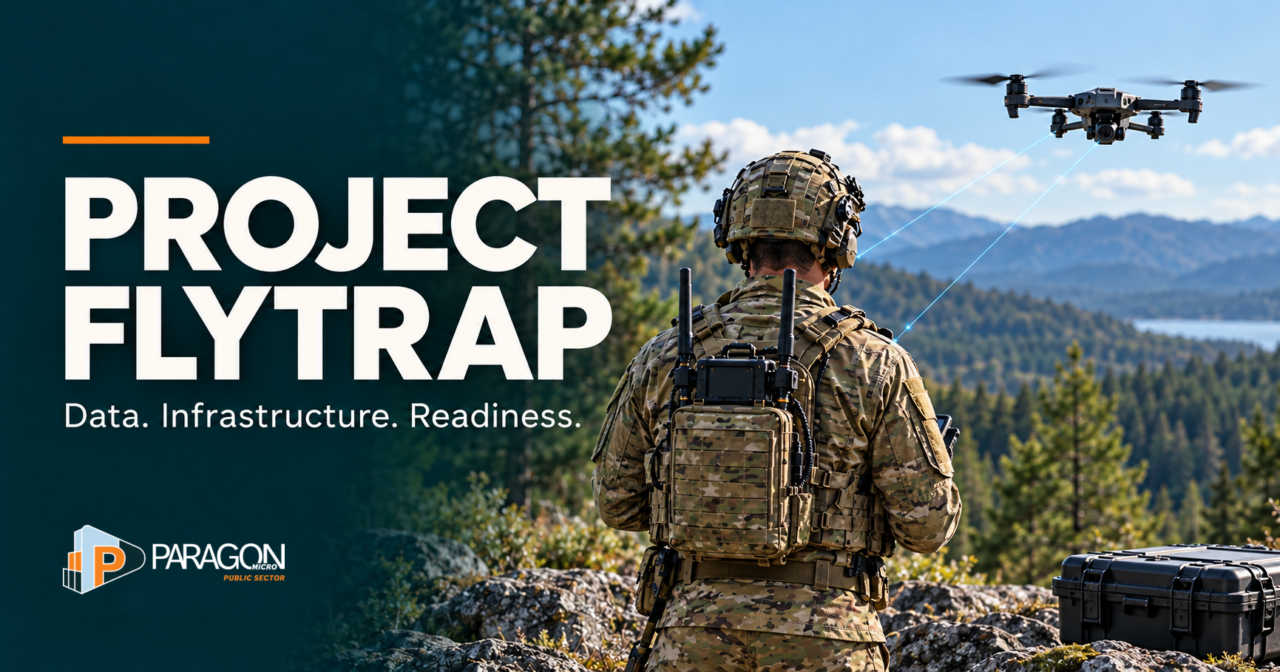
Defense insights Project Flytrap
Project Flytrap.
The integration
is the story.
What the U.S. Army’s counter-UAS experimentation series reveals about breaching the reconnaissance-strike complex, unifying sensor data, and sustaining autonomous operations.
A standalone drone or sensor can look convincing in a controlled demonstration. The real operational test begins when brigades face a networked reconnaissance-strike complex while managing incompatible sensor feeds, battery constraints, electronic warfare, and high cognitive load.
That operational reality is what makes Project Flytrap worth watching. Initiated in March 2025 as an HQDA-directed exercise series, Flytrap brings emerging counter-unmanned aircraft systems (C-UAS) into direct contact with the soldiers and formations expected to fight with them. Over roughly a year of iterative progression—moving from individual equipment operation up through squad, platoon, and troop collective exercises—the effort focused on three foundational objectives: identifying essential system capabilities, designing repeatable training programs, and solving data collection across resilient networks.
At AUSA 2026, Col. Tim Price, Col. Charles King, and CSM Jesse Clark connected these brigade-level maneuver lessons in Europe with deep-layer convergence in the Indo-Pacific. For federal program teams and system integrators, their takeaway is direct: technology alone does not preserve offensive mobility without the supporting data architecture, power infrastructure, and standardized training required to employ it.
The essential takeaways
- Offensive mobility requires breaching a sensor network. Brigades now confront a multi-domain reconnaissance-strike complex that acts like a connected alarm system linked to precision fires and drones.
- Network integration is the primary technical hurdle. Multiple disparate sensors must feed a single Common Operating Picture (COP) rather than trapping operators in incompatible, standalone systems.
- Fielding Minimum Viable Products (MVPs) accelerates learning. Putting workable capabilities into soldiers' hands now builds unit competency faster than waiting years for an ideal solution.
- Human oversight is calibrated through "reps and sets." While AI provides machine speed from minutes to seconds, commanders rely on repeated training iterations to understand system limits and establish risk boundaries.
Chapter 01 Context
What is Project Flytrap?
Project Flytrap is a recurring, HQDA-directed Army counter-UAS experimentation series in Europe focused on enabling offensive counter-drone operations so brigades can gain and maintain mobility. Rather than designating a single commercial product, Flytrap establishes a structured learning environment where Army units and allied partners put equipment into soldiers' hands and resolve network integration challenges across echelons.
Tracing its start to March 2025, the initiative progressed deliberately from individual operator familiarization through collective squad, platoon, and troop exercises. That progression allows technical teams to isolate integration bottlenecks, training gaps, and data-collection failures in smaller trials before scaling up to multinational force-on-force events.
HQDA initiation and equipment onboarding
Operation Flytrap launches with an initial focus on putting offensive C-UAS equipment into soldiers' hands and testing squad-to-troop network integration.
Flytrap 4.0 in Poland
U.S. V Corps and U.K. formations execute collective counter-UAS training iterations to evaluate emerging capabilities in the field.
Flytrap 4.5 interoperability focus
Army integration teams evaluate open-architecture data sharing through the Integrated Sensor Architecture (ISA), documented in January 2026 reporting.
Flytrap 5.0 in Lithuania
U.S. soldiers and British paratroopers exercise emerging C-UAS systems at Pabradė Training Area, providing cross-specialty operator feedback.
Brigade maneuver meets deep convergence
Col. Tim Price, CSM Jesse Clark, and Col. Charles King connect brigade multi-domain breaching with the Cross-Domain Contact Layer (CDCL).
Chapter 02 The discussion
Breaching the multi-domain reconnaissance-strike complex
The AUSA 2026 briefing partitions the modern battlefield problem into two linked arenas: enabling brigade maneuver in the close fight (led by Col. Tim Price) and orchestrating convergence in the deep layer (led by Col. Charles King). In the brigade fight, traditional security and counter-reconnaissance areas have evolved into a networked reconnaissance-strike complex combining kinetic UAS threats, counter-UAS systems, electronic warfare (EW), command networks, and precision fires.
Functionally, this reconnaissance-strike complex operates like a connected alarm system linked to a weapon: sensors detect a formation, networks transmit the data, commanders or algorithms select targets, and fires or drones strike—halting friendly maneuver before a unit ever reaches a physical obstacle. Because units initially lacked a doctrinal framework for applying new unmanned tools to this multi-domain obstacle, the formation adapted the traditional breaching framework SORA—Suppress, Obscure, Reduce, Assault:
- Stimulate and Suppress: To locate hidden threats, the brigade flies small, attritable UAS into the enemy’s security area to provoke the adversary into cycling EW systems from passive to active or turning on radars—generating electromagnetic signatures that higher headquarters can exploit for targeting.
- Obscure via Spectral Camouflage: Obscuration extends beyond visual smoke to encompass spectral camouflage—managing and reducing electromagnetic signatures that would otherwise betray a formation's position to enemy sensors.
- Reduce C2 Nodes and Assault: While breaking any link in the enemy's kill chain helps preserve mobility, attacking enemy command-and-control (C2) nodes, headquarters, and drone ground-control stations with one-way attack munitions disrupts multiple threats simultaneously—opening a corridor for the assault force to pass through, strike the enemy's rear, and restore offensive momentum.
Minimum viable products and multi-echelon convergence
A central lesson from Operation Flytrap is prioritizing Minimum Viable Products (MVPs) over waiting for perfection. Getting workable systems into soldiers' hands today allows formations to build core operational competency now rather than losing years awaiting an ideal solution. At the same time, lessons from Ukrainian operations—where units must overcome "drone transparency" to reoccupy territory—underscore that a brigade cannot execute a multi-domain breach alone; success requires multi-echelon convergence and external resources from higher headquarters.
Breaking any link in the enemy’s sensor-to-shooter chain helps preserve mobility—but unifying our own data stream is what allows commanders to see and act first.
Paragon Micro perspective on Project FlytrapChapter 03 Data
Network integration and the Common Operating Picture
Throughout Project Flytrap, network integration emerged as the primary technical challenge. When multiple sensors operate across separate, incompatible vendor systems, commanders lack a unified view of the battlespace. Solving data collection across resilient networks requires feeding disparate sensor tracks into a single shared data stream and Common Operating Picture (COP) so formations can interpret threats and act rapidly.
In Flytrap 4.5, Army teams evaluated the Integrated Sensor Architecture (ISA) to establish open-architecture data formats and verify vendor integration claims. During the AUSA Q&A, panelists also highlighted the acquisition balance between direct unit-level vendor engagement and standardized vetting processes—ensuring that emerging AI and sensor tools meet open integration baselines before fielding.
Resilient collection
Can disparate tactical sensors feed tracks across contested networks into a shared data stream?
Common meaning
Does the Common Operating Picture translate separate feeds without trapping leaders in incompatible displays?
Vetted integration
Have vendor tools passed standardized acquisition vetting to confirm open-architecture interoperability?
For supporting IT environments, connectivity and usability must be engineered together. A resilient architecture ensures that sensor data, configuration states, and system handoffs remain intelligible to operators, maintainers, and higher headquarters alike.
Chapter 04 Infrastructure
Compute, power constraints, and integrated maneuver enablers
Deploying autonomous systems and multi-domain sensors to tactical formations immediately exposes physical infrastructure limits—particularly around onboard compute, resilient communications, and power generation. These operational realities align directly with the three foundational pillars examined in our companion Autonomous Warfare Command analysis: compute, communications, and data.
Compute at the tactical edge
Placing full-stack AI autonomy on small drones or edge nodes demands processing hardware sized for tight physical and thermal envelopes.
Resilient communications
Formations require resilient data networks capable of linking distributed sensors, maneuver enablers, and higher headquarters under electronic attack.
Cohesive data and enabler integration
Engineers, sustainment, medical teams, and electronic warfare units must be woven into a single operational picture rather than isolated as detached support elements.
Power management and forward EW integration
The AUSA panel underscored that power generation and battery management remain major operational constraints. Integrating full-stack AI autonomy onto small, soldier-carried drones places heavy demands on limited battery capacity required to run sensors, communications, and onboard processing simultaneously. Sustaining these systems in the field requires deliberate planning for power generation, battery loads, and ruggedized support.
Organizational integration is equally critical. Rather than treating specialists as separate attachments, the 2nd Cavalry Regiment embeds its electronic warfare platoon up front as part of its multifunctional reconnaissance company. Operating ahead of the formation with dedicated spectrum-monitoring tools, EW soldiers identify what capabilities the adversary is bringing to bear in the breach so commanders can counter them or maneuver around them.
Chapter 05 People
Training the "New Basics" and bounding AI authority
Technology only translates into combat effectiveness when soldiers across every specialty can operate it under pressure. In the AUSA discussion, CSM Jesse Clark emphasized integrating the "New Basics"—unmanned ground vehicles (UGVs), UAS, counter-UAS, and electromagnetic spectrum awareness—directly alongside the Army’s enduring fundamentals of shoot, move, communicate, medicate, camouflage, and map reading.
Standardization through Unit Training Management and Expert Badges
Turning ad-hoc field workarounds into durable proficiency requires standardization and a disciplined Unit Training Management (UTM) system backed by dedicated time, personnel, and equipment. To establish a common baseline across all military occupational specialties, the panel proposed incorporating drone, counter-drone, and spectrum-awareness tasks into the Army’s established Expert Badge series. Even when soldiers are not designated specialists, shared baseline fluency allows teams to operate together seamlessly.
Human authority
Calibrating human-in-the-loop control through "reps and sets"
A recurring question in counter-UAS and autonomous operations is the balance between human-in-the-loop decision approval and human-on-the-loop supervision. In Multi-Domain Command Pacific, units currently keep a human in the loop while leveraging AI for machine speed, efficiency, and effectiveness—using repeated training "reps and sets" so commanders learn an AI system's capabilities and limits, establish clear boundaries, and accept a defined level of risk.
Cultivating leaders capable of driving formations amid high cognitive load requires three complementary strengths: officers with strong intellectual curiosity and tactical judgment, heavy reliance on technical expertise from the Army’s warrant officer cohort, and empowering younger soldiers who are rapidly adopting UAS tools today and will carry that native confidence into future NCO and leadership roles.
Chapter 06 The connection
From the Cross-Domain Contact Layer to Autonomous Warfare Command
Col. Charles King’s briefing on Multi-Domain Command Pacific (MDCPAC) illustrates how brigade-level integration lessons scale to theater-wide operations. Serving as the theater army’s forward edge inside an adversary’s Weapons Engagement Zone (WEZ), MDCPAC executes a multi-domain cover mission: operating small, independent teams across domains that perform reconnaissance, counter-recon, strike, and penetration to disaggregate elements of the adversary’s system and create temporary windows of relative overmatch that a separately operating main body and joint force can exploit.
To orchestrate these distributed teams without concentrating every sensor and weapon in a single vulnerable headquarters, MDCPAC employs the Cross-Domain Contact Layer (CDCL) framework built on four integrated components:
- All-Domain Sensor Arrays: Integrated sensing spanning from space to terrestrial layers.
- Agile Effectors: Layered kinetic and non-kinetic capabilities positioned for rapid convergence.
- Agentic AI-Enabled C2 at the Edge: Automated control systems that orchestrate sensors and manage parts of the fires chain.
- Durable Ground Formations: Sustainable maneuver forces able to survive inside the WEZ, conduct reconnaissance, and seize terrain.
In an era of contested logistics and sophisticated defense networks, traditional 72-hour joint targeting cycles are too slow. By using edge agentic AI to compress kill chains from minutes to seconds and reduce cognitive load, the CDCL allows commanders to focus on tactical judgment, command intent, and seizing the initiative. While Project Flytrap and our companion Autonomous Warfare Command article address distinct operational contexts, both underscore the same infrastructure reality: rapid convergence depends on ruggedized edge compute, resilient communications, and governed data pipelines.
Brigade Maneuver (Project Flytrap)
Breaching the close strike complex
Adapting SORA, embedding forward EW platoons, and unifying C-UAS sensors into a single COP so brigades maintain offensive mobility.
Deep Convergence (MDCPAC & CDCL)
Compressing kill chains in the WEZ
Combining space-to-terrestrial sensors, agile effectors, durable formations, and edge agentic AI to replace 72-hour targeting cycles with seconds-level convergence.
Chapter 07 Program perspective
Make readiness reviewable
For the supporting IT environment, Flytrap’s broader relevance is a reminder to value verifiable integration evidence over isolated demonstrations. Program managers, system integrators, and infrastructure suppliers need a shared record of what configuration was delivered, how it integrates into the Common Operating Picture, and what power and sustainment dependencies remain.
What configuration was actually assessed?
Keep hardware specifications, software builds, and open-architecture interface versions tied to the test record so MVP baselines remain repeatable.
Does the data feed a shared Common Operating Picture?
Verify that sensor outputs integrate into a common data stream rather than adding another standalone display that increases leader cognitive load.
Are power and SWaP constraints accounted for?
Evaluate battery capacity, power generation, and onboard compute draw under realistic field conditions before deployment.
Can operators and enablers train on a standardized baseline?
Provide clear documentation and configuration control that support disciplined Unit Training Management across specialties.
What happens after delivery?
Define lifecycle maintenance, spares, and support handoffs so durable formations can sustain the capability inside contested environments.
Chapter 08 Next steps
From insight to infrastructure readiness

Project Flytrap demonstrates that readiness is forged when usable technology, shared data, realistic power budgets, and disciplined training meet in the field.
Paragon Micro, through its Public Sector division, supports the infrastructure foundation behind those requirements. Inside Paragon Micro’s System Readiness Center, engineering teams bring multi-vendor configuration, staging, testing, and delivery preparation into a controlled integration environment—backed by architecture, modernization, and lifecycle services across compute, storage, networking, security, and cloud.
Common questions
What was Operation Flytrap’s primary focus when it began in March 2025?
Operation Flytrap began in March 2025 as an HQDA-directed exercise focused on enabling offensive counter-UAS operations to gain and maintain mobility at the brigade level, initially concentrating on getting equipment into soldiers’ hands and resolving network integration from squad through troop levels.
How does a brigade breach a multi-domain reconnaissance-strike complex?
Formations adapt the SORA framework (Suppress, Obscure, Reduce, Assault) to the multi-domain obstacle. Brigades fly small attritable UAS into the enemy’s security area to provoke the adversary into cycling electronic warfare systems from passive to active or turning on radars—creating signatures higher headquarters can target—while applying spectral camouflage to manage electromagnetic signatures and striking enemy C2 nodes, headquarters, and drone ground-control stations with one-way attack munitions.
How does the 2nd Cavalry Regiment employ its electronic warfare platoon during a breach?
The 2nd Cavalry Regiment places its electronic warfare platoon up front as part of its multifunctional reconnaissance company so EW soldiers operate ahead of the formation to monitor the electromagnetic spectrum, identify what capabilities the enemy is bringing to bear in the breach, and help commanders decide how to counter or maneuver around them.
How does Multi-Domain Command Pacific’s cover mission and the Cross-Domain Contact Layer (CDCL) accelerate targeting?
Operating as the theater army’s forward edge inside the Weapons Engagement Zone, Multi-Domain Command Pacific uses small independent teams in a cover mission to disaggregate adversary systems and create temporary windows of relative overmatch for the main body and joint force. Its Cross-Domain Contact Layer (CDCL) combines space-to-terrestrial sensor arrays, agile kinetic and non-kinetic effectors, durable ground formations, and agentic AI-enabled command and control at the edge to compress 72-hour joint targeting cycles down to minutes and seconds.
How do commanders balance human-in-the-loop control with AI support in counter-UAS decision making?
Units currently keep a human in the loop while using AI for machine speed, efficiency, and effectiveness. Through repeated training "reps and sets," commanders learn an AI system's capabilities and limitations so they can establish operational boundaries and accept a defined level of risk.
How does Paragon Micro’s Public Sector division support defense infrastructure readiness?
Paragon Micro, through its Public Sector division, works with federal agencies, defense programs, and system integrators to architect, procure, configure, and pre-stage compute, networking, storage, and lifecycle environments inside the Paragon Micro System Readiness Center.
Paragon Micro · Public Sector Division
Build readiness into
the supporting infrastructure.
Bring your compute, networking, storage, and lifecycle requirements to Paragon Micro’s Public Sector division to help scope, configure, stage, and prepare your environment for delivery.